


Choosing a Performance Marketing Agency: The Growth Leader's Guide for 2026
If your current marketing agency is still reporting on brand awareness while your Meta and Google CAC has climbed by 24% since last year, you aren't just losing margin; you're losing ground. It's an exhausting cycle for growth leaders in Singapore who are expected to scale revenue while navigating the black box of modern attribution. You know that vanity metrics don't pay the bills, and slow agency response times are a luxury your 2026 growth targets cannot afford. This guide will show you how to cut through the corporate fluff to find a partner that treats your S$50,000 monthly ad spend with the same precision as a financial portfolio. We will provide the exact criteria for vetting technical proficiency, stabilizing your acquisition costs, and building real-time dashboards that drive actual decision-making. We'll move past high-level theory to look at the operational frameworks that separate elite performance partners from traditional vendors.
Key Takeaways
• Stop chasing vanity metrics and learn why established brands are shifting toward specialized performance models to drive actual revenue.
• Secure your ad spend by building a robust data foundation with server-side tracking to navigate the privacy-first landscape in Singapore.
• Identify a performance-led marketing agency that masters multi-channel allocation across the complex APAC media ecosystem to scale your LTV.
• Maximize every dollar of ad spend by integrating conversion rate optimization and iterative UX testing to turn high-intent traffic into profit.
• Protect your bottom line by spotting agency red flags and moving toward high-accountability models that link fees to actual business outcomes.
The Evolution of the Marketing Agency: Moving Beyond Vanity Metrics
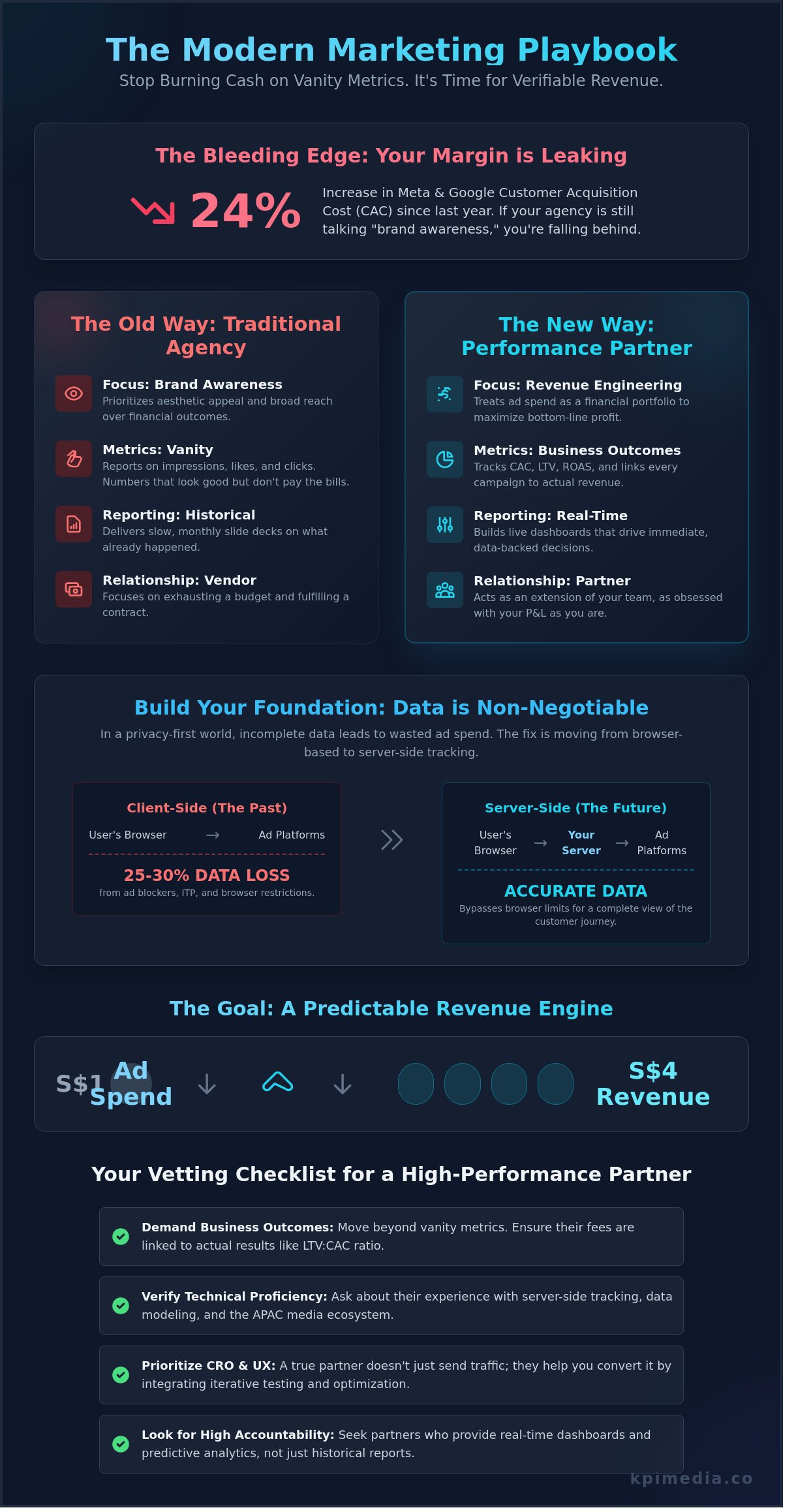
The APAC marketing landscape underwent a fundamental shift between 2021 and 2024. Established brands in Singapore no longer settle for "creative-first" strategies that prioritize aesthetic appeal over financial outcomes. Marketing leaders now face intense pressure to justify every S$1 spent. This shift pushed the traditional marketing agency model to its breaking point. Generalist firms that focus on broad awareness are being replaced by growth specialists who treat advertising as a precise financial instrument rather than a creative experiment.
Success in this environment requires a deep understanding of the Digital Marketing Overview and its transition into a data-driven science. It's about moving away from managing spend and toward engineering revenue. When an agency manages spend, they focus on exhausting a budget. When they engineer revenue, they focus on unit economics like Customer Acquisition Cost (CAC) and Lifetime Value (LTV) to ensure every campaign contributes to the bottom line. For an established brand spending S$20,000 monthly, a 0.5% shift in conversion efficiency can mean the difference between stagnation and a S$100,000 revenue lift.
To better understand how to navigate these changes, watch this helpful video on selecting the right partner:
Why Brand Awareness is No Longer Enough
Vanity metrics like impressions and social media likes are the biggest traps for growth-stage companies. While these numbers look impressive in a monthly slide deck, they rarely correlate with bankable revenue. Established brands are now aligning their marketing spend directly with financial reporting. They demand full-funnel efficiency where top-of-funnel noise is filtered out in favor of high-intent leads. If a campaign generates 1,000 likes but zero impact on the S$500 average order value, it's a failure. High-growth operators focus on the 12-month LTV to CAC ratio, ensuring that the cost to acquire a customer in Singapore's competitive market remains sustainable as they scale. They don't want "awareness"; they want a predictable engine that turns S$1 of ad spend into S$4 of revenue.
The Rise of the Specialist Growth Partner
Generalist agencies often fail when tasked with scaling complex APAC campaigns because they lack the technical depth required for modern platforms. A specialist growth partner acts as an extension of your in-house team, focusing on performance marketing as the primary engine for business expansion. They understand that the Singapore market operates differently than Australia or the US. This regional nuance matters when optimizing multi-touch attribution models across different platforms. Instead of broad strokes, these specialists use granular data to unlock hidden pockets of profitability. They don't just report on what happened; they use predictive analytics to dictate what should happen next to accelerate growth. This results-first mindset is what separates a vendor from a true partner who is as obsessed with your P&L as you are.
Building a Data-Led Foundation for Scalable Growth
Allocating S$20,000 to monthly ad spend without a robust data infrastructure is a gamble, not a strategy. In Singapore's hyper-competitive market, signal loss is the silent killer of ROAS. Most established brands lose 25% to 30% of their conversion data due to ITP restrictions and browser-based ad blockers. This data gap forces ad algorithms to optimize based on incomplete information, leading to inflated CPAs and wasted budget. High-performing brands don't just "run ads"; they build technical foundations that capture every meaningful interaction.
Moving beyond a basic GA4 setup is the first step toward maturity. You need a system that translates raw clicks into business intelligence. This involves shifting from client-side tracking to a server-side environment. This transition ensures your data remains accurate in a privacy-first world while improving website load speeds. A specialized marketing agency focuses on these technical nuances because they know that clean data is the only way to achieve predictable scaling. Without it, your conversion rate is just a vanity metric that doesn't account for the full customer journey.
The Technical Prerequisites for Scaling
Implementing server-side Google Tag Manager (sGTM) is no longer optional for brands spending over S$10,000 per month. It allows you to bypass browser limitations and send data directly to platforms like Meta and Google via CAPI. This precision improves match rates and lowers costs. To truly scale, you must integrate your CRM data with these ad platforms. Tracking offline conversions or lead-to-sale milestones ensures you're optimizing for revenue, not just "thank you" page visits. Utilizing automated dashboards provides the real-time visibility needed to pivot strategies before a campaign drains your quarterly budget.
Attribution in a Multi-Touch World
Last-click attribution is a dangerous oversimplification for growth-stage brands. It ignores the complex path a Singaporean consumer takes across LinkedIn, programmatic display, and search. Relying on last-click often leads leaders to cut "underperforming" top-of-funnel channels that are actually driving the initial intent. Understanding the balance of Performance vs. Brand Marketing requires a multi-touch framework that assigns value to every interaction.
We see brands struggle when their reporting is siloed in manual spreadsheets. Leveraging business process automation to streamline this reporting saves your team 15+ hours a week and eliminates human error. When your data flows automatically from your CRM to your visualization tools, you gain the clarity required to make high-stakes decisions. This level of transparency is exactly what an expert marketing agency provides to ensure every S$1 spent is accountable to a specific KPI.
If your current reporting feels like a rearview mirror rather than a GPS, it's time to re-evaluate your data stack. A data-led foundation doesn't just show you where you've been; it predicts where your next S$100,000 in revenue will come from.
Dominating the APAC Market with Multi-Channel Paid Media
Scaling a brand in Singapore requires more than just a high conversion rate; it demands a calculated, multi-channel approach to paid media. Efficiency is the only metric that matters when you move from a S$10,000 monthly budget to S$100,000 and beyond. Most growth-stage brands hit a wall because they over-rely on a single channel. To dominate the local and regional markets, you must balance intent-based capture with aggressive demand generation. This isn't about being everywhere; it's about being where the data proves your customers convert.
A performance marketing agency focused on growth looks at the blended CAC across the entire ecosystem. In Singapore, where CPMs on Meta often fluctuate between S$15 and S$25 depending on the season, stabilizing your acquisition costs requires a creative strategy that treats ads as data points rather than art projects. High-performance campaigns thrive on rapid iteration. We test hooks, formats, and angles every 48 to 72 hours to ensure the algorithm has the fuel it needs to find your ideal buyer at the lowest possible price point.
Mastering Search and Social Synergy
Success starts with capturing existing demand. We use Google Ads and SEM to dominate high-intent keywords where users are ready to transact. However, search alone won't fuel 10x growth. You have to create demand. We leverage Meta Ads for broad reach and TikTok Ads to tap into the high-engagement vertical video trend dominating Singapore's mobile-first demographic. For B2B leaders, we execute precision-targeted LinkedIn Ads strategies that bypass the noise and land directly in the feeds of C-suite decision-makers, keeping your LTV to CAC ratio healthy.
Expanding Reach with Programmatic and OOH
As you scale, you'll eventually exhaust your primary social audiences. This is where programmatic display becomes essential for mid-funnel retargeting and cross-device engagement. We don't stop at digital screens. The modern approach to digital out-of-home allows us to place your brand in high-traffic APAC hubs like Raffles Place or Orchard Road with programmatic precision. For brands chasing specific audience clusters, we test niche platforms like Reddit Ads, which often deliver lower CPCs than traditional channels by targeting high-affinity communities.
Stabilizing CAC while increasing spend is a game of marginal gains. In Q4 2023, we saw brands that diversified their spend across at least three channels maintain a 15% lower blended CAC compared to those sticking to a single platform. This diversification protects your brand from sudden algorithm shifts or rising costs in any one ecosystem. Our role as your marketing agency is to manage this complexity, ensuring every dollar spent is an investment in measurable, scalable growth. We focus on the bottom line so you can focus on your operations.
Beyond the Click: Maximising Revenue through CRO and Automation
Driving traffic is the easy part. Converting that traffic into bankable revenue is where most growth-stage brands in Singapore struggle. We see companies burning through monthly budgets of S$50,000 while ignoring a 1.2% conversion rate that could easily be a 2.5% with the right structural changes. High-traffic campaigns fail without Conversion Rate Optimization (CRO) because they focus on the entry point rather than the final outcome. A marketing agency that only reports on click-through rates is ignoring the metrics that actually impact your balance sheet. You must align your ad creative perfectly with the post-click experience to maintain high relevance scores and lower your acquisition costs across Google and Meta.
The transition from a click to a customer isn't a single event; it's a sequence of micro-decisions. If your landing page doesn't mirror the promise made in the ad, users bounce within 2.8 seconds. This disconnect forces your CAC upward and erodes your margins. We treat the post-click journey as a laboratory. By iteratively testing headline variations, lead form lengths, and trust signals, we ensure that every dollar of ad spend works harder. This process isn't about guesswork. It's about using hard data to remove the psychological barriers that prevent a prospect from clicking "buy" or "book."
The CRO Framework for Scaleups
Scaling requires a systematic approach to identifying friction. We use heatmaps and session recordings to pin down exactly where users drop off. If 35% of your mobile users bounce because your checkout button is hidden below the fold, you don't have a traffic problem; you have a UX flaw. Our testing focuses on revenue impact. Instead of testing button colors, we test high-leverage elements like value propositions and tiered pricing structures. Increasing your conversion rate from 2% to 4% effectively doubles your ad spend efficiency without adding a single cent to your media budget. It acts as a force multiplier for every S$1.00 spent on paid media, allowing you to outbid competitors while staying profitable.
Leveraging Automation for Efficiency
Efficiency dies in manual execution. For established brands, automation is the bridge between a raw lead and a high-LTV customer. We implement automated SMS and email sequences that trigger the moment a user abandons a cart or a high-intent form. In the Singapore market, these sequences often recover 18% to 24% of otherwise lost revenue by addressing specific local concerns like shipping times or payment security. By using dynamic creative optimization, we deliver personalized ad experiences based on previous site behavior. This removes the burden of manual campaign adjustments from your team. It allows your marketing agency partner to focus on high-level strategy and APAC market expansion. Automation ensures your customer lifetime value grows while your operational overhead remains lean.
Stop leaving money on the table with unoptimized funnels and manual follow-ups. If you're ready to squeeze more profit from your existing traffic and scale your operations, book a free growth audit with our performance specialists today.
Selecting a Performance Partner: Accountability and Results
Traditional agency contracts often serve as a safety net for the provider rather than a performance driver for the brand. In Singapore, many established companies find themselves locked into 12-month retainers with 90-day notice periods. This structure is a massive red flag. It breeds complacency and detaches the agency’s compensation from your actual business growth. A high-performing marketing agency should earn its place on your P&L every single month through measurable output. If the ROAS dips or the CAC climbs above your threshold for two consecutive quarters, you need the agility to pivot without legal friction.
The "no-contract" model is the ultimate accountability tool. It keeps the execution team hungry. When an agency knows their tenure depends on the next 30 days of performance, the focus shifts from maintaining the status quo to aggressive optimization. This mindset is vital when managing S$50,000+ monthly ad spends across competitive APAC markets. You aren't just buying media; you're buying a commitment to hit specific financial targets. Ensure your partner offers a performance guarantee tied to bottom-line KPIs like net revenue or qualified lead volume rather than vanity metrics like impressions or clicks.
Vetting a partner requires looking past the client logo wall. Dig into the technical execution within their case studies to see how they solve complex problems. Look for specific examples where they scaled a brand’s spend by 200% while keeping the cost per acquisition stable. Ask for data on how they navigated the iOS 14.5 tracking changes or how they currently handle signal loss in the Singapore market. Real expertise is found in the granular details of campaign structures and data hygiene, not in polished pitch decks.
Questions Every Growth Leader Should Ask
Attribution is the biggest point of failure in modern performance marketing. Ask how the team handles data discrepancies between platform dashboards and your internal CRM. If they rely solely on last-click attribution, they're missing the full picture of your customer journey. You also need to understand their pace. Ask about their process for creative testing and rapid iteration. In a fast-moving market like Singapore, an ad's effectiveness can decay in less than 14 days. Finally, ensure they have a proven framework for enterprise-level scaling. Managing a S$5,000 budget is fundamentally different from optimizing a S$100,000 monthly spend where marginal gains represent thousands of dollars in profit.
The KPI Media Approach: Transparency and Execution
We operate differently from the standard marketing agency by aligning our incentives directly with your success. Our performance-based incentive model means we're as invested in your margins as you are. We don't act as a detached third-party vendor. Instead, we function as a specialized extension of your in-house marketing team, providing the technical depth and execution speed required to dominate your category. We provide total transparency into every S$ spent and every conversion tracked. If you're ready to stop guessing and start scaling based on hard data, the first step is requesting a growth audit. We'll analyze your current accounts, identify the leaks in your funnel, and show you exactly where the next S$1,000,000 in revenue will come from.
Future-Proof Your Growth Strategy
Navigating the 2026 landscape requires more than just a vendor; it demands a technical partner obsessed with your LTV to CAC ratio. You've seen how vanity metrics like clicks and impressions fail to move the needle for established brands. True scale comes from a data-led foundation and a relentless focus on bottom-line revenue. Whether you're dominating the Singapore market or expanding across APAC, your marketing agency must prioritize multi-channel attribution and high-velocity testing.
At KPI Media, we've refined a framework that turns paid media into a predictable growth engine for SaaS and Enterprise leaders. You get direct access to senior growth operators who manage every S$ of your budget with surgical precision. We don't hide behind long-term contracts or vague promises. If we don't hit the pre-defined KPIs we agree on, you receive a 50% discount on our management fees. This ensures our interests are perfectly aligned with your financial success. It's time to stop guessing and start scaling with a partner that shares your skin in the game.
Scale your brand with a performance-first partner. Get started with KPI Media today.
The road to S$100M ARR is built on data and execution. Let's build it together.
Frequently Asked Questions
What should I look for in a performance marketing agency?
Look for a performance marketing agency that prioritizes bottom-line metrics like ROAS and CAC over vanity metrics. They should demonstrate a proven track record of scaling established brands with at least S$50,000 in monthly ad spend. Demand transparency in their data stack and a clear testing framework that identifies winning creatives within the first 14 days of a campaign to ensure your budget isn't wasted.
How does a growth agency differ from a traditional advertising agency?
A growth agency focuses on full-funnel optimization and measurable ROI while traditional agencies often prioritize brand awareness and creative awards. Growth partners integrate deeply with your data infrastructure to optimize for LTV and retention. They operate in rapid weekly sprints rather than quarterly campaign cycles. This ensures your S$100,000 budget is always working toward a specific revenue target rather than just general exposure.
Why is data infrastructure important for my marketing campaigns?
Robust data infrastructure eliminates the 30% discrepancy often seen between ad platform reporting and actual CRM revenue. It allows your marketing agency to implement multi-touch attribution, ensuring every SGD spent is tracked across the entire customer journey. Without a clean data layer, you're making S$10,000 decisions based on incomplete signals. This leads to wasted spend and inaccurate scaling that hurts your long-term profitability.
How do you measure the ROI of a marketing agency?
Measure ROI by calculating the net profit generated after subtracting both ad spend and agency management fees. A high-performing partner should aim for a minimum 3:1 or 4:1 ratio depending on your specific margins. Track the decrease in blended CAC over a 90-day period to see if the agency is actually improving your efficiency as you scale. If the net profit doesn't exceed the total cost, the strategy requires immediate adjustment.
What is the typical management fee for a performance agency in Singapore?
Fees in Singapore typically range from S$3,500 to S$10,000 per month for established brands, or a percentage of ad spend between 10% and 20%. Performance-based models often include a base retainer plus a bonus tied to hitting specific KPI targets like lead volume or revenue growth. Avoid agencies charging less than S$2,000 as they usually lack the senior talent required for complex APAC scaling and technical data integration.
How long does it take to see results from a new paid media strategy?
Initial data signals appear within 7 days, but full optimization usually requires a 90-day window to achieve statistical significance. The first 30 days focus on baseline testing and infrastructure setup. By day 60, you should see a 15% to 20% improvement in conversion efficiency as the algorithm learns which audience segments respond best. This iterative process ensures that scaling happens only when the unit economics are proven.
Do I really need server-side tracking for my ad campaigns in 2026?
Yes, server-side tracking is mandatory in 2026 to recover the 25% of conversion data lost to browser-based privacy restrictions. It improves site speed by reducing client-side scripts and ensures your Meta and Google algorithms receive accurate signals. Brands ignoring this technology see a significant rise in CAC because their bidding models are optimized using incomplete data sets. It's an essential requirement for maintaining a competitive edge in Singapore's digital market.
Can a marketing agency help with regional expansion across APAC?
An experienced agency scales your brand into markets like Vietnam, Indonesia, or Thailand by localizing creative assets and navigating fragmented payment landscapes. They understand that a S$50 CPL in Singapore might translate to a S$5 CPL in Malaysia, requiring different funnel structures and conversion benchmarks. This regional expertise ensures you don't burn capital on strategies that fail to account for local consumer behavior and diverse regulatory environments.






.webp)






Let us build your acquisition engine
Our Founder will personally propose a custom media plan to crush your KPIs.