


Reducing Customer Acquisition Cost in Singapore: A 2026 Performance Framework
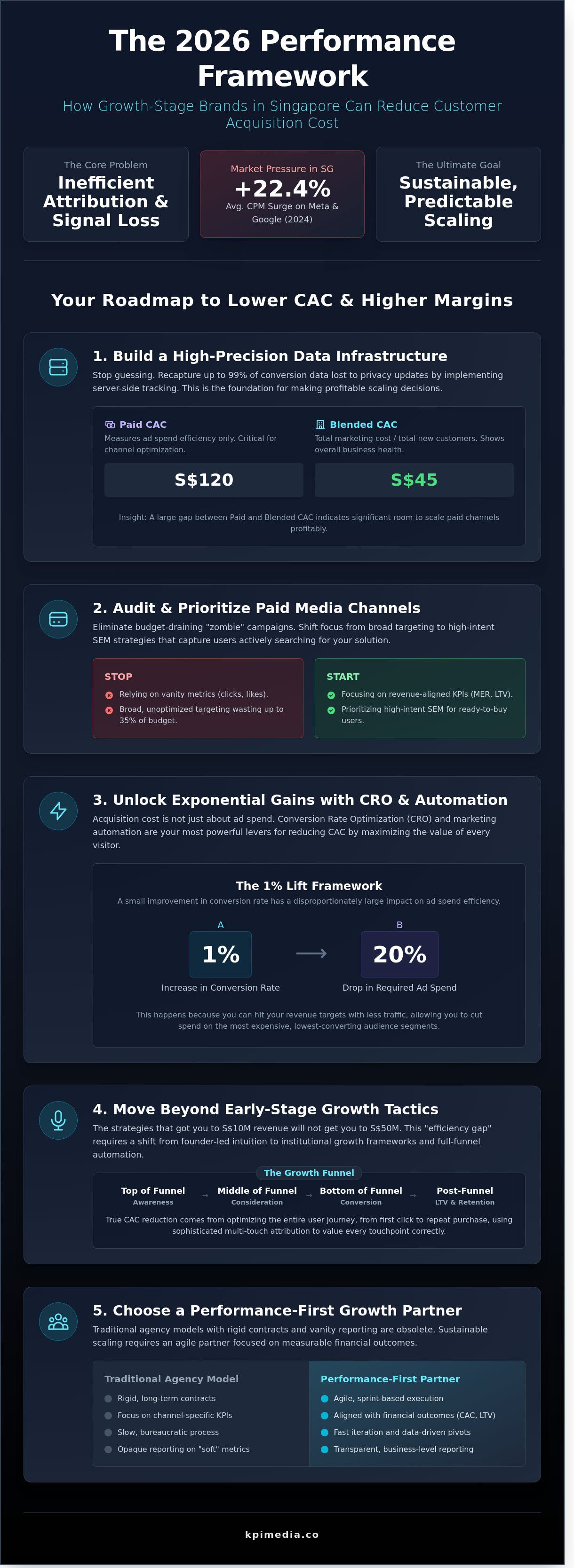
In 2024, CPMs across Meta and Google in the Singapore market surged by an average of 22.4%, forcing growth-stage brands to confront a harsh reality: the old playbook for scaling is broken. You likely already feel the pressure of these rising costs and realize that simply increasing your ad budgets won't solve the problem of inefficient attribution. This article outlines our 2026 performance framework for reducing customer acquisition cost singapore by leveraging high-precision data and full-funnel optimization to stabilize your margins.
We will show you how to move away from guesswork and toward a predictable acquisition model that aligns every marketing dollar with tangible revenue growth. We are going to dive into the technical shifts required to fix your attribution and unlock better visibility into your true LTV to CAC ratios so you can scale with confidence. By the end, you'll have a clear roadmap to stop wasting S$10,000 or more on low-intent audiences and start building a sustainable engine for the APAC region.
Key Takeaways
• Recapture lost conversion data with server-side tracking to accurately distinguish between Blended and Paid CAC for better scaling decisions.
• Audit your current channel mix to eliminate budget-draining "zombie" campaigns and prioritize high-intent SEM strategies that capture ready-to-buy users.
• Discover how a 1% lift in conversion rate can trigger a 20% drop in spend, providing a proven framework for reducing customer acquisition cost singapore brands need to scale.
• Leverage marketing automation and CRO to remove friction from the user journey and maximize the efficiency of every S$ invested in paid media.
• Evaluate why performance-first growth partnerships outperform traditional agency models by prioritizing agility and measurable financial outcomes over rigid contracts.
The 2026 Singapore Landscape: Why CAC is Climbing for Growth Brands
Singapore's digital advertising market is a pressure cooker. By 2026, the city-state has reached a level of digital maturity where every square meter of the 728 square kilometer island is accounted for in ad auctions. For brands scaling past the S$10M revenue mark, the "low-hanging fruit" of the local market has been picked clean. The math has changed. As we enter 2026, the sheer density of the Singaporean market has turned digital auctions into a zero-sum game for established players. You aren't just competing with direct rivals; you're fighting for the same 5.5 million mobile users as every global conglomerate and local scale-up.
The primary challenge for growth leaders today is signal loss. Privacy-first tracking mandates have decimated traditional attribution models, making it harder to pinpoint exactly which S$1 spent led to a conversion. This lack of visibility often results in inflated Customer Acquisition Cost (CAC) figures that don't reflect the actual health of the business. For growth-obsessed brands, reducing customer acquisition cost singapore requires moving beyond surface-level metrics and building a robust, first-party data infrastructure that bypasses third-party cookie reliance.
To better understand the mechanics of cost management, watch this breakdown:
The Reality of Rising CPMs in SG
In 2026, Meta and Google CPMs in Singapore have seen a 22% year-on-year increase in the finance and B2B SaaS sectors. This surge is driven by market density. When everyone bids for the same high-intent keywords like "best enterprise software SG," costs skyrocket. Relying on vanity metrics like click-through rates or social engagement is a fast track to budget depletion. We see established brands wasting up to 35% of their monthly spend on broad targeting that fails to convert. Success now demands a tactical pivot toward revenue-aligned KPIs like Marketing Efficiency Ratio (MER) and cohort-based LTV analysis. If your agency is still bragging about "cheap clicks," they're ignoring your bottom line.
Moving Beyond Early-Stage Growth Tactics
The strategies that propelled your brand to its first S$10M in revenue will likely fail during the push to S$50M. This is the "efficiency gap." Early growth often relies on founder-led intuition and aggressive, unoptimized spend. Scaling to the next level requires institutional growth frameworks. You must transition from simple lead generation to full-funnel marketing automation and sophisticated multi-touch attribution. This involves identifying high-LTV customer segments and doubling down on them, rather than chasing every possible lead in the APAC region. Reducing customer acquisition cost singapore at this stage is about precision. It's about optimizing the conversion rate of your existing traffic and using data to predict which prospects are worth the higher acquisition price. We focus on the delta between acquisition cost and long-term value to ensure every dollar spent is an investment, not an expense.
Building a Data Infrastructure That Uncovers Your Real Acquisition Costs
Scaling a growth-stage brand in the local market requires a clinical approach to your unit economics. You cannot succeed at reducing customer acquisition cost singapore if your data is fragmented or based on surface-level metrics. High-performing teams distinguish between Blended CAC and Paid CAC to make informed scaling decisions. While Paid CAC focuses strictly on the efficiency of your ad spend, Blended CAC provides the total picture by including organic and direct traffic. If your Paid CAC is S$120 but your Blended CAC remains at S$45, you have significant room to push your paid channels harder without compromising overall profitability.
Multi-Touch Attribution is the process of assigning value to every touchpoint in a customer journey to reveal true channel performance. Without this framework, you risk over-crediting the "last click" and cutting spend on top-of-funnel channels that actually fuel your pipeline. In a market as competitive as Singapore, relying on default platform reporting often leads to inflated results and wasted budget.
The Foundation: GA4 and Server-Side Tracking
Standard browser-side tracking is no longer sufficient for brands aiming for the next level of growth. Privacy updates like Safari’s ITP and the rise of ad blockers mean that up to 30% of your conversion data never reaches your ad platforms. This data gap forces algorithms to optimize with incomplete information, ultimately driving up your costs. Implementing server-side tagging allows you to recapture this lost data by moving the tracking process from the user's browser to your own server. This improves signal quality for platforms like Meta and Google, allowing their AI to find high-value users more efficiently.
This technical shift aligns with broader trends where Singapore's digital transformation initiatives have encouraged businesses to adopt more robust data architectures. To turn this raw data into actionable strategy, growth leaders use automated dashboards to visualize real-time performance across every touchpoint. These tools eliminate the manual labor of data cleaning and provide a single source of truth for your marketing spend.
Attribution Modelling for Complex Sales Cycles
Established brands rarely see a linear path to purchase. A customer might discover you through a LinkedIn ad, engage with three email newsletters, and finally convert after a direct search. Choosing the right model is critical. While a data-driven model is often the gold standard for high-volume accounts, a time-decay model can be more effective for shorter, high-intensity promotional periods in the Singapore retail sector. The goal is to identify which touchpoints actually move the needle.
For brands with high-touch sales cycles or offline components, closing the loop is essential. You must integrate your CRM data back into your analytics suite to connect digital leads with final revenue. If a lead costs S$20 but never converts to a S$2,000 contract, that lead is expensive regardless of the low initial cost. By passing offline conversion data back to your ad platforms, you train the system to ignore low-quality traffic and focus on users who generate actual ROI. If you want to see how these data structures impact your bottom line, audit your current tracking setup to identify where your budget is leaking.
Precision in tracking is the only way to achieve sustainable growth. When you stop guessing which ads work and start measuring the entire journey, reducing customer acquisition cost singapore becomes a repeatable process rather than a guessing game. This infrastructure serves as the bedrock for every optimization you make in your paid media and creative strategy.
Optimising Paid Media Channels for High-Intent Conversion
Scaling an established brand in Singapore requires a ruthless approach to budget allocation. Many marketing leaders find their accounts cluttered with "zombie" campaigns. These are legacy setups that continue to run out of habit despite delivering a sub-par ROAS. A recent internal audit of a mid-market enterprise showed that 24% of their monthly spend was tied up in these low-performing assets. By cutting these, you immediately free up capital for high-intent Search Engine Marketing (SEM).
Shifting budget toward SEM allows you to capture users who are already in the decision-making phase. When a prospect searches for specific solutions in the local market, your brand must be visible. This direct response approach is fundamental to reducing customer acquisition cost singapore. It's about capturing existing demand rather than trying to manufacture it from scratch at a high cost. Every S$1,000 moved from a vague awareness play to a high-intent search term typically yields a 3x higher conversion rate for growth-stage companies.
Paid social strategy must also evolve from "spray and pray" to mid-funnel nurturing. High-growth brands often overspend on top-of-funnel awareness that never converts. Instead, focus on a performance-first creative strategy. Aesthetics matter, but conversion is the priority. A high-production video that fails to drive a click is a liability. Use direct-response creative that addresses specific pain points and leads the user toward a clear call to action. This ensures your social spend acts as a bridge to conversion rather than a drain on resources.
Precision Search and Social Management
Dominating high-intent keywords requires a granular approach to Google Ads and SEM. In the competitive Singapore market, bidding on broad terms is a recipe for budget depletion. Focus on long-tail queries that signal a readiness to buy. For B2B brands, LinkedIn Ads provide the precision needed to reach decision-makers. By targeting specific company sizes and job functions, you avoid wasting S$ on non-prospects. When scaling Meta Ads, use broad-to-specific audience layering. This allows the algorithm to find your best customers while you maintain control over demographic guardrails.
Testing and Iteration Frameworks
Effective scaling relies on an "Always-On" testing methodology. Rotate creatives every 10 to 14 days to prevent ad fatigue without triggering a full algorithm reset. This keeps performance stable while you search for the next winning asset. Rigorous A/B testing of ad copy and landing page pairings is essential. A 12% improvement in landing page conversion can drastically lower your overall CAC. To maintain efficiency, implement AI-driven bid strategies. These tools automate cost-per-result optimisation, allowing your team to focus on high-level strategy rather than manual bid adjustments. This systematic approach is the most reliable way of reducing customer acquisition cost singapore while maintaining growth momentum.
Beyond the Click: Using CRO and Automation to Force CAC Down
Scaling an established brand in a competitive market requires more than just aggressive bidding. If your landing page converts at 2% and you increase that to 3%, you haven't just improved your site; you've effectively slashed your acquisition costs by a third. A 1% absolute increase in conversion rate frequently leads to a 20% drop in CAC. This math is the foundation of efficient growth. Every drop of friction in your funnel is a hidden tax on your marketing budget. When you eliminate these barriers, you stop paying for users to bounce and start paying for them to convert.
Conversion Rate Optimisation is the most effective lever for reducing CAC because it extracts more value from the traffic you have already paid for.
Landing Page Optimisation for Growth Brands
Singaporean consumers are discerning and risk-averse. For growth-stage brands, trust signals are the primary currency. Including local physical addresses, regulatory logos where applicable, or testimonials from recognizable local companies can shift the needle. Mobile-first design is a baseline requirement in a market where 90% of users browse on smartphones. If your checkout requires ten fields and five page loads, you're losing money. We recommend "one-click" conversion paths using local payment methods like PayNow or integrated digital wallets to bypass the friction of manual card entry. Reducing the steps from ad click to the final purchase page is the fastest way of reducing customer acquisition cost singapore brands can implement today.
Leveraging Marketing Automation
Human follow-up is expensive and slow. When a lead stalls, the cost of acquisition climbs every hour that lead remains cold. Implementing business process automation ensures that no prospect falls through the cracks. By automating lead management, you remove the manual labor costs that often inflate your total CAC. Automated email and SMS sequences can recover S$10,000 or more in monthly abandoned cart revenue without a single minute of manual intervention. These systems work in the background to nurture prospects who weren't ready to buy on the first click, effectively increasing the conversion rate of your existing traffic pool.
Dynamic content takes this efficiency further by personalising the landing page based on the specific ad source. If a user arrives from a search for high-end logistics solutions, they shouldn't see a generic homepage. They should see a headline and case study specific to that industry. This relevance ensures the user feels understood immediately, which directly improves the conversion rate. When you combine these automated touchpoints with a high-intent traffic strategy, reducing customer acquisition cost singapore becomes a predictable outcome rather than a guessing game. It's about building a system that works harder so your media spend doesn't have to.
Stop letting your media spend leak out of an unoptimised funnel. Audit your conversion path with KPI Media to identify exactly where your growth is stalling.
Scaling Sustainably with a Performance-First Growth Partner
Traditional marketing agencies often prioritize their own revenue over your profit margins. They focus on total ad spend or creative awards while ignoring the hard reality of your P&L. A results-obsessed growth partner operates on a different frequency. We don't care about vanity metrics like impressions or reach if they don't lead to a lower CAC and a higher LTV. Successfully reducing customer acquisition cost singapore requires a partner that treats your capital as their own. This means moving away from the "set and forget" mentality of legacy firms toward a model of constant, iterative testing and optimization.
Long-term contracts are a red flag in performance marketing. They protect the agency from their own underperformance and kill the agility needed to pivot when market conditions shift. If an agency isn't delivering measurable ROI within the first 90 days, you shouldn't be tied to them for another nine months. We believe in earning our place on your balance sheet every single month. This approach forces a relentless focus on ROAS and CAC alignment, ensuring every S$1 invested works harder than the last. When incentives are aligned, the agency's success is directly tied to your bottom line.
KPI Media was built to support scaleups and established enterprises looking to capture the APAC market. We replace the generic agency model with a specialized team that understands the nuances of regional platforms and local consumer behavior. We act as an elite extension of your internal marketing team, bringing technical depth in data analytics and marketing automation that most in-house teams lack the bandwidth to maintain. Our goal is to build a growth engine that is predictable, profitable, and entirely data-led.
The KPI Media Performance Guarantee
We put our fees on the line because we're confident in our frameworks. If we don't hit the pre-agreed KPIs for your campaigns, we apply a 50% discount to our management fees. This isn't just a marketing gimmick; it's about absolute alignment. We provide 24/7 transparency through real-time data dashboards, giving you a clear view of where every cent is going. You'll never have to wait for a monthly report to know if your campaigns are profitable. Our team works at the speed of your business, optimizing daily to ensure we're reducing customer acquisition cost singapore while maintaining lead quality.
Next Steps: Auditing Your Current CAC
Scaling spend without a technical audit is the fastest way to burn your marketing budget. Most accounts we take over have at least 15% to 25% waste hidden in poor tracking, overlapping audiences, or outdated bidding strategies. We identify the low-hanging fruit first, often finding immediate opportunities to lower costs by tightening your multi-touch attribution models. Before you increase your monthly spend from S$20,000 to S$200,000, you need to ensure your data foundation is bulletproof. Book a strategy session to optimize your acquisition costs and let's map out a scalable growth roadmap for your brand.
Future-Proof Your Growth Strategy
Scaling a growth-stage brand in the 2026 Singapore landscape demands more than just increasing ad spend. It requires a relentless focus on reducing customer acquisition cost singapore through precision data infrastructure and full-funnel automation. By shifting from broad-reach tactics to high-intent paid media and aggressive conversion rate optimization, you secure a competitive edge that protects your margins as market competition intensifies. Success depends on moving past surface-level metrics to embrace multi-touch attribution and real-time performance tracking.
KPI Media operates as an elite extension of your marketing team. We are SaaS and growth-stage specialists focused on data-driven APAC scaling. Our framework is built on absolute accountability; we offer a 50% discount on retainers if agreed KPIs are not met. This ensures our interests remain perfectly aligned with your bottom line. Stop guessing where your budget goes and start scaling with a partner that values measurable ROI as much as you do.
Request a performance marketing audit from KPI Media to unlock your next phase of efficient growth.
Your path to sustainable scale starts with a single, data-backed decision.
Frequently Asked Questions
What is a good Customer Acquisition Cost (CAC) for Singaporean brands?
A healthy CAC for Singaporean brands typically aligns with a 3:1 LTV to CAC ratio to ensure long-term profitability. For established B2C SaaS companies in the region, we benchmark a target CAC between S$60 and S$120. B2B enterprise firms often see costs ranging from S$800 to S$2,500 per acquisition. Your specific benchmark depends on your gross margin and churn rate. If your ratio drops below 2:1, your scaling efforts are likely unsustainable.
How does server-side tracking help reduce my acquisition costs?
Server-side tracking reduces acquisition costs by reclaiming up to 20% of conversion data lost to browser-based blockers and iOS 14 privacy restrictions. This precision allows ad platform algorithms to optimize against accurate datasets rather than incomplete signals. Better data leads to smarter automated bidding. You'll stop wasting budget on users who've already converted, directly reducing customer acquisition cost singapore by improving your ROAS by 15% on average.
Can I lower my CAC without decreasing my total advertising spend?
You'll lower your CAC while maintaining or increasing spend by improving conversion efficiency across the funnel. Focus on high-intent audience segments and creative refreshes to drive down cost-per-acquisition. In 2023, brands that optimized their post-click experience saw a 22% reduction in CAC without cutting a single dollar from their media budget. Efficiency isn't about spending less; it's about making every S$1 work harder through better targeting and messaging.
Why is my CAC rising even though our ad click-through rates are high?
High CTRs coupled with rising CAC usually indicate a disconnect between your ad promise and the landing page experience. You're successfully buying clicks, but those visitors aren't converting into customers. This often happens when creative is too broad or when the offer isn't clear once the user lands. We frequently see this in the Singapore market when brands prioritize engagement metrics over bottom-funnel intent. Audit your bounce rates; a rate over 70% suggests your traffic isn't qualified.
How often should we audit our digital marketing channels for cost efficiency?
Perform a comprehensive channel audit every 90 days to evaluate long-term performance trends and attribution shifts. Weekly tactical reviews are necessary to catch immediate anomalies in spend or conversion rates. This cadence ensures you're not over-investing in decaying channels. In a fast-moving market like Singapore, monthly deep dives into your multi-touch attribution models help you reallocate budget from underperforming segments before they drain your quarterly margins.
What role does Conversion Rate Optimisation (CRO) play in lowering CAC?
CRO is the most direct lever for reducing your CAC because it increases the volume of customers from your existing traffic. If you double your conversion rate from 2% to 4%, you effectively halve your acquisition cost. Scaling brands should aim for a continuous A/B testing cycle, targeting at least two major experiments per month. Even a 0.5% lift in checkout completion can save an established brand S$10,000 in monthly ad waste.
Is it better to focus on one channel or a multi-channel approach in Singapore?
A multi-channel approach is essential for established brands to reach the 5.9 million active internet users in Singapore across different touchpoints. Relying on a single platform creates significant platform risk and limits your scaling ceiling. Most successful growth-stage companies find their anchor channel first, then diversify to capture 15% to 30% of their leads from secondary sources like LinkedIn or SEM. This strategy creates a holistic presence that lowers CAC through brand familiarity.
How can I accurately calculate blended CAC versus paid CAC?
Calculate paid CAC by dividing your total performance marketing spend by customers acquired directly from paid channels. For blended CAC, divide your entire marketing budget, including software and headcounts, by the total number of new customers across all sources. Monitoring the gap between these two metrics is vital. If your blended CAC is significantly lower than your paid CAC, your organic flywheels are healthy. Aim for a blended CAC that stays 20% below your paid acquisition cost.















Let us build your acquisition engine
Our Founder will personally propose a custom media plan to crush your KPIs.