


The Growth Playbook: A Data-Driven Framework for Scaling Your Business
Let’s be direct. The term ‘growth’ has become a hollow buzzword, leaving many Singaporean founders and marketing leaders chasing vanity metrics instead of revenue. You're executing campaigns and analyzing dashboards, but still struggle to connect specific activities to a lower CAC or a higher LTV. The constant flood of so-called ‘growth hacks’ only adds to the noise, making it impossible to know where to invest your next dollar for maximum impact. This operational ambiguity is the single biggest barrier to scale.
This playbook is the antidote. We’re moving beyond abstract theory to deliver a concrete, data-driven framework for engineering predictable expansion. We will show you how to identify the only metrics that matter for long-term success, build a repeatable engine for high-value customer acquisition, and make strategic decisions with the confidence that comes from clear, quantifiable data. It’s time to stop guessing and start building a scalable future for your business.
Key Takeaways
- Move beyond vague goals. This framework redefines growth as a strategic, company-wide system, not just a marketing responsibility.
- Isolate the signal from the noise. Discover the three core KPIs that truly dictate your company's trajectory and financial health.
- Translate metrics into action. Identify the specific levers you can pull across the customer lifecycle to directly influence your core KPIs.
- Shift from one-off campaigns to a sustainable system. Learn the operational blueprint required to build a scalable growth engine.
Redefining Growth: From Vague Goal to Strategic Imperative
The dictionary defines growth simply as an increase in size. For a modern business, especially a competitive Singaporean SaaS startup, this definition is dangerously incomplete. True business growth isn't just about getting bigger; it's about getting stronger, smarter, and more profitable. The era of "growth at all costs"-burning through venture capital for market share without a clear path to profitability-is over. It’s a failed model that mistakes fleeting revenue spikes for sustainable success.
To understand how to architect this modern approach, start here.
Moving beyond simplistic goals requires treating expansion not as a wish, but as a core strategic business activity. It demands a framework that is measurable, repeatable, and directly tied to your bottom line. This means deconstructing the concept into its core, interconnected components.
Beyond Revenue: The Components of Scalable Growth
Scalability is built on a balanced foundation, not just a single metric. True progress is measured across four key pillars:
- Customer Base: Systematically acquiring new, high-value customers.
- Customer Value: Increasing Lifetime Value (LTV) through retention and expansion revenue.
- Market Share: Building brand equity to become a dominant force in your niche.
- Operational Efficiency: Scaling operations without a proportional increase in costs.
Vanity Metrics vs. Growth Metrics: Knowing the Difference
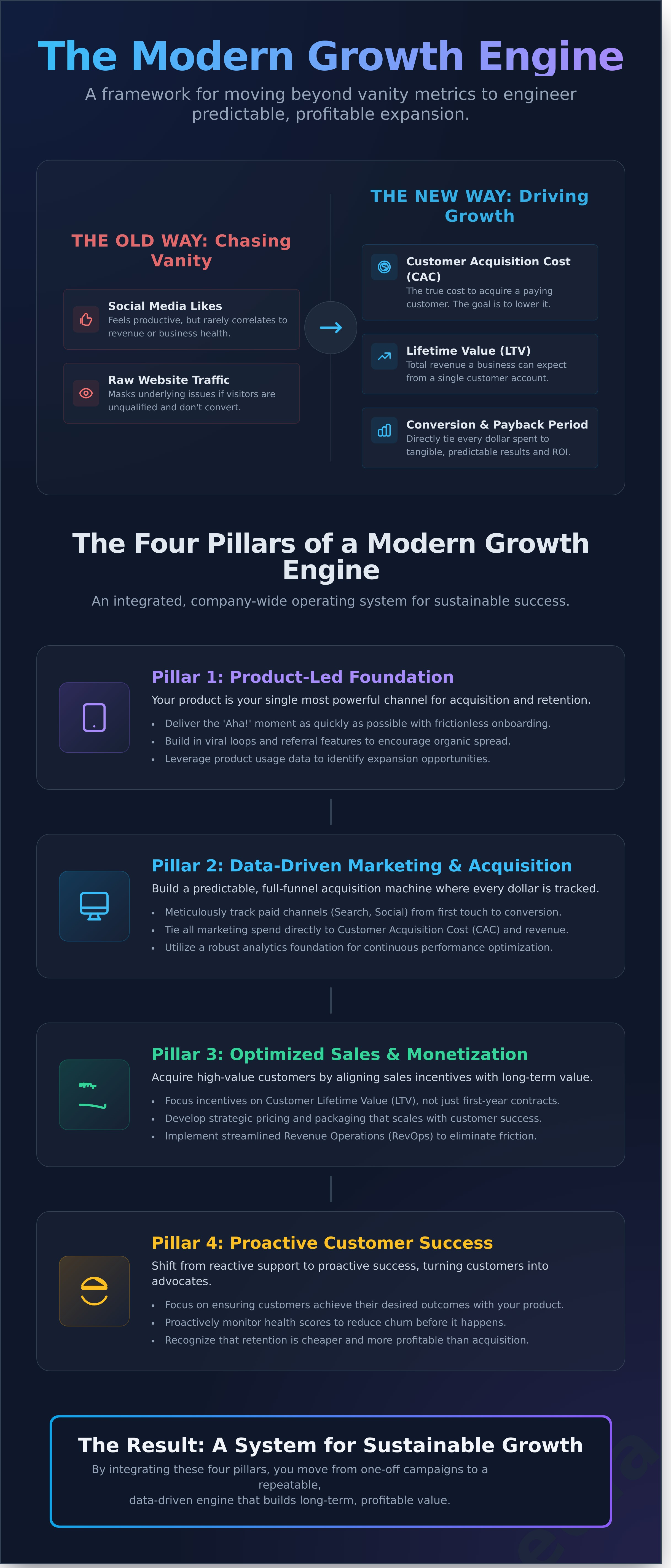
Vanity metrics like social media likes or raw website traffic feel productive but often mask underlying problems. They don't correlate to revenue or profitability. Actionable metrics, in contrast, are directly tied to business outcomes. We focus on the numbers that matter: Customer Acquisition Cost (CAC), LTV, conversion rates, and payback periods. The goal is to tie every marketing dollar spent to a tangible result, ensuring that reducing your CAC from S$250 to S$180 directly impacts your company's financial health.
The Four Pillars of a Modern Growth Engine
Sustainable growth isn't a marketing task; it's a company-wide operating system. The old model of siloing acquisition into one department is broken. To build a truly scalable business, you need an integrated engine built on four interconnected pillars. Understanding how these pillars support your business is critical, a concept echoed in foundational frameworks like Harvard Business Review's The Five Stages of Small Business Growth. A weakness in any single pillar doesn't just create a problem-it compromises the entire structure.
Pillar 1: Product-Led Foundation
Your product is your most powerful marketing channel. A product-led foundation uses the product itself to drive acquisition and retention. This starts with frictionless user onboarding designed to deliver the 'aha!' moment as quickly as possible. By analyzing product usage data, you can pinpoint opportunities to build in viral loops, referral features, or freemium models that turn satisfied users into a powerful, self-perpetuating acquisition channel.
Pillar 2: Data-Driven Marketing & Acquisition
This pillar is about building a predictable acquisition machine. It leverages paid channels like Search and Social to drive qualified leads, but with a critical distinction: every dollar spent is meticulously tracked. Whether it's a S$5,000 LinkedIn campaign or a S$20,000 Google Ads budget, marketing spend must be tied directly to Customer Acquisition Cost (CAC) and revenue. This requires a full-funnel view and a robust analytics foundation to optimize performance from first touch to final conversion.
Pillar 3: Optimized Sales & Monetization
The goal isn't just to close a deal; it's to acquire a high-value customer. This pillar focuses on aligning sales incentives with long-term Customer Lifetime Value (LTV), not just first-year contract value. It involves strategic pricing and packaging designed to maximize revenue over the entire customer lifecycle. A streamlined Revenue Operations (RevOps) function is crucial here, eliminating friction and ensuring data flows seamlessly from marketing to sales to finance.
Pillar 4: Proactive Customer Success & Retention
Acquiring a new customer costs far more than retaining an existing one. This final pillar shifts the focus from reactive support to proactive success. It’s about ensuring customers achieve their desired outcomes with your product, which in turn reduces churn. This creates a powerful feedback loop where customer insights inform product improvements, while also identifying and capitalizing on expansion revenue opportunities through targeted upsells and cross-sells.
Measuring What Matters: The 3 Core Growth KPIs
A growth framework is useless without measurement. To move from abstract strategy to tangible results, you must track the numbers that define your business's health and scalability. Forget vanity metrics. For a SaaS business in Singapore, sustainable growth is built on three core Key Performance Indicators (KPIs). These metrics form the foundation of a data-driven strategy, telling you precisely where to invest and when to scale.
Customer Acquisition Cost (CAC)
CAC is the total price you pay to acquire a new paying customer. It’s the ultimate measure of your sales and marketing efficiency. To calculate it, you must be ruthlessly honest about your expenses.
- Formula: (Total Sales & Marketing Spend) / (New Customers Acquired)
- Example: If you spend S$15,000 on Google Ads, content marketing, and sales salaries in a quarter to acquire 100 customers, your CAC is S$150.
A common mistake is ignoring "soft" costs like salaries or software subscriptions. Your CAC must include every dollar spent on acquisition to be accurate. Track this by channel to see which platforms deliver the most profitable customers.
Lifetime Value (LTV)
LTV represents the total revenue you can expect from a single customer over the entire duration of their relationship with your company. It quantifies the long-term value of each acquisition.
- Formula: (Average Revenue Per User) x (Customer Lifetime)
- Example: If your average customer pays S$99 per month and typically stays for 30 months, their LTV is S$2,970.
LTV determines the absolute maximum you can afford to spend on CAC. For deeper insights, segment LTV by customer cohort to identify your most valuable user profiles.
The LTV:CAC Ratio: Your Growth North Star
This is the single most important metric for a scalable business. The LTV:CAC ratio directly measures the profitability of your customer acquisition efforts and the viability of your entire business model.
A healthy ratio for a SaaS business is generally considered 3:1 or higher. This means for every dollar you spend acquiring a customer, you generate at least three dollars in lifetime revenue.
- An LTV:CAC of 1:1 means you’re breaking even, but losing money once you factor in operational costs.
- An LTV:CAC of 3:1+ (e.g., LTV of S$3,000 and CAC of S$1,000) signals a strong, profitable model ready to scale.
This ratio is your primary lever. A strong ratio gives you the green light to accelerate ad spend. A weak one tells you to pause, optimize your funnel, or refine your pricing before burning more capital.
Activating Growth: Key Levers Across the Customer Lifecycle
Data provides the map, but action drives the vehicle. Moving from measurement to execution requires a systematic framework that applies pressure at the right points in the customer journey. True scalability isn't achieved by excelling in one area; it’s the result of a balanced, full-funnel strategy that optimizes for acquisition, activation, and monetization simultaneously. This is the operational engine of sustainable growth.
Top of Funnel: Driving Scalable Acquisition
This is where your customer journey begins. The goal is to build a predictable system for generating qualified traffic and leads. A diversified approach is critical for mitigating risk and maximizing reach in the competitive Singapore market.
- Paid Search (Google Ads): Capture high-intent demand precisely when prospects are searching for a solution. This is about converting existing intent, not creating it.
- Paid Social (LinkedIn/Meta): Proactively target and build audiences based on firmographics and behavior. Perfect for generating awareness and demand where none existed.
- Content & SEO: Develop a long-term, compounding asset that lowers your blended customer acquisition cost (CAC) over time by capturing organic traffic.
- Influencer Marketing: Collaborate with trusted voices to build brand equity and reach targeted audiences. This is especially powerful for market expansion; for example, brands entering the Middle East often hire influencers UAE to quickly establish local credibility.
Need a predictable acquisition engine? See how we help.
Middle of Funnel: Nurturing Activation & Engagement
Getting a click is easy; earning a user is hard. This stage is about converting traffic into active users by demonstrating value and building trust. It’s the critical bridge between marketing and product.
- Landing Page Optimization (CRO): Systematically test headlines, copy, and CTAs to maximize the conversion rate from visitor to lead or trial sign-up.
- Marketing Automation: Use targeted email sequences to nurture leads, onboard new users, and guide them to their "aha!" moment.
- Social Proof: Deploy case studies, testimonials, and webinars to build credibility and dismantle purchase objections before they arise. Your activation rate is a direct indicator of product-market fit.
Bottom of Funnel: Maximizing Retention & Monetization
Acquisition fills the bucket, but retention prevents it from leaking. This final stage focuses on maximizing Lifetime Value (LTV) and turning customers into a new acquisition channel.
- Retention Campaigns: Implement proactive churn-reduction tactics, from customer success check-ins to re-engagement email flows.
- Upsell & Cross-sell: Identify opportunities to increase revenue from your happiest customers by moving them to higher-tier plans or add-on products.
- Referral Programs: Build a flywheel by incentivizing your existing customer base to become your most effective advocates.
- Pricing & Packaging Tests: Continuously A/B test your pricing strategy. A simple test between a S$99 and S$119 monthly plan can unlock significant new revenue.
Building Your Growth Engine: People, Process & Partners
A modern growth strategy isn't a collection of marketing campaigns; it's a fully integrated operational system. Once you have defined your metrics and mapped your funnel, the final step is to build the engine that drives it. This engine is built on three core pillars: the right people, a rigorous process, and strategic partners who accelerate your trajectory.
The Modern Growth Team Structure
Silos kill momentum. A high-performance team operates cross-functionally, uniting marketing, product, and sales around shared KPIs. Key roles include a Growth Lead to orchestrate strategy, a Performance Marketer to execute paid acquisition, a Data Analyst to translate numbers into insights, and a Product Manager to optimize the user experience. Top teams are staffed with T-shaped marketers-specialists with deep expertise in one area (like paid social) and broad knowledge across the entire funnel.
This focus on developing a well-rounded, resilient team mirrors the educational philosophy of institutions that build core soft skills from an early age. In Singapore, for example, enrichment centers like SuperMinds are dedicated to nurturing these foundational abilities in children, recognizing that future professional success is built on an early bedrock of communication, creativity, and critical thinking.
Implementing an Experimentation Framework
Sustainable results are born from high-tempo testing. An experimentation framework moves you from guesswork to data-driven decision-making. Prioritize ideas using a simple system like ICE (Impact, Confidence, Ease) to focus resources on the highest-potential tests. Critically, every outcome-win or lose-must be documented. This builds an institutional knowledge base and fosters a ‘fail fast’ culture where learning is the primary output, unlocking breakthrough performance.
When to Partner with a Growth Agency
For an early-stage startup in Singapore, the build vs. buy dilemma is acute. Hiring a full in-house team can easily exceed S$250,000 in annual salary costs before you see a single result. It’s time to bring in external expertise when you hit a scaling plateau or lack the specialized talent to unlock the next level of growth. Look for a data-obsessed partner with proven SaaS expertise and performance-based incentives. The right agency doesn’t just run ads; they accelerate your learning curve and help you avoid the costly mistakes we've seen countless others make. A true partner functions as an extension of your team, focused entirely on your metrics. Find out more about how we scale SaaS businesses at kpimedia.co.
From Playbook to Performance: Activate Your Growth Engine
The path to scale is no longer a mystery. It's a system. This playbook demystifies the process, transforming a vague ambition into a strategic imperative. The key takeaways are clear: success hinges on a robust engine built on four core pillars, and it is measured relentlessly by the KPIs that truly matter-like LTV and CAC. Without this structure, you're just guessing.
But a framework is only as powerful as its execution. As a specialized agency for venture-backed startups, we translate these principles into tangible results. We deploy proven, data-driven frameworks specifically for APAC expansion, ensuring your strategy is calibrated for the Singapore market. Our unique performance guarantee means we are as invested in your bottom line as you are. This isn't just consulting; this is a partnership.
The time for incremental gains is over. It's time for intentional, scalable growth. Ready to scale? Let's build your growth engine.
Frequently Asked Questions About Growth
What is the difference between growth hacking and growth marketing?
Growth hacking prioritizes short-term, rapid experiments to find scalable acquisition channels, often with a product-led focus. Think of Dropbox's early referral program. Growth marketing evolves this into a sustainable, full-funnel strategy. It systematically integrates product, marketing, and data to optimize the entire customer lifecycle-from acquisition to retention and revenue. It’s less about "hacks" and more about building a repeatable, data-driven engine for long-term success.
How long does it take to see results from a data-driven growth strategy?
Leading indicators like improved click-through rates or lower cost-per-lead can appear within 30-60 days. However, significant business impact takes longer. Expect to see meaningful changes in lagging indicators like Customer Acquisition Cost (CAC) and Lifetime Value (LTV) within 3-6 months. This timeline depends on your sales cycle and the velocity of your experimentation. The key is consistent, data-informed iteration, not a one-time fix.
What is the first hire a startup should make for a growth team?
Your first hire should be a T-shaped marketer with a strong analytical foundation. This individual needs broad knowledge across multiple channels-SEO, content, paid social-but deep expertise in one or two core areas relevant to your business. They must be obsessed with data, capable of running experiments independently, and focused on moving core metrics. Look for a strategic doer who can both build a financial model and execute the campaign that validates it.
Can a business achieve significant growth without using paid advertising?
Yes, significant organic growth is achievable, but it demands a different strategic focus. This path relies on building compounding assets like SEO-driven content, engineering-as-marketing tools, and strong product-led growth loops. While effective, these channels often have a longer time-to-value than paid advertising. Paid channels are not a requirement, but they are a powerful lever to accelerate customer acquisition and validate product-market fit quickly and efficiently.
How much should a venture-backed startup budget for marketing and growth?
For a venture-backed B2B SaaS startup in Singapore, a common benchmark is allocating 30-40% of your annual recurring revenue (ARR) to sales and marketing. For a company with S$1M ARR, this means a S$300,000-S$400,000 budget. This is a starting point. The optimal budget is ultimately determined by your LTV:CAC ratio. A healthy ratio (3:1 or higher) justifies more aggressive spending to accelerate market capture in a competitive landscape.
What is a 'growth loop' and how does it work?
A growth loop is a self-reinforcing system where one cohort of users generates new users as a natural byproduct of using your product. Unlike a linear funnel, a loop creates compounding returns. For example, in Pinterest's loop, a user signs up (Acquisition), creates a board (Action), which then gets indexed by Google and discovered by new users (Output), restarting the loop. Each cycle fuels the next, creating scalable, organic acquisition.





.webp)










Let us build your acquisition engine
Our Founder will personally propose a custom media plan to crush your KPIs.