


How to Scale a Startup in Singapore: The Founder's Playbook
You’ve achieved product-market fit. The initial traction was driven by pure founder grit, but now growth feels unpredictable. Your customer acquisition cost (CAC) is climbing, and the playbook that got you here is starting to break under pressure. This is the critical juncture where many promising ventures stall, caught between founder-led hustle and the need for a scalable system. The challenge is clear: you need a strategic framework for what comes next. This is your definitive guide on how to scale a startup in singapore, designed to move you from reactive tactics to a predictable growth engine.
Forget the fluff. This is a founder's playbook built on hard metrics and proven operational frameworks. We will dissect the key indicators, like a healthy LTV:CAC ratio, that signal true readiness to accelerate. You will learn to systematically leverage Singapore’s unique ecosystem of grants and VCs, build a high-performance team without derailing your culture, and optimize your customer acquisition engine for efficiency. By the end, you won't just have a plan; you'll have an actionable system to unlock sustainable growth and make confident, data-backed decisions.
Key Takeaways
- Leverage Singapore’s three core pillars-government, capital, and talent-to build a strategic launchpad for APAC market domination.
- Shift from opportunistic growth to predictable scaling by mastering your unit economics (LTV:CAC) before building a data-driven marketing and sales engine.
- Learn why the culture and processes that built your founding team will break at 50 employees, and discover the frameworks to scale your organization effectively.
- The playbook for how to scale a startup in Singapore involves de-risking your journey by sidestepping common, costly pitfalls in fundraising, talent acquisition, and regional expansion.
The Foundation: Leveraging Singapore's Unique Scaling Ecosystem
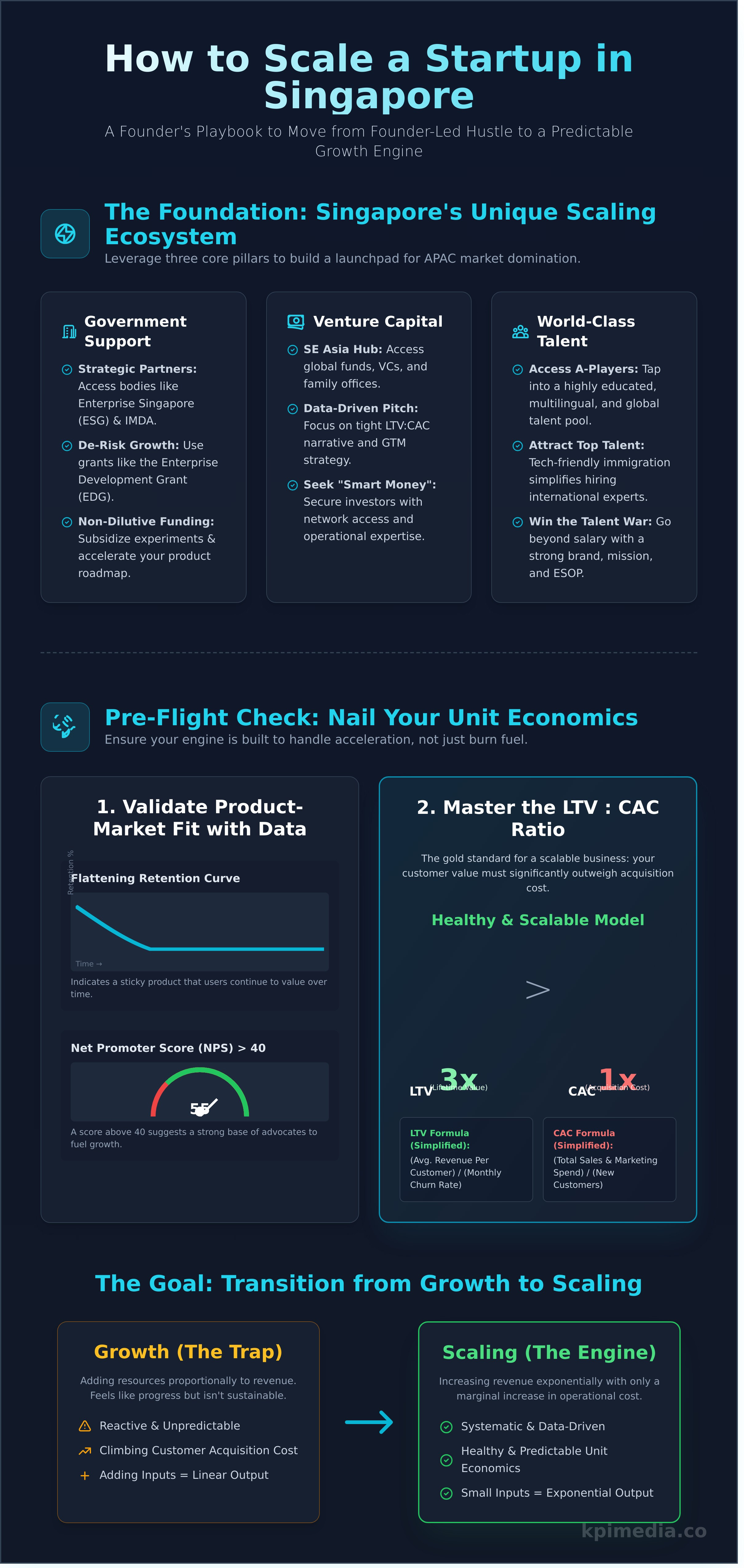
Scaling from Singapore isn't just about a local market; it's about unlocking the entire APAC region. The city-state offers a hyper-efficient launchpad, but success hinges on a founder's ability to leverage its interconnected infrastructure. Understanding Singapore's Unique Scaling Ecosystem reveals three core pillars you must master: strategic government support, deep capital markets, and a world-class talent pool. This isn't just theory; it's the operational playbook for how to scale a startup in Singapore effectively.
For a practical overview of the business landscape, this video provides a concise summary:
Unlike other regional hubs that may excel in one area, Singapore's strength lies in the powerful synergy of all three. Neglecting any one of these pillars means leaving growth on the table. Here’s how to activate each one.
Government Support: Grants and Strategic Partnerships
Government bodies here are not regulators; they are strategic partners. Enterprise Singapore (ESG) is your primary contact, offering grants like the Enterprise Development Grant (EDG) to de-risk critical growth initiatives-think international market access or core technology upgrades. For tech startups, agencies like the IMDA provide sector-specific programs. Use this support to subsidize your scaling experiments and accelerate your product roadmap with non-dilutive funding.
Venture Capital and Funding Landscape
Singapore is the undisputed hub for venture capital in Southeast Asia, attracting global funds and family offices. The funding path from Seed to Series B/C is well-established. To succeed, your pitch must be data-driven, with a tight narrative around your unit economics (LTV:CAC) and go-to-market strategy. The goal isn't just capital; it's securing smart money from investors who provide network access and deep operational expertise to help you scale.
Talent and Immigration
Access to A-players is a key competitive advantage. Singapore’s talent pool is highly educated, multilingual, and globally-minded. Government initiatives are also designed to attract top-tier international tech talent, simplifying immigration. To win, you need more than a high salary. A compelling employer brand, a clear mission, and a meaningful employee stock ownership plan (ESOP) are critical to building a team that can execute at scale.
Beyond compensation and mission, a commitment to professional development is a powerful differentiator in Singapore's competitive talent market. Offering opportunities for upskilling, such as a part time diploma for working adults singapore, demonstrates a long-term investment in your employees' careers, boosting both loyalty and capability.
Pre-Flight Check: Nailing Unit Economics Before Hitting the Accelerator
Before you inject capital into growth, you must understand a critical distinction: growth is not scaling. Growth is adding resources proportionally to revenue. Scaling is exponential-it’s about increasing revenue with only a marginal increase in operational cost. This efficiency is the core of how to scale a startup in Singapore, but it’s impossible without a validated foundation.
Attempting to scale before achieving Product-Market Fit (PMF) and mastering your unit economics is the number one reason promising startups fail. This pre-flight check ensures your engine is built to handle the acceleration, not just burn fuel.
Validating Product-Market Fit with Data
Gut feeling doesn’t scale. Data does. PMF isn't a vague feeling; it's a measurable state where your product serves a market that pulls it forward. Prove it with hard metrics. Your retention curve should flatten over time, indicating a sticky product. Churn rates should be low and stable. Use Net Promoter Score (NPS) as a leading indicator-a score consistently above 40 suggests you have a base of advocates ready to fuel word-of-mouth growth.
Mastering Your Unit Economics: The LTV:CAC Ratio
If PMF is the engine, unit economics is the fuel gauge. You must know your numbers cold before you spend. The two most critical KPIs are:
- Lifetime Value (LTV): The total revenue you expect from a single customer. (Simplified: Avg. Monthly Revenue Per Customer / Monthly Churn Rate)
- Customer Acquisition Cost (CAC): The total cost to acquire one new customer. (Simplified: Total Sales & Marketing Spend / New Customers Acquired)
The gold standard for a scalable SaaS business is an LTV:CAC ratio of 3:1 or higher. For every S$1 you spend, you get S$3 back. If your ratio is below this, pouring money into marketing will only accelerate your losses.
Ensuring Your Operations Can Handle Demand
A successful marketing engine can quickly break an unprepared operational backend. Before you scale, pressure-test your infrastructure. Can your tech stack handle 10x the users without crashing? Are your customer support processes automated and efficient enough to manage a surge in tickets? As you plan for key headcount increases, it's wise to explore available government support for startups, which can provide grants and resources to de-risk this expansion. Automate every repetitive task now to ensure your human capital is focused on high-value activities, not manual work.
Building the Growth Engine: A Data-Driven Marketing & Sales Framework
Early-stage wins often come from hustle and opportunistic tactics. But true scaling demands a system. The key to how to scale a startup in singapore is to stop treating marketing and sales as separate functions and instead build a single, integrated growth engine. This means shifting from random acts of marketing to a predictable, data-driven framework that fuels the entire customer funnel-from generating awareness in a competitive market to driving conversions and ensuring long-term retention. In the hyper-competitive Singapore's startup ecosystem, a repeatable engine isn't a luxury; it's the core mechanism for survival and dominance.
Architecting Your Paid Media Strategy
Your growth engine needs high-octane fuel. In Singapore and the wider APAC region, this fuel comes from a diversified portfolio of paid channels. High-intent platforms like Google Search capture immediate demand, while LinkedIn and Meta (Facebook/Instagram) are essential for building awareness and generating leads. The goal is to structure campaigns for rapid testing and learning. Isolate variables, find winning creative-audience combinations, and then scale budgets decisively. Expert Paid Search Management can significantly accelerate this process, moving you from budget burn to predictable ROI faster.
Implementing a Robust Analytics & Attribution Framework
You cannot scale what you cannot accurately measure. A scalable growth engine is built on a foundation of clean data. This requires a modern analytics stack: GA4 for event-based tracking, server-side tagging to combat data loss from privacy updates, and seamless CRM integration to connect ad spend directly to revenue. Move beyond last-click attribution to a multi-touch model that properly values every touchpoint in the customer journey. Automated Dashboards unify this data, providing a single source of truth for making critical scaling decisions with confidence.
Choosing a Growth Partner: Agency vs. In-House
Hiring an in-house team in Singapore is costly and time-consuming. While a dedicated internal team offers deep product focus, partnering with a specialist agency provides immediate access to a full team of experts, battle-tested frameworks, and cross-industry insights. This accelerates your time-to-market and de-risks your investment. When selecting a partner, look for a proven track record, a data-first methodology, and transparent performance metrics. A performance guarantee ensures the agency is fully aligned with your scale-up goals, making them a true extension of your team.
Scaling People and Culture: From Founding Team to Organization
Your product has traction and your metrics are climbing. Now comes the hardest part: scaling your team. The informal, high-velocity culture that powered your first ten hires will break as you approach fifty. Mastering the human element is a core challenge of how to scale a startup in Singapore, transforming a promising venture into a resilient organization built for hypergrowth.
Success is no longer about individual heroics; it's about building a system of people, processes, and principles that can sustain momentum. Here’s how to architect your organization for scale.
Hiring Your First Key Leadership Roles
Your first move is to hire leaders who have navigated this stage before. Focus on three critical roles: Head of Sales, Head of Marketing, and Head of Product. Look for operators with proven "scale-up" experience-they've built teams, systems, and playbooks from the ground up. This allows founders to delegate with confidence, transitioning from doing the work to leading the people who do the work. Implement a structured interview process that specifically tests for this experience, asking candidates to detail how they scaled a team or process in a previous role.
Codifying Your Culture to Survive Growth
As your headcount multiplies, "culture-by-osmosis" fails. What was once implicit must be made explicit. Document your core values and operating principles-the non-negotiable behaviours that define your company. Reinforce them through transparent communication rhythms like weekly all-hands meetings and clear internal updates. Most importantly, embed these values into your performance management system. When promotions and recognition are tied directly to your stated principles, culture becomes a measurable driver of performance, not just a slogan.
Leveraging Automation for Operational Efficiency
To empower your growing team, you must eliminate operational friction. Automation is your key lever. Target high-volume, repetitive processes in sales, marketing, and finance. Implement a robust CRM like HubSpot to act as a central nervous system, creating a single source of truth for all customer data. Automation doesn't replace talent; it liberates it. By removing manual errors and administrative burdens, you free your team to focus on high-value strategic work. Explore our Business Process Automation services to see how we build scalable operational frameworks that accelerate growth.
Common Pitfalls When Scaling in Singapore (And How to Avoid Them)
The path from a promising startup to a market leader is littered with costly mistakes. The most successful founders understand that a key part of knowing how to scale a startup in Singapore is de-risking the journey. This isn't about avoiding risk entirely-it's about anticipating and neutralizing the most common growth-killing traps before they drain your runway.
Treat this section as your strategic pre-mortem. Here are the three critical pitfalls that sink promising Singaporean startups and the data-driven frameworks to avoid them.
Pitfall 1: Premature Scaling
This is the number one killer. Premature scaling means pouring fuel on a fire that isn't burning efficiently yet-aggressively spending on marketing and sales before you've nailed Product-Market Fit (PMF) and unit economics. The result? You burn through investor cash with a deeply negative ROI. Before you scale, run this Go/No-Go checklist:
- Unit Economics: Is your Lifetime Value (LTV) at least 3x your Customer Acquisition Cost (CAC)?
- Retention: Is your monthly logo churn consistently below 2%? Are early cohorts showing strong engagement?
- Demand: Is a significant portion of your growth organic or referral-based, not just paid?
If the answer to any of these is no, pause. Go slow to go fast. Fix the model before you floor the accelerator.
Pitfall 2: Misunderstanding the APAC Market
Using Singapore as your HQ is a strategic advantage, but treating Southeast Asia as a single market is a fatal error. A campaign that crushes it in Singapore will likely fail in Jakarta or Bangkok without deep localization. Each market has unique languages, payment preferences, cultural nuances, and digital channels. Don't just translate your website; adapt your entire go-to-market strategy. Use Singapore as a controlled testbed to perfect your playbook, then hire local leadership in expansion markets to execute with authentic, on-the-ground knowledge.
Alternatively, some companies accelerate their entry into new regions through strategic acquisitions, a move that can instantly provide a local team and customer base. While complex, this strategy can be de-risked with guidance from M&A advisory specialists like PP-X, who provide frameworks for successful acquisition-led growth.
Pitfall 3: Neglecting Retention for Acquisition
Chasing new logos while ignoring existing customers is like pouring water into a leaky bucket. It’s expensive and futile. The data is clear: improving retention by just 5% can increase profitability by 25% to 95%. High churn cripples your LTV and forces you to spend more on an ever-increasing CAC. The solution is to operationalize customer success from day one. Tie a portion of your team's KPIs to retention metrics like Net Revenue Retention (NRR), not just new monthly recurring revenue. A healthy, growing customer base is the ultimate foundation for sustainable scale.
Navigating these challenges requires a data-first growth engine. If you're ready to build a scalable acquisition and retention strategy on a solid foundation, see how we build growth frameworks at KPI Media.
Execute Your Singapore Scaling Strategy
Scaling in Singapore isn't just about speed; it's about precision. Mastering how to scale a startup in singapore means anchoring your strategy in rock-solid unit economics before hitting the accelerator. From there, you can leverage the nation's unique ecosystem to build a truly predictable, data-driven growth engine.
Building that engine is our sole focus. As specialists for venture-backed startups, KPI Media operates as an extension of your team. We deploy a rigorous, data-driven approach to unlock full-funnel growth, from optimizing CAC to maximizing LTV. Our unique performance guarantee means we are as invested in your KPIs as you are, eliminating the risk of a typical agency engagement. Ready to build your scalable growth engine? Get your free growth proposal from KPI Media.
The opportunity in Singapore is immense. With the right framework, your startup won't just participate-it will lead. Now, go execute.
Frequently Asked Questions
What is the difference between growing and scaling a startup?
Growth is linear. You add resources-like budget or headcount-and get a proportional increase in revenue. For every new salesperson, you acquire a predictable number of new clients. This model adds both revenue and costs at a similar rate, which can limit your ultimate velocity and profitability.
Scaling is exponential. It’s about increasing revenue at a much faster rate than your costs. You invest in systems, technology, and processes that allow one new salesperson to unlock ten times the clients. The goal is to build a high-efficiency engine where revenue dramatically outpaces operational expenses.
How do I know if my startup has achieved Product-Market Fit?
Product-Market Fit (PMF) is not a feeling; it is a set of measurable data points. The clearest quantitative signals are a low, stable monthly churn rate (ideally under 5% for B2B SaaS) and a high percentage of new customers acquired through organic or referral channels. This indicates the market is actively pulling your product.
Another strong indicator is a shortening sales cycle and consistently high conversion rates without significant changes to your product or sales process. If a critical mass of users would be "very disappointed" without your product, you have achieved the qualitative side of PMF and are ready to scale aggressively.
What is a good LTV:CAC ratio for a SaaS startup in Singapore?
The universal benchmark for a healthy, scalable SaaS business is an LTV:CAC ratio of at least 3:1. This means for every dollar spent acquiring a customer, you generate at least three dollars in lifetime value. This ratio confirms your customer acquisition model is profitable and sustainable for the long term.
In the competitive Singapore market, aiming higher provides a distinct advantage. A ratio of 4:1 or 5:1 signals a highly efficient growth engine, unlocking capital to reinvest in product development and market expansion. As a rule, you should also aim to recover your Customer Acquisition Cost (CAC) in under 12 months.
What are the most important government grants for scaling a tech startup in Singapore?
To fuel your scaling journey, focus on grants that support capability development and internationalisation. The Enterprise Development Grant (EDG) is crucial for strengthening core business functions, process redesign, and overseas expansion. For deep-tech startups, the Startup SG Tech grant provides vital early-stage funding for proprietary technology development.
When you are ready to expand into the broader APAC region, the Market Readiness Assistance (MRA) Grant is essential. It helps cover the costs of overseas market promotion, business development, and market entry. Leveraging these grants provides non-dilutive capital to accelerate your growth trajectory without sacrificing equity.
When is the right time to hire a performance marketing agency?
The right time is immediately after you have validated Product-Market Fit. An agency is not there to find your market; they are hired to help you dominate it. You should have a proven product, predictable unit economics (a healthy LTV:CAC ratio), and an initial, repeatable sales process before engaging a growth partner.
Hire an agency when your team hits a ceiling on optimization or lacks the specialized expertise to unlock new acquisition channels at scale. The objective is to inject a scalable system and deep-funnel expertise to amplify what is already working, turning predictable revenue into exponential growth.
How should I adapt my marketing strategy for the broader APAC region?
Never treat APAC as a monolithic market. A successful expansion from Singapore demands a hyper-localised GTM strategy for each country. This extends beyond simple language translation to adapting messaging for cultural nuances, optimising pricing for local economies, and integrating region-specific payment gateways.
Your channel mix must also be tailored. While LinkedIn is a B2B powerhouse in Singapore and Australia, platforms like LINE in Thailand, Naver in South Korea, or WeChat in China are non-negotiable for reaching key decision-makers. Execute granular market research before deploying capital to ensure maximum ROI.
What are the first key leadership roles to hire when scaling?
When scaling, founders must evolve from "doing" to "leading." The first key hires should take ownership of the core revenue-generating functions. A Head of Sales is essential to build and manage a repeatable sales machine, while a Head of Marketing is required to scale lead generation far beyond founder-led initiatives.
The third critical role is a Head of Product. This leader ensures the product roadmap stays aligned with the needs of a rapidly growing customer base, which is vital for minimising churn and driving expansion revenue. Understanding how to scale a startup in Singapore means building a leadership team that can execute and drive KPIs independently.






.webp)








Let us build your acquisition engine
Our Founder will personally propose a custom media plan to crush your KPIs.