


The Definitive Customer Acquisition Strategy for Startups
Are you burning through your seed funding on marketing channels that don't deliver? In the competitive Singapore market, every dollar counts, and random acts of marketing lead to a depleted runway, not sustainable growth. The noise of countless channels is deafening, leaving you paralysed by choice and unsure where to invest your next S$10,000. It’s time to stop guessing and start building a system that predictably generates revenue.
This guide delivers that system. We provide the definitive customer acquisition strategy for startups, engineered for the unique pressures of the Southeast Asian ecosystem. Forget the fluff. This is a battle-tested framework to systematically identify, test, and scale the channels that drive profitable growth. We will equip you with a repeatable engine to acquire your first 1,000 customers, master your Customer Acquisition Cost (CAC), and build a scalable model that investors will back. Let's build your growth engine.
Key Takeaways
- Stop the 'growth at all costs' mindset. Define your North Star Metric first to ensure every dollar spent on acquisition drives real business value.
- Avoid spreading your budget thin across every platform. Learn a framework to prioritize the highest-impact acquisition channels for your specific ICP and sales cycle.
- A successful customer acquisition strategy for startups replaces random marketing acts with a systematic Test, Measure, Scale engine to find and exploit winning channels.
- Understand why high churn invalidates even the best acquisition efforts-your most powerful growth lever isn't just finding new customers, it's keeping them.
The Foundation: Before You Spend a Single Dollar on Acquisition
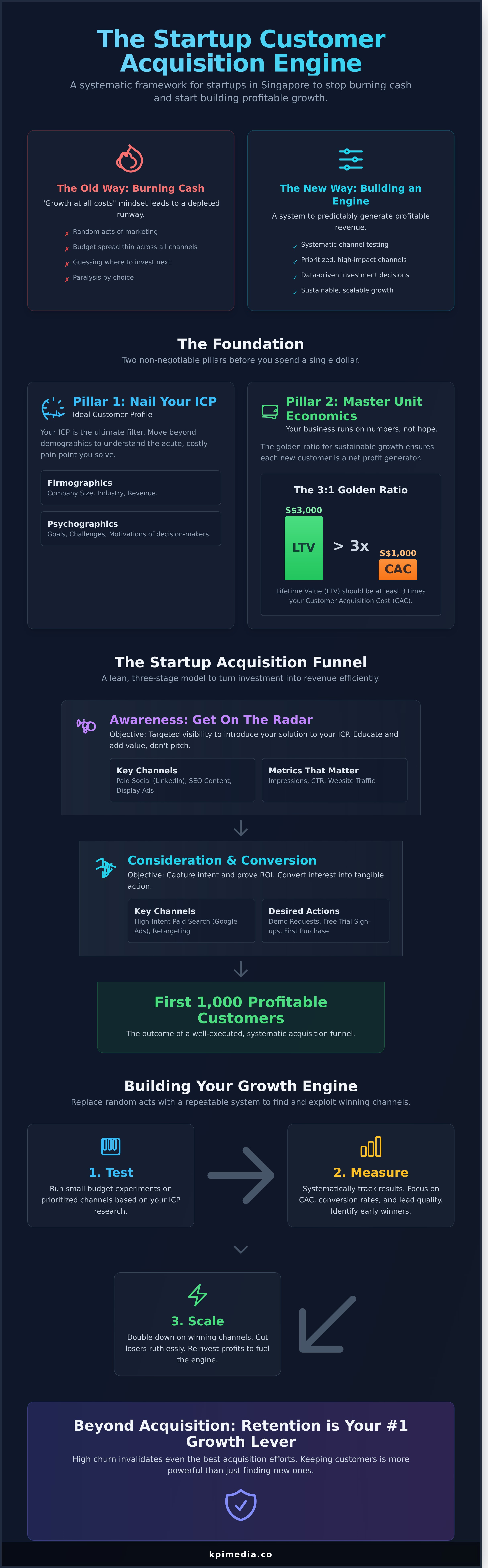
In the high-stakes Singaporean market, the "growth at all costs" mindset is a death sentence. Before you pour your first dollar into ads, you must build a bulletproof foundation. An effective customer acquisition strategy for startups isn't about vanity metrics; it's about profitable, sustainable growth. This pre-flight check prevents you from burning cash on the wrong audience and channels.
To scale intelligently, you must first define what customer acquisition truly means for your business. Watch this to understand the high-level thinking required.
This foundation rests on two non-negotiable pillars: your Ideal Customer Profile (ICP) and your Unit Economics. Get these right, and you unlock scalable growth. Get them wrong, and you’re just accelerating toward zero.
Nail Your Ideal Customer Profile (ICP)
Your ICP is more than basic demographics. For B2B SaaS, this means deep firmographics (company size, industry, revenue) and psychographics (the goals, challenges, and motivations of the key decision-makers). Identify the acute, costly pain point your product solves for this exact segment. Validate your assumptions with customer interviews and competitor analysis. A sharp ICP is the ultimate filter for every marketing decision you make.
Master Your Unit Economics: CAC and LTV
Your business runs on numbers, not hope. The two most critical metrics are Customer Acquisition Cost (CAC) and Lifetime Value (LTV).
- Customer Acquisition Cost (CAC): This is the total cost of sales and marketing to acquire a single new customer. A comprehensive understanding of customer acquisition cost includes ad spend, salaries, and tool subscriptions.
- Lifetime Value (LTV): This is the total revenue you predict a single customer will generate over their entire relationship with your company.
The golden ratio for sustainable SaaS growth is an LTV:CAC of at least 3:1. If your LTV is S$3,000, your target CAC should be S$1,000 or less. This ensures each new customer is a net profit generator, not a liability. Set this target CAC before you launch a single campaign.
Mapping the Startup Acquisition Funnel
Forget the complex, multi-touch attribution models of enterprise giants. A successful customer acquisition strategy for startups requires a lean, agile framework built for one purpose: rapid, measurable growth. Your funnel isn’t just a marketing concept; it’s a machine for turning investment into revenue, and as Paul Graham famously articulated, understanding the imperative of growth is non-negotiable. We operate on a streamlined, three-stage model designed to optimize for speed and capital efficiency.
This blueprint moves prospects from discovery to decision with precision, ensuring every dollar spent is tracked against a clear performance indicator.
Awareness Stage: Getting on the Radar
The objective here is targeted visibility. You need to introduce your solution to your Ideal Customer Profile (ICP) where they already are, capturing attention from prospects who are problem-aware but not yet solution-aware. The goal is to generate qualified traffic, not premature sales pitches.
- Key Channels: Paid social (e.g., LinkedIn ads targeting specific roles in Singapore), top-of-funnel SEO content (guides, "how-to" articles), and targeted display ads on relevant industry publications.
- Metrics that Matter: Impressions, Reach, Click-Through Rate (CTR), and Website Traffic. We focus on maximizing relevant eyeballs at an efficient cost.
Your content must educate and add value. Think less "Buy Now" and more "Here’s How to Solve Your Problem." This builds initial trust and positions you as an authority.
Consideration & Conversion Stages: From Prospect to Customer
This is where intent is captured and ROI is proven. Once a prospect is aware of you, the objective shifts to converting that interest into a tangible action-a demo request, a free trial sign-up, or a first purchase. This is the engine of your customer acquisition strategy for startups, where we aggressively optimize to lower acquisition costs.
- Key Channels: High-intent paid search (Google Ads), retargeting campaigns, in-depth case studies featuring Singapore-based clients, product webinars, and frictionless free trials.
- Metrics that Matter: Lead Generation, Cost Per Lead (CPL), and ultimately, Conversion Rate. Every activity is measured against its ability to drive revenue and keep your CPL in a target range, for instance, under S$80.
Here, your messaging becomes solution-focused. You demonstrate undeniable value and make it incredibly simple for a qualified lead to become a paying customer. This is how you build a scalable growth engine.
Prioritizing Channels: Where to Place Your Bets First
The most common mistake startups make is spreading a limited budget thin across a dozen channels. This shotgun approach guarantees mediocrity. An effective customer acquisition strategy for startups demands ruthless prioritization. The goal is to focus first on channels that offer high user intent and rapid feedback loops, allowing you to validate your messaging and unit economics quickly. This framework provides a clear starting point for placing your initial bets where they will generate the fastest learnings and revenue.
High-Intent Channels for Quick Wins: Paid Search
Paid search allows you to capture demand the moment it materializes. When a prospect in Singapore actively searches for a solution like yours, you need to be there. This is why expert Google Ads management is often the first scalable channel for startups. It bypasses the awareness phase and targets users ready to convert. To manage your initial budget-even a modest S$1,500 per month-focus on branded and long-tail keywords to control costs. The payoff isn't just leads; it's immediate data on what messaging drives conversions.
Targeted Reach Channels for Awareness: Paid Social
Once you have a baseline from search, use paid social to build targeted awareness. Platforms like Meta Ads offer powerful demographic and psychographic targeting to reach your precise Ideal Customer Profile (ICP) where they spend their time. This is critical for building top-of-funnel traffic and creating remarketing audiences you can nurture later. While essential for B2C, its B2B capabilities are increasingly potent for reaching decision-makers in specific industries across Singapore and Southeast Asia.
Long-Term Moats: SEO and Content Marketing
Paid channels deliver speed; SEO and content deliver sustainability. This is your long-term play to build a defensive moat that compounds over time. While not a quick win, it systematically reduces your long-term Customer Acquisition Cost (CAC). Start by creating content for bottom-of-funnel topics-like competitor comparisons or use-case-specific guides-to capture high-intent organic traffic. Understanding the full landscape of customer acquisition strategies shows that a robust content engine is foundational. It fuels every other channel, providing valuable assets for your paid campaigns and creating a powerful, compounding customer acquisition strategy for startups.
Building Your Growth Engine: The Test, Measure, Scale Framework
Random acts of marketing burn cash and yield zero insight. An effective customer acquisition strategy for startups replaces guesswork with a systematic growth engine. The Test, Measure, Scale framework is how you de-risk your marketing spend in the competitive Singaporean market. It’s a disciplined process for running small, data-informed experiments to identify winning channels before committing significant budget, a methodology that successful agencies like Posicionar use to drive predictable results regardless of the market.
Phase 1: Test - Running Disciplined Experiments
Every dollar spent must generate data. Start with a clear hypothesis: "This LinkedIn ad creative targeting fintech PMs in Singapore will lower our CPL below S$75." Isolate one variable per test-the audience, the creative, or the offer. Set a strict budget (e.g., S$500) and timeframe (e.g., 7 days) to declare a winner. Meticulously document every result to build an invaluable library of market intelligence.
Phase 2: Measure - Tracking What Truly Matters
Flawless analytics are non-negotiable. Before you spend a single dollar, ensure your tracking is perfect. Focus on metrics that directly impact your bottom line-Customer Acquisition Cost (CAC), Cost Per Lead (CPL), and Conversion Rate-not vanity metrics. Use automated dashboards to monitor performance in near real-time, ensuring you can attribute every conversion back to its source and understand true channel value.
Phase 3: Scale - Doubling Down on Winners
Once an experiment delivers a positive, repeatable ROI, it's time to scale. This isn’t about flipping a switch; it's a controlled process. Gradually increase the budget-from S$500 to S$1,500, then S$5,000-while closely monitoring for diminishing returns. A channel that is profitable at a S$1k/month spend may see its CAC skyrocket at S$10k/month. Reinvest learnings from winning campaigns to fuel your next round of experiments, compounding your growth.
This iterative loop is the core of a modern customer acquisition strategy for startups, transforming your marketing from a cost center into a predictable revenue driver. It's the exact methodology we use to build growth engines for our SaaS partners at kpimedia.co.
Beyond Acquisition: Why Retention Is Your Most Powerful Growth Lever
Acquiring a customer is only the beginning. The brutal reality for Singaporean startups is that a high churn rate will systematically dismantle your growth engine, no matter how effective your acquisition channels are. Pouring marketing budget into a leaky bucket is a direct path to failure. High churn invalidates your Customer Acquisition Cost (CAC) and renders your entire funnel unprofitable.
The most successful scale-ups understand this critical link: excellent retention directly increases your Customer Lifetime Value (LTV). A higher LTV means you can afford a higher CAC, allowing you to outbid competitors on paid channels and accelerate market penetration. A powerful customer acquisition strategy for startups must be built on a foundation of retention.
Of course, retention begins with the product itself. Core technical decisions, such as choosing between native and hybrid app development, can profoundly impact user experience and performance. For startups weighing these options, insights from custom software developers like API Pilot can be invaluable in building a product that retains users from day one.
The Critical First 30 Days: Nailing User Onboarding
Your first 30 days determine your next 300. The primary goal of onboarding is to eliminate friction and guide new users to their "Aha!" moment-the point where they experience your product's core value. A smooth onboarding is the single biggest predictor of long-term retention. Deploy a multi-channel approach to drive activation:
- In-app guides: Use tooltips and walkthroughs to highlight key features.
- Email sequences: Deliver tutorials and use cases that demonstrate immediate value.
- Personalized support: Offer proactive help to high-value sign-ups.
Building Feedback Loops
Your users are your most valuable source of intelligence. You must systematically collect, analyze, and act on their feedback. Implement systems to understand user sentiment from both active and churned customers. Use Net Promoter Score (NPS) surveys, conduct exit interviews, and monitor support tickets. This data isn't just for the product team; it's gold for marketing, providing the exact language and pain points for your next acquisition campaign.
Leveraging Happy Customers for Growth
Your best customers should be your best marketing channel. A strong retention strategy turns satisfied users into a new, low-cost acquisition engine. The lowest CAC, often approaching S$0, comes from organic word-of-mouth and structured referrals. Encourage this by implementing a formal referral program and prompting happy users to leave reviews on platforms like G2 and Capterra.
This creates a powerful growth loop where acquisition fuels retention, which in turn fuels more acquisition. Integrating this loop is a non-negotiable part of a modern customer acquisition strategy for startups. At KPI Media, we help SaaS businesses build these integrated systems to unlock scalable, capital-efficient growth.
From Strategy to Scale: Your Next Move
You now have the blueprint. A successful customer acquisition strategy for startups isn't a single tactic-it's a complete system. It begins with a solid foundation of understanding your customer and unit economics. It accelerates through a disciplined Test, Measure, Scale framework applied to the right channels. And critically, it achieves sustainable momentum by prioritizing customer retention as your most powerful growth lever. This is how you move from unpredictable wins to a repeatable growth engine.
Translating this framework into tangible results in Singapore's dynamic market requires specialized expertise. At KPI Media, we partner exclusively with venture-backed startups to do just that. We don't operate on fluff; we execute on data. Our proven case studies and unique performance guarantee on retainers demonstrate our commitment to your bottom line. We function as an extension of your team, obsessed with hitting your KPIs.
Ready to stop guessing and start scaling with confidence? Talk to an expert about scaling your startup's acquisition strategy. The next stage of your growth is within reach.
Frequently Asked Questions
How much should a startup budget for customer acquisition?
Your budget isn't a fixed percentage; it's a function of your growth stage and unit economics. Early-stage startups in Singapore might allocate 20-40% of their operating budget to validate channels. For growth-stage startups, the budget should be tied directly to your LTV:CAC ratio. If your unit economics are strong (e.g., a 3:1 ratio), you invest aggressively to capture the market. The goal is to fund profitable growth, not just spend on marketing.
Which customer acquisition channel is best for a B2B SaaS startup?
There is no single "best" channel, only the most efficient one for your specific ICP. For Singaporean B2B SaaS, high-intent channels like Google Ads and targeted LinkedIn campaigns often provide the fastest path to initial traction and data. However, for long-term, scalable growth, content marketing and SEO are non-negotiable. We recommend a multi-channel approach, starting with paid channels to validate messaging and keywords, then reinvesting those learnings into organic strategies for compounding returns.
How long does it take to see results from a customer acquisition strategy?
The timeline for results depends entirely on the channel. Paid channels like PPC can generate leads and conversion data within the first 30-60 days, allowing for rapid optimization. Organic channels like SEO are a long-term asset; expect to see meaningful traffic and lead flow in 6-9 months. An effective customer acquisition strategy for startups balances these timelines, using paid media for immediate feedback while building a defensible organic moat for sustainable growth.
What is a good Customer Acquisition Cost (CAC) for a startup?
A "good" CAC is always relative to your Customer Lifetime Value (LTV). The benchmark for a healthy SaaS business is an LTV:CAC ratio of 3:1 or higher. For example, if your average customer LTV is S$6,000, a CAC of S$2,000 is sustainable for aggressive growth. Early-stage startups might temporarily accept a lower ratio to gain market share, but a viable customer acquisition strategy for startups must have a clear roadmap to achieving this 3:1 metric.
Should I focus on organic (SEO) or paid (PPC) channels first?
Start with PPC. It provides immediate market feedback and actionable data. You can test messaging, landing pages, and keyword intent with a controlled budget, quickly identifying what resonates with your target audience. Use these validated learnings from your PPC campaigns to inform and de-risk your long-term SEO strategy. This data-driven sequence ensures your content marketing efforts are focused on topics with proven conversion potential, maximizing your ROI from day one.
How do I know when to scale a marketing channel?
You scale a channel when it demonstrates predictable profitability. The key signal is a stable and acceptable CAC that maintains a healthy LTV:CAC ratio (ideally >3:1) as you increase spend. Do not scale based on vanity metrics like traffic or impressions. Once you have a consistent conversion rate and a proven return on ad spend (ROAS), you can methodically increase the budget. Scaling is a data-driven decision to pour fuel on a fire that's already burning efficiently.

















Let us build your acquisition engine
Our Founder will personally propose a custom media plan to crush your KPIs.