


Paid Media Management in APAC: The Definitive Guide for Scaling Your Business
Pouring your ad budget into the Asia-Pacific region often feels like a high-stakes gamble. The promise of explosive growth is met with the harsh reality of a deeply fragmented market, making effective paid media management APAC a complex challenge. From Kakao in South Korea to LINE in Japan and Grab in Singapore, a misstep on the wrong platform can evaporate tens of thousands in ad spend. Most Western companies fail here, applying a monolithic strategy to a diverse continent and achieving little more than a negative ROAS.
This guide cuts through the noise. It delivers the actionable playbook you need to unlock scalable growth, moving from unpredictable spending to a predictable Customer Acquisition Cost (CAC). You will learn precisely how to allocate budget with confidence, select the right channels for maximum impact, and build a high-performance growth engine that drives profitable expansion across the region. Stop guessing and start scaling.
Key Takeaways
- Unlock growth by treating APAC as a collection of distinct markets, not a single entity; learn to tailor your strategy to unique local consumer behaviors and platforms.
- Implement a proven 4-step framework to systematically de-risk market entry and scale across the region, moving from high-level strategy to tactical execution.
- Effective paid media management APAC requires identifying the highest-ROI channels for each sub-region and tying every ad dollar directly to revenue-focused KPIs.
- Make the critical in-house vs. agency decision with confidence using a clear framework that weighs cost, speed, and local expertise for your specific growth stage.
Why APAC Paid Media Management Demands a Hyper-Local Strategy
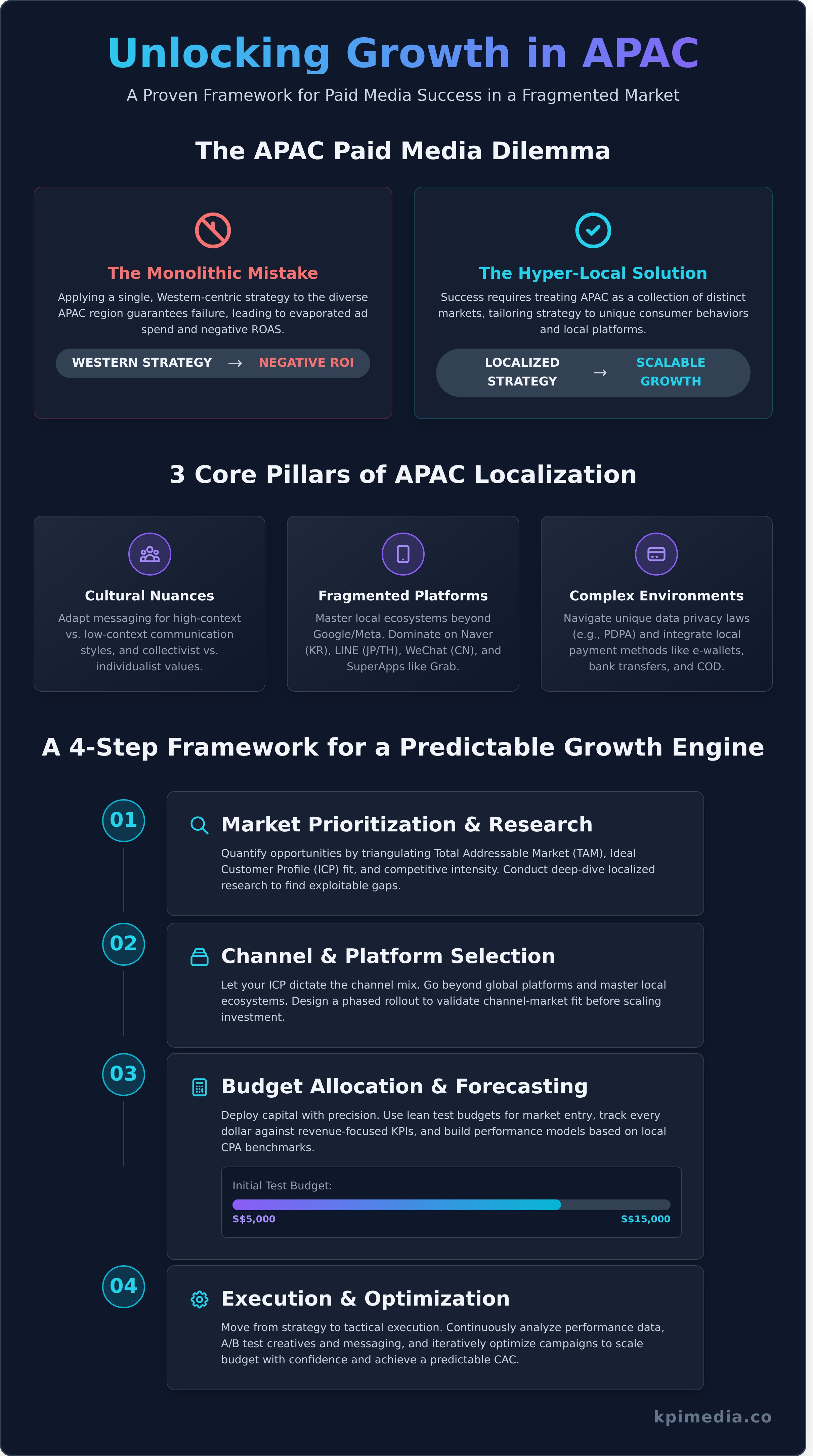
Treating the Asia-Pacific region as a single market is the fastest way to burn your ad budget. A Western-centric strategy, copy-pasted into APAC, guarantees failure. The region is a complex mosaic of dozens of countries, each with unique economic trajectories, digital ecosystems, and consumer psychologies. Misapplying the digital advertising fundamentals on a macro-level, without granular localization, leads to negative ROI and stalled growth. Effective paid media management APAC is not about broad strokes; it’s about surgical, country-specific execution.
To understand the shift towards more sophisticated, data-driven approaches, this overview provides critical context:
Scaling successfully requires a strategic framework built on three core pillars of localization. Ignoring them means you're not just wasting money; you're failing to connect with your total addressable market.
Cultural Nuances and Consumer Behavior
Communication styles dictate ad performance. A direct, low-context message that works in Australia will likely fail in high-context Japan, where subtlety and relationship-building are paramount. Ad creative must also reflect collectivist values (common in many Asian markets) versus the individualistic focus of the West. Attitudes towards promotions, brand trust, and data privacy vary wildly, demanding custom messaging and offers for each target market.
The Fragmented Digital Platform Landscape
Your audience isn't just on Google and Meta. Dominant local platforms are non-negotiable for market penetration. Think Naver in South Korea, LINE in Japan and Thailand, or WeChat in China. In Southeast Asia, a mobile-first consumption pattern is the default. Your entire strategy-from creative formats to landing pages-must be optimized for mobile to capture a user base that often bypasses desktop entirely.
Navigating a Complex Regulatory and Payment Environment
Compliance is not optional. Each country has its own data privacy laws, like Singapore's Personal Data Protection Act (PDPA), that govern how you collect and use customer data. Furthermore, the payment landscape is fractured. Credit card penetration can be low, making local payment methods like bank transfers, e-wallets, and even Cash-on-Delivery (COD) essential for conversion. This directly impacts your ability to track LTV and optimize the funnel, requiring a more sophisticated approach to attribution.
A 4-Step Framework for Building Your APAC Paid Media Engine
Scaling in APAC demands more than a bigger budget; it requires a repeatable system. We deploy a battle-tested, four-step framework that transforms market entry from a gamble into a calculated science. This is the core methodology we use to build predictable customer acquisition engines for venture-backed SaaS leaders, moving from high-level market intelligence to granular campaign execution. Effective paid media management APAC is built on this disciplined, data-first approach.
Step 1: Market Prioritization and Research
We don't guess; we quantify. Your entry point is selected by triangulating Total Addressable Market (TAM), Ideal Customer Profile (ICP) fit, and competitive intensity. Once a market is greenlit, we conduct deep-dive localized research-analyzing search behavior, audience nuances, and competitor ad creatives to find exploitable gaps in the landscape.
Step 2: Channel and Platform Selection
Your ICP dictates the channel mix, not industry trends. While global platforms like Google and Meta are foundational, success in APAC often hinges on mastering local ecosystems. Understanding the dominant digital economy trends in Asia Pacific-from SuperApps like Grab to local social networks-is non-negotiable. We map your audience to these platforms and design a phased rollout to validate channel-market fit before scaling investment.
Step 3: Budget Allocation and Performance Forecasting
Capital is deployed with precision. Initial market entry tests are funded with lean, data-gathering budgets, often starting from S$5,000 to S$15,000. We build performance models that account for currency fluctuations and local Cost-Per-Acquisition (CPA) benchmarks, establishing clear KPIs for every stage of the funnel. This ensures every dollar is tracked against a specific outcome, from cost-per-impression to customer acquisition cost.
Step 4: Creative and Landing Page Localization
Simple translation is a recipe for failure. We focus on cultural transcreation, ensuring your ad copy, imagery, and offers resonate with local values and motivations. This extends to the entire user journey. Landing pages are meticulously optimized with local languages, currencies, and essential payment gateways like PayNow to eliminate friction at the point of conversion.
The Essential Paid Media Channels Across Key APAC Markets
Success in the Asia-Pacific region hinges on rejecting a one-size-fits-all approach. The digital landscape is a fragmented mosaic of dominant local players and global platforms. A robust paid media management APAC strategy requires a granular, market-by-market channel allocation to unlock scalable growth. Your channel mix in Singapore will not work in South Korea-period.
To accelerate planning, here is a high-level overview of the primary performance channels across key markets:
| Country/Region | Key Search Engines | Key Social & Messaging Apps | Key E-commerce & Marketplace Platforms |
|---|---|---|---|
| Southeast Asia (SG, ID, TH, VN) | Meta (FB/IG), TikTok, LINE (TH), Zalo (VN) | Shopee, Lazada, Tokopedia (ID) | |
| East Asia (JP, KR, TW) | Google, Naver (KR), Yahoo! Japan (JP) | LINE (JP, TW), KakaoTalk (KR), Meta | Rakuten (JP), Coupang (KR), PChome (TW) |
| ANZ (AU, NZ) | Google, Bing | Meta (FB/IG), LinkedIn, TikTok | Amazon AU, The Iconic |
Dominating Search in APAC
While Google commands over 95% market share in Singapore, Australia, and Indonesia, treating it as the only option is a strategic failure. To penetrate South Korea, you must master Naver. To maximize reach in Japan, a dual strategy across Google and Yahoo! Japan is non-negotiable. Bidding strategies must adapt; Naver’s CPCs can be lower, but the platform demands deep Korean-language expertise and an understanding of its unique ad formats like Brand Search and Power Link.
Winning on Social and Messaging Apps
Meta (Facebook and Instagram) provides the foundational layer for audience targeting across most of SEA. Yet, true dominance requires leveraging hyper-local platforms.
- LINE: Essential for driving engagement and running display campaigns in Japan, Taiwan, and Thailand.
- KakaoTalk: The primary channel in South Korea for everything from brand awareness via Bizboard ads to performance campaigns.
- TikTok: Its explosive growth offers unparalleled reach for top-of-funnel initiatives across the entire region, with rapidly evolving direct-response capabilities.
E-commerce and Marketplace Advertising
For D2C brands, advertising directly on marketplaces like Shopee, Lazada, and Tokopedia is critical for capturing high-intent, bottom-of-funnel demand. These platforms are product search engines. For B2B SaaS startups, LinkedIn is the premier channel for targeting senior decision-makers in commercial hubs like Singapore and Sydney. An effective performance framework integrates these channels-using social to create demand and marketplaces or search to capture it with maximum efficiency.
Measuring Success: The KPIs and Analytics for APAC Growth
In paid media, data isn't for reporting-it's for decision-making. Vanity metrics like impressions and clicks don't build businesses; revenue and profitable growth do. Effective paid media management APAC demands a sophisticated measurement framework that translates ad spend directly into business outcomes. This is especially critical when navigating the region's complex landscape of multiple currencies, diverse user behaviors, and cross-border data flows.
Without a robust analytics foundation, you’re not scaling; you’re just spending. Measurement is the mechanism that unlocks scalable, profitable growth.
Beyond ROAS: The Core Metrics That Matter
Return on Ad Spend (ROAS) is a useful channel-level indicator, but it doesn't tell the whole story. For SaaS startups, the North Star metrics are Customer Acquisition Cost (CAC) and Lifetime Value (LTV). We track blended CAC-incorporating all marketing and sales costs-to understand the true price of growth. For a Singapore-based SaaS, a S$1,500 CAC might be highly profitable against a S$6,000 LTV, while a S$500 CAC for a low-value product could be unsustainable. Realistic benchmarks are set for each market entry, acknowledging that initial CAC in a new market like Indonesia will differ from mature campaigns in Australia.
Solving for Multi-Touch Attribution
The modern customer journey is fragmented across devices and platforms. A prospect might see a LinkedIn ad, click a Google search result, and finally convert after a retargeting campaign. Last-click attribution is obsolete. We deploy data-driven attribution models to assign credit accurately across the funnel. In the post-iOS14 era, server-side tracking via Facebook's Conversion API (CAPI) and server-side GTM is non-negotiable. It ensures data integrity, protects your budget from being allocated based on flawed signals, and provides a clearer picture of performance.
Building Your APAC Performance Dashboard
A unified performance dashboard is your command center for regional growth. It must visualize performance clearly for all stakeholders, breaking down data silos. We build dashboards that consolidate mission-critical KPIs, allowing you to see performance at a glance across countries, channels, and campaigns.
- Core Components: Spend vs. Budget (by country), Blended CAC, Trials/Demos, Marketing Qualified Leads (MQLs), and LTV:CAC Ratio.
- Visualization: Track performance in local currencies (SGD, AUD, THB) while reporting a unified view in your primary currency.
- Cadence: Establish a weekly or bi-weekly rhythm for strategic reviews to analyze trends, re-allocate budget, and accelerate what’s working.
This disciplined approach transforms your paid media management APAC from a reactive expense into a predictable engine for revenue. To see how we build performance frameworks that drive growth, visit us at kpimedia.co.
In-House vs. Agency: Choosing Your APAC Paid Media Management Model
The decision to build an in-house team or partner with an agency is a critical growth lever. For startups scaling across Asia-Pacific, this isn't just a resource question-it's a strategic choice that defines your speed to market and capital efficiency. The right model accelerates your path to profitability; the wrong one burns cash and stalls momentum.
When an In-House Team Makes Sense
An internal team offers unparalleled product immersion and cultural alignment. They live your brand daily. However, the costs and risks in APAC are substantial. A single senior performance marketer in Singapore can command a salary well over S$120,000, excluding benefits and equity. Scaling requires multiple hires with specific language and platform skills, creating a massive fixed cost. More critically, an internal team often develops strategic blind spots, lacking the cross-industry insights that prevent costly mistakes in new markets.
The Case for a Specialized APAC Agency
A specialized agency provides an immediate competitive advantage. You don't just hire one person; you embed an entire team of channel specialists, data analysts, and regional strategists for a fraction of the cost of a full-time hire. This model unlocks immediate scalability and leverages cross-client learnings, ensuring your budget is deployed on proven tactics, not experiments. It transforms your paid media management APAC strategy from a cost center into a predictable growth engine. See how our agency model accelerates APAC growth.
What to Look for in an APAC Paid Media Partner
Choosing the right partner is non-negotiable. Your decision framework should be built on evidence, not promises. Demand a partner who demonstrates:
- A Data-Driven Methodology: They should operate from a foundation of hard metrics and transparent reporting, linking every action directly to your CAC and LTV goals.
- Proven Regional Case Studies: Ask for specific examples of scaling startups in your vertical across key APAC markets, not just in their home country.
- A Performance-Aligned Model: The best partners tie their success to yours, often through flexible contracts or performance-based incentives that eliminate long-term risk.
- Deep Platform Expertise: They must possess mastery of global platforms like Google and LinkedIn, plus on-the-ground expertise in local giants like Naver, Kakao, and LINE.
Scale Your APAC Footprint with Precision
Mastering the Asia-Pacific market is not about casting a wide net; it's about surgical precision. Success hinges on deploying hyper-local strategies, a robust execution framework, and a relentless focus on the KPIs that signal profitable growth. This is the core of effective paid media management APAC, moving your business from presence to dominance.
Executing this requires deep, regional expertise. As a Singapore-based hub, KPI Media specializes in scaling venture-backed startups across these complex markets. We operate as a dedicated growth partner, so invested in your success that we offer a unique 50% retainer discount performance guarantee. We don't just manage campaigns; we build scalable revenue engines.
The opportunity in APAC is immense, but the window for market leadership is closing. Stop guessing and start scaling with a team that has the proven expertise to deliver. Ready to Scale in APAC? Get Your Custom Growth Proposal.
Frequently Asked Questions
How much should a startup budget for paid media when first entering the APAC market?
For a serious market entry test, we recommend a minimum pilot budget of S$15,000 to S$25,000 per month for three months. This allows for sufficient data collection across key platforms like LinkedIn and Google Ads to establish baseline CAC and CPL metrics. Anything less risks inconclusive data, preventing you from making informed decisions on scalability. The goal is to validate product-market fit and unit economics before committing to a larger, full-scale investment.
Which APAC country is the best to start with for a B2B SaaS company?
For most B2B SaaS startups, Singapore is the optimal launchpad. Its status as a regional business hub, high English proficiency, and sophisticated digital infrastructure reduce initial friction. This allows you to test messaging and acquisition models in a high-LTV environment before expanding. Once the model is proven here, markets like Australia offer scale, while Malaysia and the Philippines provide cost-effective entry points for further growth.
What are the biggest mistakes companies make when launching paid media campaigns in Southeast Asia?
The most common failure is a "one-size-fits-all" creative and platform strategy. A campaign that works in Singapore will fail in Vietnam without deep localization of language, payment methods, and cultural nuances. Another critical error is underestimating mobile-first behavior. Companies that don't prioritize mobile-optimized landing pages and creatives see conversion rates plummet. Effective paid media management APAC demands a market-by-market approach, not a regional copy-paste.
How do you approach ad creative and copy localization for diverse markets like Japan and Indonesia?
We deploy a "transcreation" framework, not just translation. For Japan, this means respecting formality, emphasizing group harmony, and using visuals that convey trust and precision. For Indonesia, creative must be mobile-first, vibrant, and often incorporate community-focused messaging. We use native-speaking strategists for each market to ensure every ad element-from headline to CTA-resonates with local business etiquette and drives measurable action.
What is a realistic timeframe to see a positive return on ad spend in a new APAC market?
Expect a 90-day validation phase. The first 30 days are for data acquisition and establishing baseline KPIs like CPC and CPL. By day 60, we focus on aggressive optimization to drive down CAC and validate conversion funnels. A clear trend towards positive ROAS should be evident by the end of month three. From there, we focus on scaling winning campaigns to accelerate market penetration and maximize LTV.
How does your performance guarantee work for new clients targeting APAC?
Our guarantee is rooted in mutual commitment and transparent KPIs. We operate on a rolling monthly basis-no lock-in contracts. We agree on clear performance targets (e.g., target CPL, MQL volume) within the first 30 days. If we don't demonstrate measurable progress towards these goals, you can walk away. Our success is directly tied to yours, making our approach to paid media management APAC a true growth partnership.





.webp)





Let us build your acquisition engine
Our Founder will personally propose a custom media plan to crush your KPIs.