


Digital Marketing in 2026: A Performance Framework for Scaling Established Brands
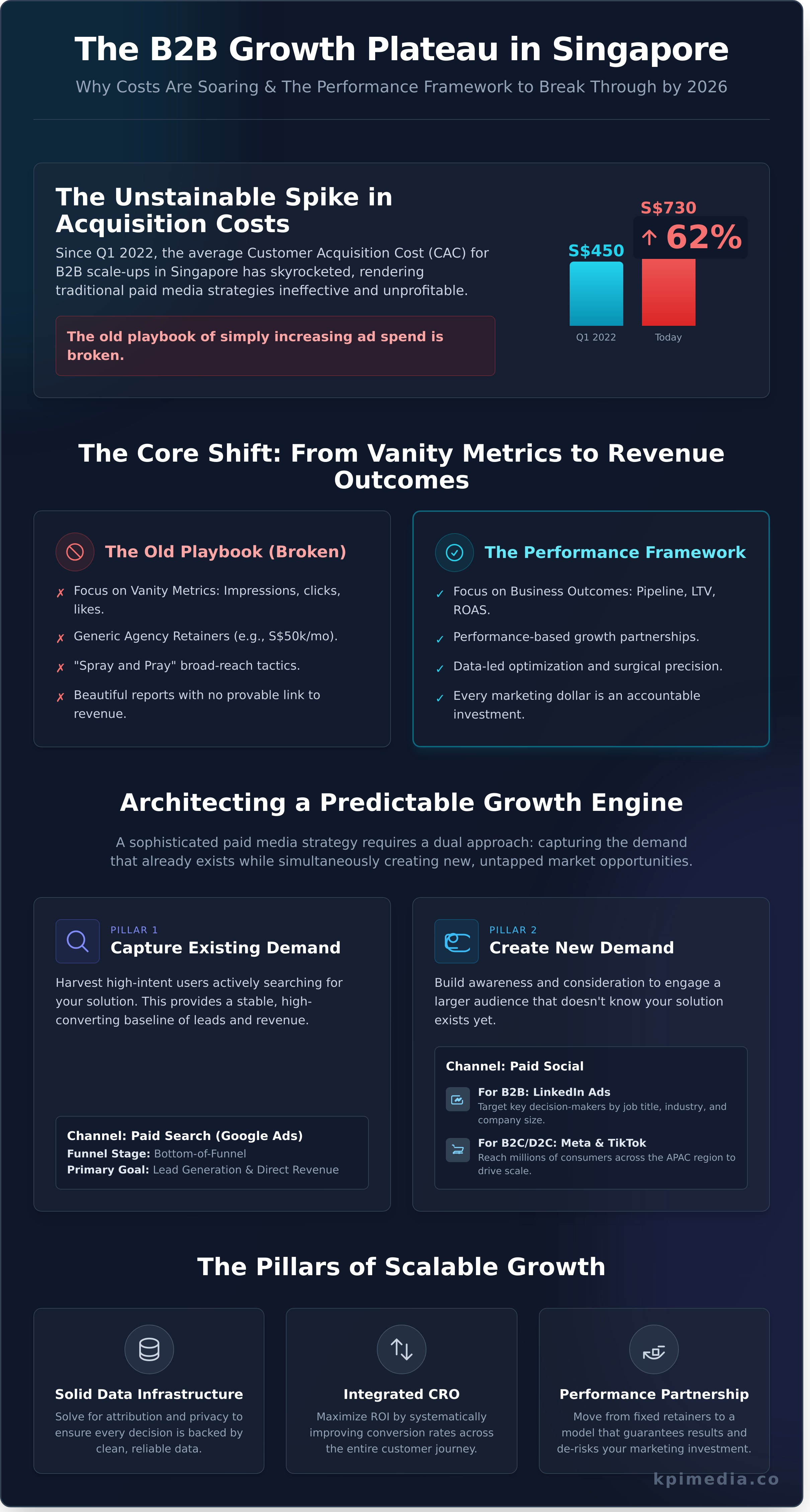
Since Q1 2022, the average Customer Acquisition Cost for B2B scale-ups in Singapore has spiked by over 62%, pushing what was a manageable $450 CAC into an unsustainable $730 territory. You're likely feeling this pressure. The old paid media playbook is broken, and simply increasing spend is no longer a viable growth strategy when data is fragmented across APAC markets and ROI is impossible to prove.
This article isn't about incremental tweaks. It's a data-driven performance framework built specifically for established brands to stabilize acquisition costs, accelerate revenue, and master the complex regional landscape by 2026. We'll break down the exact attribution models, paid media frameworks, and data infrastructure you need to build a predictable growth engine for your digital marketing efforts. It's time to stop guessing and start scaling with precision.
Key Takeaways
- Understand the critical shift in digital marketing from vanity metrics to a revenue-first framework focused on pipeline, LTV, and ROAS.
- Discover how to plug the data infrastructure gap to solve for attribution and use CRO to maximize the ROI of your ad spend in APAC.
- Learn a proven framework for scaling revenue by using Paid Search to capture existing market demand and Paid Social to create it.
- Evaluate the performance-based growth partner model as a powerful alternative to traditional agency retainers for de-risking investment and guaranteeing results.
Modern Digital Marketing: Why Performance-Led Strategies Outpace Traditional Awareness
The definition of digital marketing has fundamentally changed. By 2026, it’s no longer a collection of awareness channels designed to generate impressions and clicks. It’s a revenue-first ecosystem. For growth-stage brands in Singapore, treating your marketing budget like a scalable financial asset isn’t just an option; it’s the only way to win. The old model of chasing vanity metrics like likes and follower counts has been replaced by an relentless focus on hard business outcomes: qualified pipeline, customer lifetime value (LTV), and a positive return on ad spend (ROAS).
To see how these core strategies work in practice, this overview provides an excellent foundation.
This pivot is precisely why many established brands hit a growth ceiling. They partner with generic agencies that deliver beautiful reports filled with impressions but fail to connect their $50,000 monthly retainer to actual revenue. The "Expert Growth Partner" model flips this script entirely. It integrates directly with your financial goals, treating every campaign as an investment vehicle designed for a specific, measurable return. We don't just manage ads; we build and optimize growth engines.
The Evolution of the Digital Marketing Funnel
A full-funnel approach is critical, but its execution must be precise. Traditional "spray and pray" tactics, like broad-reach display ads, burn capital with minimal impact on the bottom line. For an established SaaS brand in APAC, capturing high-intent leads is vastly more valuable than generating millions of low-quality impressions. This means prioritizing channels where prospects are actively searching for a solution, not just passively scrolling.
Performance as the New Standard
A results-first mindset realigns marketing with core business objectives. Every dollar spent must be accountable. When your marketing team and agency partner are obsessed with the same KPIs as your CFO, you unlock scalable growth. This requires a deep integration of data analytics, paid media, and conversion rate optimization to ensure the entire customer journey is geared toward revenue. Performance marketing is the systematic pursuit of measurable revenue growth through data-led optimization. The evolution of various Digital marketing strategies over the past decade shows a clear and irreversible trend toward this data-centric model. It’s not about spending more; it’s about investing smarter.
High-Impact Channels: Scaling Revenue Through Paid Search, Social, and Programmatic Media
A high-converting website is only half the battle. To truly scale revenue in Singapore, you need to fuel your funnel with high-quality, targeted traffic. This is where a sophisticated paid media strategy becomes non-negotiable. It’s not about just buying ads; it’s about architecting a multi-channel engine that captures existing demand while simultaneously creating new opportunities for growth. A cohesive paid media plan is the foundation of any effective digital marketing initiative for an established brand.
Effective Paid Search Management is the starting point. It allows you to harvest existing market demand with surgical precision, targeting users in Singapore actively searching for your solution. This bottom-of-funnel traffic is often the highest converting, providing a stable baseline of leads and revenue. But relying solely on search means you’re missing the much larger audience that doesn't yet know you exist.
Precision in Paid Search and Social
To generate new demand, paid social is essential. For B2C and D2C brands in the APAC region, Meta and TikTok are the primary arenas for scaling. They offer unparalleled reach to build brand awareness and drive consideration among millions of Singaporean consumers. For B2B growth-stage brands, LinkedIn Ads provide a direct line to key decision-makers, allowing you to target by job title, company size, and industry with unmatched accuracy. A disciplined testing framework is the only way to win here. Systematically iterating on creative, copy, and audience segments is what separates stagnant campaigns from those that consistently lower Customer Acquisition Cost (CAC). Building a robust performance framework for social demands this level of rigor.
The Role of Programmatic and OOH
Programmatic advertising fills the strategic gap between high-intent search and discovery-based social. Using sophisticated data signals, Programmatic Display allows enterprise brands to reach ideal customer profiles across the wider web, building brand recall long before a user ever searches for a relevant keyword. This top-of-funnel activity is crucial for long-term growth. This modern digital marketing mix now includes Digital Out-of-Home, integrating real-world touchpoints-like screens at Raffles Place MRT or Changi Airport-with online retargeting. For established brands, unified media buying across these channels is key. It breaks down data silos, provides a clear view of multi-touch attribution, and ensures every dollar spent is working to drive a measurable business outcome. Aligning this complex media mix is where we consistently find the most significant growth levers for our partners.
The Data Infrastructure Gap: Solving for Attribution and Privacy in the APAC Landscape
“How do we know our digital marketing is actually working?” It’s the question every Singapore-based CMO has to answer. You’re spending tens, or even hundreds of thousands of SGD per month on ads, content, and technology, but the connection between that spend and your P&L remains blurry. The standard dashboards in your ad platforms don't tell the full story. They can't.
This ambiguity isn't a campaign problem; it's an infrastructure problem. Growth-stage brands are operating with a data gap, complicated by a fragmented customer journey and an increasingly complex regulatory environment. Navigating the maze of Attribution and Privacy in the APAC Landscape, including Singapore's own PDPA, requires a fundamental shift away from browser-based tracking toward a more robust, server-side approach. Closing this gap is the first step to unlocking scalable growth.
Mastering Multi-Touch Attribution
For established brands, last-click attribution is a liability. It assigns 100% of conversion credit to the final touchpoint, completely ignoring the LinkedIn ads, content downloads, and email sequences that nurtured the lead. This flawed model leads to poor budget allocation, systematically underfunding the channels that build your pipeline. To fix this, you need a data framework that maps the entire customer journey. This starts with a best-in-class Google Analytics 4 (GA4) setup, but quickly moves to server-side tracking via sGTM to ensure data accuracy. With over 30% of Singapore's mobile users on iOS, server-side tracking is no longer optional-it's essential to bypass tracking preventions and capture a true picture of performance.
Data Visualization and Real-Time Insights
Static PDF reports from agencies are relics. They create a "black box" around your performance data, leaving you to make critical budget decisions based on outdated information. We replace this with live, Automated Dashboards that provide a single source of truth for your entire team. This level of transparency is non-negotiable. It means our team and yours are looking at the exact same KPIs, in real-time, enabling agile decisions that accelerate growth. This robust Data & Analytics Implementation also aligns incentives. When attribution is clear and trusted, we can build performance-based models tied directly to the metrics that matter: customer acquisition cost (CAC), lifetime value (LTV), and ultimately, revenue.
Maximizing Efficiency: Integrating Conversion Rate Optimization (CRO) and Marketing Automation
Pouring more budget into paid media without a solid CRO framework is like trying to fill a leaky bucket. Growth-stage brands in Singapore often hit a ceiling where increasing ad spend, whether it's $20,000 or $100,000 per month, yields diminishing returns. The problem isn’t the traffic; it's the inefficient conversion path. A systematic CRO process plugs those leaks, ensuring every dollar you invest in your digital marketing strategy works harder to generate revenue, not just clicks.
The goal is to systematically raise your conversion floor. This isn't about guesswork. It’s a rigorous process of hypothesis-driven testing on critical assets like landing pages, pricing pages, and demo request funnels. By analyzing user behavior with tools like Hotjar and running controlled A/B tests with platforms like VWO, we can identify and eliminate friction points. A single headline change can lift conversion rates by 15%. Optimizing a form from five fields to three can boost submissions by 25%. These iterative improvements create a more efficient funnel that turns traffic into qualified leads or sales consistently.
The ROI of Systematic CRO
Even marginal gains in conversion rates have a compounding effect on your bottom line. Lifting your conversion rate from 1.0% to just 1.5% on 50,000 monthly visitors doesn't just add 250 conversions; it’s a 50% increase in your marketing ROI from the exact same ad spend. A seamless User Experience (UX) is no longer a "nice-to-have" in performance marketing. It is a core driver of profitability, directly lowering your Customer Acquisition Cost (CAC) and setting the stage for higher lifetime value.
Automation as a Growth Multiplier
Once CRO captures a lead, Marketing Automation takes over to nurture it efficiently. Effective Business Process Automation removes manual friction from your sales cycle. Instead of leads going cold, they are instantly segmented and entered into personalized email sequences. We implement automated lead scoring systems that qualify prospects based on their behavior and firmographic data, allowing your sales team to focus only on the highest-intent opportunities. By integrating CRM data from platforms like Salesforce with your digital marketing channels, you create a powerful feedback loop that optimizes campaigns for revenue, not just form fills.
True scalability is achieved when CRO and paid media work in lockstep. A LinkedIn campaign targeting CFOs in Singapore’s fintech sector should direct traffic to a landing page with messaging, case studies, and a call-to-action built specifically for that persona. We then test variants of that page to find the optimal combination that drives demo requests. This synergy ensures your ad budget is spent acquiring customers, not just traffic, creating a predictable engine for growth.
Building this integrated system requires deep expertise. Let's analyze your funnel and build a roadmap to unlock your true conversion potential.
Selecting a Growth Partner: Moving from Agency Retainers to Performance-Based Outcomes
Once your CRO framework is in place, the final lever for explosive growth is choosing the right partner to execute and scale your strategy. The traditional agency model, built on long-term retainers and opaque deliverables, is broken. It incentivizes activity, not outcomes. For growth-stage brands in Singapore, paying a $10,000 monthly retainer for reports filled with vanity metrics is a direct path to stagnation. You don't need another vendor; you need a partner with skin in the game.
A true growth partner operates on a completely different premise. Their success is intrinsically tied to yours. They focus on moving the only metrics that matter: revenue, qualified leads, and customer lifetime value. This shift from a service provider to an integrated growth engine is critical for any brand serious about scaling its digital marketing efforts efficiently.
The Performance Guarantee Advantage
A performance-based model isn't just a pricing strategy; it's a statement of confidence. It aligns incentives perfectly. When an agency offers a performance guarantee, like our model where clients only pay 50% of that month's retainer if we miss the KPI agreed for the month, the risk shifts from you to them. This immediately eliminates the friction and doubt inherent in fixed-retainer relationships. It forces a level of transparency and accountability that rigid, 12-month contracts are designed to avoid. The conversation changes from "hours worked" to "results delivered."
Scaling Across APAC
Singapore is a world-class hub, but it's also a gateway to the broader Asia-Pacific region. Scaling into markets like Indonesia, Thailand, or Vietnam requires more than just translating ad copy. Each market has a unique digital ecosystem, from dominant super-apps like Grab and Gojek to preferred payment methods and social platforms like LINE. A one-size-fits-all Western strategy will fail. Your partner must possess deep, localized expertise to navigate these cultural and technological nuances. An established brand can't afford to learn these lessons the hard way. Scale your brand with a performance-first partner.
To ensure you're choosing a partner truly aligned with your revenue goals, use this checklist during your evaluation process:
- Revenue-Tied Compensation: Does their model depend on hitting MQL, SQL, or revenue targets? Or are they simply billing for time and materials? A real partner links their fee directly to your success.
- Contract Flexibility: Are you being pushed into a 12-month lock-in? A confident agency proves its value every 30 days and doesn't need to trap clients in rigid contracts.
- KPIs vs. Vanity Metrics: Scrutinize their sample reports. Are they highlighting clicks and impressions, or are they focused on metrics like Customer Acquisition Cost (CAC) and pipeline velocity?
- Proven APAC Case Studies: Ask for specific examples of how they've scaled a brand from Singapore into at least two other APAC markets. Vague assurances aren't enough; demand performance data.
Choosing the right Digital Marketing Agency isn’t about outsourcing tasks. It’s about finding a strategic partner obsessed with your bottom line. Demand accountability, alignment, and a relentless focus on measurable growth.
Build Your 2026 Growth Engine Today
The path to scaling in 2026 is clear. It’s not about bigger budgets; it’s about smarter execution. Success hinges on two core pillars: a performance-led strategy that replaces outdated awareness metrics with measurable revenue, and a data infrastructure built to solve for attribution and privacy across the complex APAC landscape.
This is the future of digital marketing, and it requires a partner as obsessed with your bottom line as you are. We built KPI Media on a foundation of radical transparency. We operate without long-term contracts because our results speak for themselves. With specialized expertise in APAC growth scaling, we guarantee our performance. If we miss the KPI we agreed for the month, you only pay 50% of that month's retainer.
Stop paying for effort and start investing in outcomes. Request a performance-guaranteed growth proposal today. Let’s unlock your next stage of growth, together.
Frequently Asked Questions
What is the difference between digital marketing and performance marketing?
Performance marketing is a subset of digital marketing that is 100% focused on measurable outcomes like leads, sales, or conversions. While broader digital marketing can include brand awareness campaigns with less direct ROI, every dollar in performance marketing is tied to a specific key performance indicator (KPI). It’s about driving accountable growth, not just generating impressions. We hold every campaign accountable to metrics like Cost Per Acquisition (CPA) and Return On Ad Spend (ROAS).
How do growth-stage brands calculate a healthy Customer Acquisition Cost (CAC)?
A healthy Customer Acquisition Cost (CAC) is determined by its relationship to your Customer Lifetime Value (LTV). For scalable growth, your LTV:CAC ratio should be at least 3:1. This means for every $100 you spend to acquire a new customer, that customer should generate at least $300 in lifetime value. Focusing on this ratio, rather than a fixed dollar amount, ensures your acquisition strategy is profitable and sustainable as you scale operations in the Singapore market.
Why is server-side tracking necessary for digital marketing in 2026?
Server-side tracking will be non-negotiable for effective digital marketing by 2026 because of the full phase-out of third-party cookies. It sends conversion data directly from your server to marketing platforms, bypassing browser-based tracking blockers and privacy updates like Apple’s ITP. This creates a more accurate and reliable data stream for attribution and optimization, ensuring your ad spend is based on complete, first-party data rather than fragmented browser signals that can underreport conversions by over 30%.
How long does it typically take to see measurable ROI from a new digital marketing strategy?
For paid media campaigns, you can expect to see measurable ROI and a stable CPA within 60 to 90 days. This initial phase is crucial for gathering performance data, testing audiences, and optimizing creative assets. For strategies with a longer flywheel, like SEO and content marketing, a 6 to 12-month timeline is more realistic to achieve significant organic visibility and lead flow. The key is tracking leading indicators like pipeline value from the start.
What are the most effective digital marketing channels for B2B brands in APAC?
For B2B brands targeting the APAC region, LinkedIn Ads and Google Search Ads consistently deliver the highest quality leads. LinkedIn’s granular targeting by job title and company size is unmatched for reaching decision-makers in markets like Singapore and Australia. We often see clients achieve a 15% lower cost-per-lead for senior roles on LinkedIn compared to other platforms. Complementing this with targeted Google Search campaigns captures high-intent prospects actively seeking solutions.
Should established brands manage digital marketing in-house or hire a specialized agency?
Established brands should hire a specialized agency to access deep, channel-specific expertise that is inefficient to build internally. An agency provides immediate access to a team of dedicated specialists in paid media, CRO, and analytics. This allows your in-house marketing leaders to focus on core strategy and brand development while the agency drives tactical execution and optimization. This hybrid model almost always accelerates growth more effectively than relying on an in-house team alone.
How does Conversion Rate Optimization (CRO) impact my paid media budget?
CRO directly multiplies the efficiency of your paid media budget. By improving your landing page’s conversion rate, you convert more of the traffic you’ve already paid for. For example, lifting your conversion rate from 2% to 3% is a 50% increase in leads from the same ad spend, effectively cutting your Cost Per Acquisition by a third. This allows you to scale your budget profitably or reinvest the savings to expand into new channels.
What metrics should marketing leaders prioritize in their executive dashboards?
Marketing leaders should prioritize metrics that connect directly to revenue and business objectives. Your executive dashboard must move beyond vanity metrics and focus on Customer Acquisition Cost (CAC), Lifetime Value (LTV), the LTV:CAC ratio, and Marketing-Sourced Revenue. These core KPIs provide a clear, unfiltered view of your marketing engine’s financial contribution and demonstrate its direct impact on the company’s bottom line, which is what the C-suite truly cares about.




.webp)






_%20cover.png)


Let us build your acquisition engine
Our Founder will personally propose a custom media plan to crush your KPIs.