


SEO Services for Growth-Stage Brands: A 2026 Performance Framework
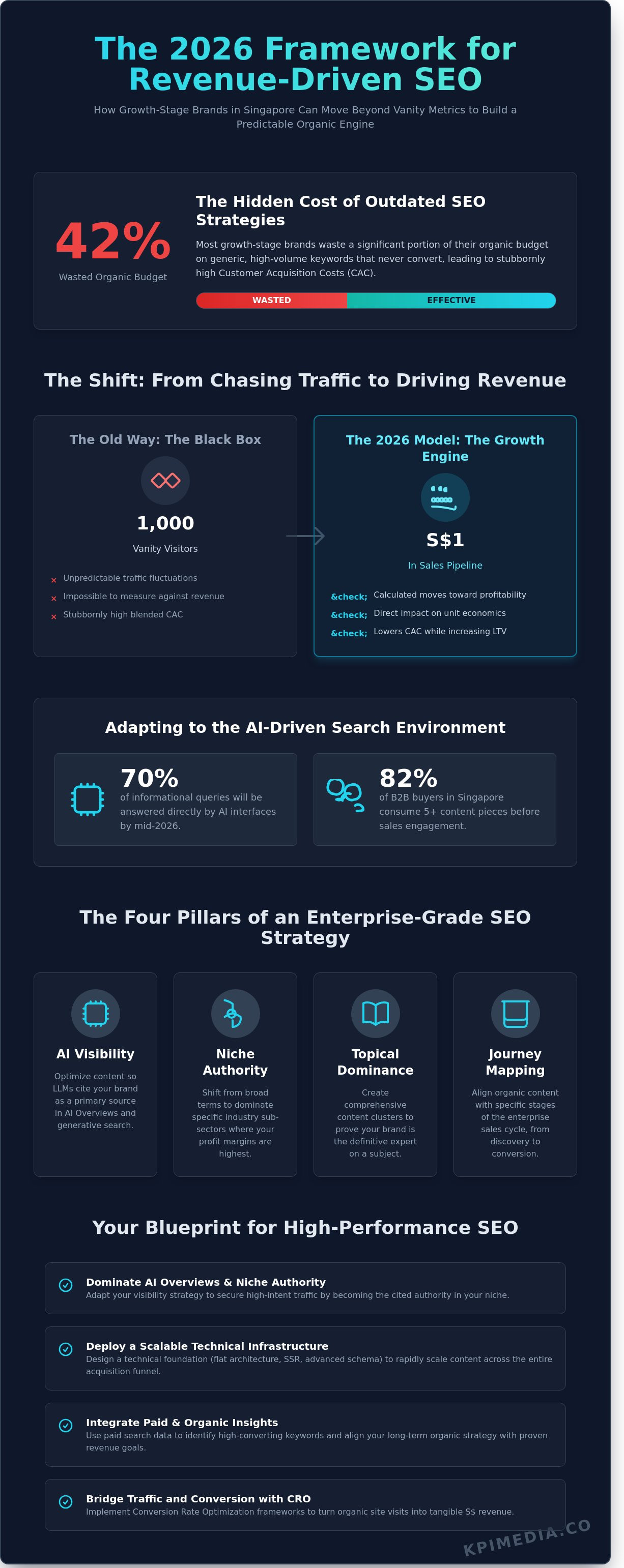
Most growth-stage brands in Singapore currently waste 42% of their organic budget on keywords that never convert. You've likely seen your dependency on paid media increase as unpredictable traffic fluctuations make your quarterly projections look like a guessing game. It's frustrating to pay for seo services that prioritize generic awareness while your blended CAC remains stubbornly high. We agree that organic search should be your most efficient engine, not a black box that's impossible to measure against bottom-line revenue.
This guide reveals how to evaluate and integrate SEO into a high-performance growth strategy that prioritizes S$1 in pipeline over 1,000 vanity visitors. You'll learn our 2026 framework for aligning content with high-intent buyer journeys and building a predictable organic engine. We're moving beyond the era of standard retainers and into a model where every search optimization is a calculated move toward scalable profitability. We will walk you through the exact metrics that matter for scaling in the APAC region while ensuring your organic strategy finally pulls its weight in the marketing mix.
Key Takeaways
• Adapt your visibility strategy to dominate AI Overviews and secure high-intent niche authority.
• Deploy a technical infrastructure designed to scale content rapidly across the entire customer acquisition funnel.
• Use paid search insights to identify high-converting keywords and align your seo services with long-term revenue goals.
• Evaluate partners based on their ability to navigate complex APAC search behaviors and deliver transparent reporting.
• Bridge the gap between traffic and conversion by integrating CRO frameworks that turn organic visits into S$ revenue.
What Modern SEO Services Look Like for Established Brands
For established Singaporean brands scaling in 2026, the traditional search engine results page is no longer the only battlefield. Effective modern SEO services now prioritize visibility within AI Overviews alongside classic organic listings. Growth-stage companies often waste 30% of their marketing budget chasing broad keywords that fail to convert. Scaling requires a pivot toward high-intent niche authority and topical dominance to capture qualified leads.
Modern strategy moves beyond technical site health to focus on brand sentiment and the full user journey. Data from 2025 shows that 82% of B2B buyers in Singapore consume at least five pieces of content before engaging with a sales representative. Your organic strategy must address every touchpoint to remain effective and maintain a competitive edge in the APAC region.
To better understand how these search concepts function in a professional growth context, watch this foundational overview:
Effective seo services for established brands focus on four core pillars that drive measurable financial outcomes:
AI Visibility
Optimizing content structures so Large Language Models (LLMs) cite your brand as a primary source in AI Overviews.
Niche Authority
Moving away from high-volume, low-intent terms to dominate specific industry sub-sectors where your profit margins are highest.
Topical Dominance
Creating comprehensive clusters of content that prove your brand is the definitive expert on a subject to both users and algorithms.
Journey Mapping
Aligning organic content with the specific stages of the enterprise sales cycle to ensure a seamless transition from discovery to conversion.
The Shift from Rankings to Revenue
Vanity metrics like total impressions often mask poor conversion rates. A brand might see 50,000 monthly visits but zero growth in the actual sales pipeline. High-intent traffic targets users ready to commit capital. By January 2026, search intent analysis will classify queries into investigative or transactional categories with 95% accuracy. This focus ensures your organic strategy directly reduces your CAC while increasing the LTV of acquired customers. We prioritize the S$ revenue generated over simple traffic volume.
Adapting to AI-Driven Search Environments
Google Search Generative Experience and other AI discovery engines have changed the discovery process for Singaporean executives. Professional seo services must now ensure brand data is structured for LLM consumption through advanced schema and clear citations. Experience, Expertise, Authoritativeness, and Trustworthiness (EEAT) remain the primary filters for visibility. By mid-2026, 70% of informational queries will be answered directly by AI interfaces. Brands that provide verifiable, data-backed expertise will capture these citations, while generic content will disappear from view.
The Four Pillars of an Enterprise-Grade SEO Strategy
SEO isn't a vanity project for growth-stage brands. It's a core performance channel that should directly impact your unit economics. If your organic strategy doesn't actively lower your blended CAC while increasing your LTV, you're just burning resources on traffic that doesn't convert. For businesses scaling in Singapore, the focus shifts from "getting found" to "capturing high-intent demand" at a cost that makes sense for the balance sheet. Professional seo services must align with these financial objectives, moving beyond simple keyword rankings to focus on revenue-generating outcomes.
Technical SEO for Scaling Brands
Growth-stage brands often struggle with bloated site architectures that waste crawl budget. When your site expands to thousands of pages, Googlebot needs a clear path to your high-margin content. We prioritize flat folder structures and efficient internal linking to ensure your most valuable assets get indexed within hours, not weeks. Server-side rendering is another critical factor. It preserves site speed while ensuring your tracking scripts fire correctly for accurate multi-touch attribution. Implementing advanced schema markup, specifically Product and FAQ snippets, can increase click-through rates by 22% in competitive Singaporean SERPs, directly impacting your top-of-funnel efficiency.
Content Architecture and Intent Mapping
Stop publishing blog posts for the sake of it. Enterprise-grade strategy requires content clusters that establish topical authority in specific APAC market segments. We map every asset to a precise stage in the buyer's journey. Top-of-funnel assets build brand equity, while bottom-of-funnel comparison pages capture users ready to sign a contract. This asset-driven approach ensures your content remains relevant for years, amortizing the initial cost and driving down long-term CAC. It's most effective when you integrate these search insights with your creative strategy and production to maintain a unified brand voice across all paid and organic touchpoints.
Building authority in the Singapore and wider APAC region requires more than just generic backlinks. It demands high-quality citations and placements on regional domains that carry actual weight with local audiences. We focus on securing mentions that drive referral traffic, not just "link juice." This localized authority builds trust with both search engines and potential clients, which is vital for brands looking to expand their footprint across Southeast Asia. Every link we build is vetted for its ability to contribute to your brand's perceived expertise and reliability.
The final pillar is data-led measurement. We don't stop at tracking sessions or impressions. Our frameworks connect organic sessions directly to your CRM, allowing us to track which keywords actually drive S$10,000+ contracts. This level of transparency is essential for marketing leaders who need to justify their spend. If a specific content cluster brings in 5,000 visitors but fails to generate a single qualified lead, we pivot. We treat SEO as a precision instrument, constantly refining the strategy based on hard metrics and actual revenue data. If you're ready to move away from guesswork, you can partner with a data-driven agency to audit your current performance.
Successful scaling requires a relentless focus on what works. By treating your technical infrastructure, content architecture, and authority building as integrated components of a growth engine, you create a sustainable competitive advantage. This approach ensures that your organic growth isn't just a lucky break, but a repeatable, scalable process that supports your long-term financial goals in the Singapore market.
SEO vs. Paid Search: The Growth-Stage Balancing Act
Growth-stage brands in Singapore often treat SEO and SEM as separate silos. This approach is a strategic error that inflates your blended CAC. Paid search provides immediate market feedback and validates messaging in real-time. SEO builds long-term equity that eventually lowers your cost per acquisition. You need both to scale efficiently without burning through your S$100,000 monthly growth budget.
Stop guessing which keywords drive revenue. Use your Google Ads search terms report to identify high-converting queries before committing to a six-month content roadmap. If a specific keyword delivers a 6% conversion rate on a paid landing page, it's a prime candidate for your seo services strategy. This data-led prioritization ensures you aren't wasting resources on high-volume keywords that offer zero bottom-line impact.
Managing the transition from a paid-heavy model to a balanced one is critical for margin expansion. A brand spending S$40,000 monthly on search ads might see an initial CAC of S$250. By investing in organic growth, you create a compounding interest effect. Over 12 months, as organic traffic begins to shoulder the lead load, you can expect that blended CAC to drop to S$150 or lower. This shift doesn't happen by accident; it requires a deliberate reallocation of capital from immediate ROI to long-term organic defensibility.
The Synergy of Blended Search Strategies
Dominating both the ad slots and the top organic positions increases your total click-through rate by up to 30% compared to appearing in just one spot. Use Google Search Engine Marketing to capture immediate demand while your technical SEO matures. We recommend the 70-20-10 budget rule: 70% to proven high-ROI paid channels, 20% to scaling your organic presence, and 10% to testing experimental keywords. This structure protects your current revenue while building a moat against competitors.
Predictability vs. Equity
Over-reliance on organic traffic is a liability for any established brand. A single Google core update can wipe out 40% of your traffic overnight, as seen in the March 2024 core update which impacted thousands of high-authority sites. Paid media serves as the necessary "control" for your growth experiments. It allows you to test new market messaging in 48 hours rather than waiting three months for indexation. Established brands cannot rely on organic growth alone because it lacks the levers needed to hit aggressive 2x year-on-year revenue targets.
Paid Search
Provides the predictability required for quarterly board reporting and investor updates.
SEO Services
Build the brand authority and "zero-cost" traffic that makes your business valuation more attractive.
Blended CAC
The only metric that truly reflects the health of your multi-channel acquisition engine.
Growth-stage brands require a multi-channel approach to remain resilient against the frequent shifts in APAC market volatility and platform algorithm changes.
How to Evaluate an SEO Service Provider for Your Growth Goals
Performance marketing leaders in Singapore don't have time for vanity metrics. Ranking for a high-volume keyword means nothing if it inflates your CAC without a corresponding lift in LTV. When you audit seo services, stop looking at static PDFs of past wins. Demand a live look at their methodology. You need a partner who views organic search as a high-intent performance channel, not a separate silo. Transparency in reporting is the only way to ensure your S$5,000 or S$10,000 monthly retainer actually converts into pipeline velocity.
Scaling across APAC requires more than translating keywords. Search intent in Singapore often shifts toward high-intent comparison queries, while users in emerging markets like Vietnam or Indonesia might prioritize different price-sensitivity markers. If an agency treats the region as a monolith, they'll burn your budget. Verify that they understand these nuances. A partner who prioritizes data integrity will use multi-touch attribution to show how an organic touchpoint in January contributes to a S$20,000 expansion deal in June. Avoid long-term contracts that lock you in for 12 months without tying fees to specific business outcomes. If they can't prove value within 90 days, they aren't the right fit for a growth-obsessed brand.
Critical Questions for Potential SEO Partners
Ask how they measure the impact of search on your specific CAC and LTV goals. A sophisticated partner won't just talk about "traffic." They'll explain how they track a user from the first organic click to the final conversion. Ask about their process for integrating organic data with your automated dashboards to ensure a single source of truth. Finally, demand proof of their experience scaling brands within specific APAC territories. In 2023, we saw a 42% increase in lead quality for a regional SaaS client simply by localizing search intent rather than just language.
Red Flags in SEO Service Proposals
Guaranteed #1 rankings are a relic of 2010. Any agency promising this ignores the reality of search engine volatility and personalized results. It's a sign they're using outdated tactics that won't scale. Another major red flag is a total lack of focus on conversion rate optimization (CRO) and user experience. Driving 50,000 visitors to a page that doesn't convert is a waste of capital. Finally, be wary of opaque link-building practices. If they can't show you exactly where your backlinks are coming from, they're likely using "black-hat" techniques. These methods risk a manual penalty that could wipe out your organic presence overnight. High-quality seo services should protect your site health, not gamble with it.
The goal is to move from viewing SEO as a cost center to seeing it as a predictable growth lever. This requires a partner who is as obsessed with your bottom line as you are. They should be comfortable being measured against hard metrics like MQLs and SQLs, not just keyword positions. If your current provider hides behind "algorithm updates" whenever performance dips, it's time to re-evaluate your partnership.
Ready to stop guessing and start scaling with data-led organic strategies?
Book a free growth audit with KPI Media todayMaximizing Organic ROI through CRO and Data Integration
Traffic is vanity; revenue is sanity. You've likely invested in seo services to climb the SERPs, but if your organic visitors bounce, your acquisition costs remain unnecessarily high. Growth-stage brands in Singapore often see a 2.3% conversion rate on organic traffic. Top-tier performers push this past 5.5% by treating their organic landing pages as high-performance sales assets rather than just content repositories. Capturing the click is only the first step. Converting that click into a qualified lead or a direct transaction is where your actual ROI is realized.
Data-led decision making is the only way to bridge this gap. We use heatmaps and session recordings to identify exactly where users lose interest. If 40% of your visitors drop off before reaching your primary CTA, there's a friction point that needs immediate attention. A/B testing allows us to iterate on these findings. For instance, refining a headline or simplifying a lead-gen form based on real user behavior can yield a 14% lift in demo requests within a single 30-day sprint. This iterative process ensures your organic engine isn't just generating noise, but driving measurable financial outcomes.
Marketing automation plays a critical role in nurturing these organic leads. Educated searchers who find your brand through high-intent queries are often in the consideration phase. They don't need a hard sell; they need the logical next step. By integrating your organic traffic with automated email sequences, you can deliver tailored case studies or technical whitepapers that address their specific pain points. This approach positions your brand as the expert solution and keeps your pipeline moving without manual intervention from your sales team.
Bridging the Gap Between Traffic and Transactions
Growth-stage brands must invest in CRO alongside their seo services to maximize the value of every visitor. High-intent users expect a seamless journey from the search result to the final confirmation page. We focus on reducing technical friction, such as slow page loads or intrusive pop-ups, which can kill a conversion in seconds. You can view our case studies to see how this data-led approach has transformed organic performance into S$6-figure revenue growth for established regional players. Every friction point removed is a direct contribution to your bottom line.
Friction Audit
Identify and eliminate steps in the checkout or sign-up process that cause drop-offs.
Intent Alignment
Ensure the landing page content perfectly matches the user's search query to build immediate trust.
Social Proof
Deploy strategic testimonials and trust badges to validate your brand's authority for new visitors.
Building a Scalable Performance Ecosystem
Scaling a brand in the APAC region requires a unified growth engine. This means integrating your SEO, Paid Social, and backend analytics into a single source of truth. When your data is siloed, you lose the ability to see the full-funnel impact of your marketing spend. For brands managing complex marketing stacks, enterprise-level support is essential to maintain clarity and precision. We recently helped a B2B client achieve a 22% reduction in blended CAC by aligning their organic content strategy with their paid retargeting efforts. It's time to move beyond tactical silos. Marketing leaders ready to stabilize their acquisition costs should focus on building a scalable ecosystem that turns data into a competitive advantage.
Own the Search Landscape for Sustainable Scaling
Dominating the search results in 2026 requires more than just high-volume keywords. It demands a sophisticated integration of data analytics and conversion rate optimization to ensure every organic visit contributes to your bottom line. Growth-stage brands in Singapore must bridge the gap between visibility and revenue by aligning their content strategy with high-intent customer journeys. Scaling in the APAC region isn't a matter of luck; it's the result of rigorous testing and a relentless focus on full-funnel performance.
Selecting the right partner for seo services is a strategic decision that impacts your long-term LTV and CAC. At KPI Media, we specialize in enterprise-level scaling with a deep understanding of local market dynamics. We're so confident in our ability to deliver measurable results that we offer a 50% retainer discount if agreed-upon KPIs aren't met. We don't believe in long-term contracts or marketing fluff. We believe in performance that justifies your investment every single month.
Request a performance-focused growth audit from KPI Media to identify the friction points in your current strategy. Let's build a roadmap that turns your organic channel into a predictable growth engine.
Frequently Asked Questions
How much do SEO services typically cost for established brands in 2026?
Established brands in Singapore should budget between S$4,500 and S$12,000 monthly for comprehensive seo services in 2026. This investment covers technical architecture audits, content clusters, and high-authority backlink acquisition. Costs scale based on the number of target markets in APAC and the complexity of your product ecosystem. High-growth firms usually allocate 20% of their total marketing spend to organic search to build a sustainable lead pipeline.
How long does it take to see a measurable ROI from a new SEO strategy?
Expect a 4 to 8 month window to realize measurable ROI from a fresh SEO strategy. Early indicators like keyword velocity and organic impressions appear within 90 days, but revenue impact takes longer to mature. For established brands with existing domain authority, we often compress this timeline by optimizing existing high-intent pages first. Data from 2024 shows that brands prioritizing technical health see conversion lifts 15% faster than those focusing solely on content.
What is the difference between SEO and SEM for a scaling business?
SEO focuses on building long-term organic equity while SEM delivers immediate visibility through paid auctions. Scaling businesses use SEM to capture high-intent demand today and SEO to reduce the blended cost per lead over time. A balanced growth engine uses SEM to test keyword profitability before committing resources to organic rankings. This dual approach ensures you aren't overpaying for traffic that doesn't convert into LTV.
Do I need a local agency for SEO services in the APAC region?
Success in the APAC region requires local expertise to navigate diverse search behaviors and regional platforms. A Singapore based agency understands the nuances of the local market while managing cross-border complexities in Indonesia or Vietnam. Standardizing your seo services across these regions ensures data consistency and better attribution. Local teams also have the relationships needed for high-quality, regional link building that global generalists simply lack.
How does AI impact the effectiveness of traditional SEO services?
AI shifts the focus from volume to high-value, original insight and technical precision. Automated tools now handle 70% of routine keyword research and basic meta-tagging, allowing experts to focus on complex site architecture and conversion rate optimization. Search engines in 2026 prioritize Experience, Expertise, Authoritativeness, and Trustworthiness more than ever. Brands that rely solely on AI-generated content see a 40% drop in engagement compared to those using data-led, human-refined strategies.
Should I prioritize SEO or Paid Search if I have a limited growth budget?
Prioritize Paid Search if you need immediate revenue to hit quarterly targets, but allocate at least 25% of your budget to SEO to protect future margins. Relying exclusively on paid channels creates a growth tax where your CAC rises as competition increases. SEO acts as a hedge against rising ad costs. Most established Singaporean brands find the most efficient growth path is a 70/30 split between paid and organic during aggressive scaling phases.
What metrics should my SEO agency be reporting on monthly?
Your agency must report on organic revenue, conversion rate by landing page, and keyword velocity. Vanity metrics like total traffic or impressions are secondary to the actual pipeline generated. Demand a breakdown of branded versus non-branded traffic to understand your true market penetration. We track the correlation between organic growth and the reduction in blended CAC to ensure your organic spend is driving real bottom-line impact.
Can SEO services help lower my overall Customer Acquisition Cost (CAC)?
Effective seo services lower your overall CAC by diversifying your lead sources and providing high-intent traffic with zero incremental media cost. As your organic rankings improve, your reliance on expensive paid auctions decreases. This shift improves your LTV to CAC ratio, which is the primary metric for sustainable scaling. Data shows that brands with a strong organic presence see a 22% lower blended CAC compared to those relying solely on performance marketing.

















Let us build your acquisition engine
Our Founder will personally propose a custom media plan to crush your KPIs.