


Search Engine Marketing (SEM) in 2026: The Growth Leader’s Strategic Guide
Your customer acquisition cost is climbing. The $500 daily budget that delivered last quarter is now bleeding cash, and scaling your SEM strategy across Southeast Asia feels more like a gamble than a calculated expansion. In the competitive Singapore market, relying on last year's playbook is a direct path to inefficient spend and stalled growth. When every dollar matters, you can't afford a strategy built on hope.
The problem isn't the channel; it's the outdated approach. Vague agency reports and a focus on broad, expensive keywords won't deliver the predictable pipeline you need. To win in 2026, you need a system—a data-driven machine built for one purpose: converting high-intent users into high-LTV customers at a sustainable cost. It requires precision, transparency, and a deep understanding of multi-market dynamics.
This guide provides that system. We're giving you the strategic framework for mastering high-performance search engine marketing. You will learn the mechanics to stabilize your CAC, unlock predictable sales volume, and build a repeatable model for scaling your brand profitably across the Asia-Pacific. Let's get to work.
Key Takeaways
- Discover how mastering Quality Score is the critical lever to reduce your cost per click and stabilize customer acquisition costs in the 2026 ad auction.
- Learn when to strategically increase your sem investment to capture immediate demand and bridge critical gaps while your long-term SEO strategy matures.
- Get the actionable roadmap for scaling across the Asia-Pacific, starting with the foundational audit of your data and tracking infrastructure.
- Move beyond vanity metrics by learning to measure paid search performance against revenue outcomes and critical business KPIs.
What is Search Engine Marketing (SEM) in 2026?
In 2026, Search Engine Marketing is no longer just about bidding on keywords. It’s the strategic deployment of paid media to capture high-intent demand precisely at the moment of need. The discipline has evolved far beyond its manual origins; modern Search Engine Marketing (SEM) now leverages sophisticated, signal-based audience targeting powered by machine learning to drive predictable bottom-funnel performance. It's the most reliable channel for converting active demand into measurable revenue.
For a clear breakdown of the fundamentals, this overview covers the essentials:
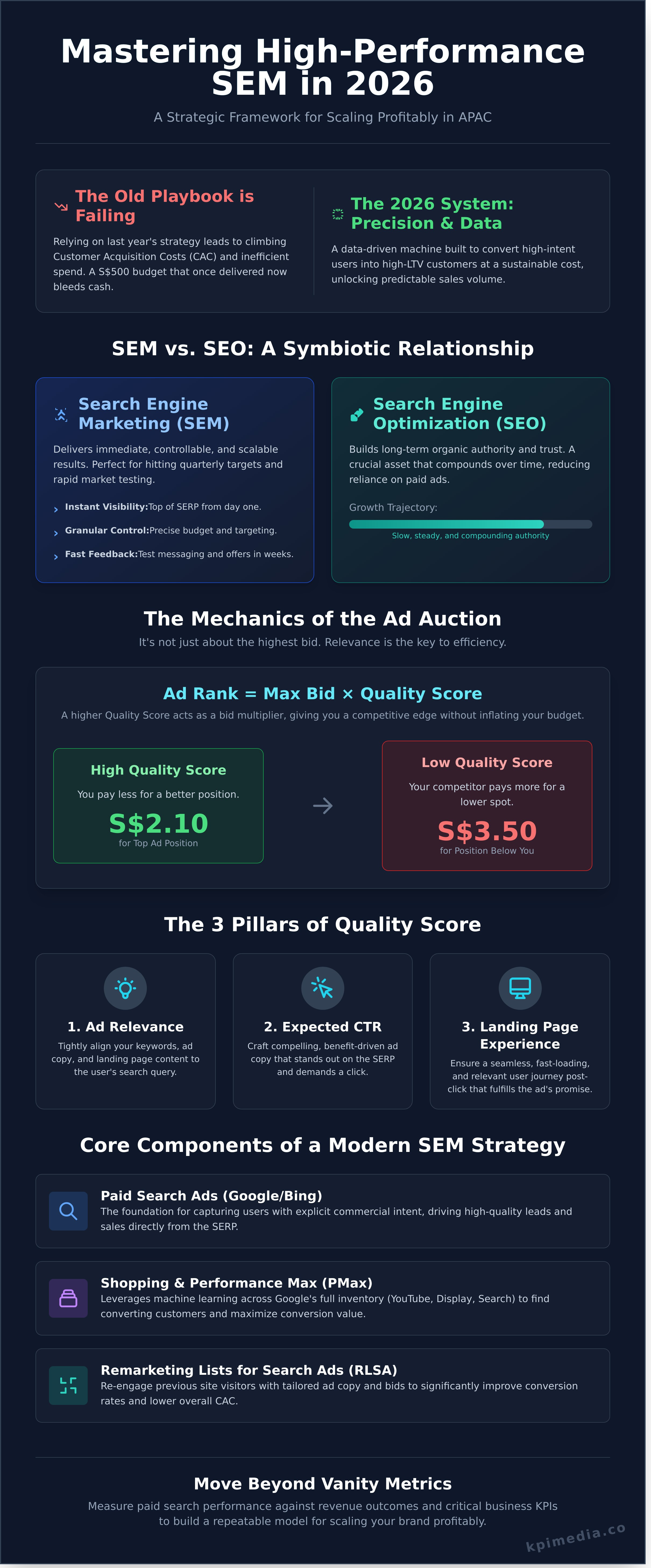
For a mature growth-stage brand, SEM and SEO are not competitors-they are two sides of the same coin. SEO builds long-term organic authority and trust, a crucial asset that compounds over time. SEM, however, delivers immediate, controllable, and scalable results. It’s the engine you activate to hit quarterly sales targets, dominate key search terms, and defend your market share against aggressive competitors.
The Core Components of Modern SEM
A successful sem strategy integrates several key pillars to maximize impact and efficiency:
- Paid Search Ads: This is the foundation. Text-based ads on Google and Bing allow you to capture users with explicit commercial intent, driving high-quality MQLs and sales directly from the search engine results page (SERP).
- Shopping and Performance Max (PMax): Leveraging Google's full ad inventory, these automated campaign types use machine learning to find converting customers across YouTube, Display, and Search, optimizing for maximum reach and conversion value.
- Remarketing Lists for Search Ads (RLSA): This critical component closes the loop. It allows you to re-engage previous site visitors with tailored ad copy and bids, significantly improving conversion rates and lowering your overall Customer Acquisition Cost (CAC).
Why SEM is Essential for Growth-Stage Brands
For brands focused on scaling, SEM provides a level of control and speed that organic channels cannot match:
- Instant Visibility: In hyper-competitive markets like Singapore and the broader APAC region, you can’t afford to wait months for SEO to take effect. SEM places your brand at the top of the SERP from day one.
- Granular Budget Control: Allocate your marketing spend with precision. Set daily budgets down to the last $, target specific postcodes, or focus ad spend on your most profitable customer segments.
- Rapid Market Testing: Launching a new feature or expanding into a new market? SEM provides an immediate feedback loop. Test messaging, pricing, and product-market fit with a small budget and get actionable data within weeks, not quarters.
The Mechanics of a High-Performance SEM Engine
Success in search engine marketing is no longer a simple bidding war. Today’s ad auctions on Google and Bing are sophisticated, real-time marketplaces where relevance and data precision win. To drive scalable growth, you must master the mechanics that determine cost, placement, and ultimately, ROI. This means moving beyond manual optimizations and embracing an AI-driven approach that aligns every dollar spent with tangible business outcomes.
The engine's core is Google’s Ad Rank, a calculation that rewards advertisers for more than just a high bid. A superior Quality Score can dramatically lower your cost per click (CPC). For instance, a high score might mean you pay $2.10 for a top position, while a competitor with poor ad relevance pays $3.50 for the spot right below you. This efficiency is why we obsess over:
- Ad Relevance: Tightly aligning keywords, ad copy, and landing page content.
- Expected CTR: Crafting compelling copy that demands a click.
- Landing Page Experience: Ensuring a seamless, fast, and relevant user journey post-click.
Mastering the Auction Dynamics
The interplay between your bid and Quality Score is fundamental to effective sem. A higher score acts as a bid multiplier, giving you a competitive edge without inflating your budget. For a deeper analysis, this comprehensive guide to SEM breaks down bidding strategies in detail. In today's privacy-focused landscape, enriching your campaigns with first-party data-like CRM lists or high-LTV customer segments-further sharpens your bidding precision, telling the algorithm exactly which leads are most valuable to your business.
Integrating AI and Automation
The evolution from manual bidding to automated strategies like Value-Based Bidding (VBB) marks a critical shift. Instead of optimizing for low-cost conversions, VBB optimizes for high-value revenue, directly impacting your bottom line. AI-driven campaigns like Performance Max (PMax) have accelerated this change, but they demand strategic oversight. Success with PMax isn’t about relinquishing control; it’s about feeding the algorithm with high-quality inputs. This includes powerful creative assets, refined audience signals, and robust conversion tracking. This new reality requires a move toward automated dashboards that provide real-time visibility into performance, enabling you to make swift, data-led decisions.
SEM vs SEO: Strategic Budget Allocation for Scale
For growth-obsessed brands, the SEM vs. SEO debate isn't about choosing one over the other. It's about strategic resource allocation. Your marketing dashboard reveals the truth: you need both immediate traction and long-term, defensible growth. The key is to make them work in concert, creating a powerful flywheel effect where one channel's success fuels the other.
Many leaders see paid and organic search as siloed functions. However, understanding What is Search Engine Marketing (SEM) shows it's a discipline that can encompass both. A unified strategy prevents budget cannibalization and unlocks compounding returns. The visibility from a strong paid presence often boosts trust and click-through rates on your organic listings-a "halo effect" that your dashboard can track through blended CTR metrics.
Efficiency vs. Velocity
The core trade-off is simple. SEM delivers velocity; SEO builds efficiency. Paid search provides immediate traffic and lead flow, but the tap turns off the moment you stop paying. SEO is an asset that generates compounding, high-margin returns over time, but requires patience. When you have aggressive quarterly revenue targets to hit, a strategic injection of sem budget is the most direct lever you can pull. The goal is to balance the marketing mix: use paid channels to capture immediate demand while investing in organic to lower your blended Customer Acquisition Cost (CAC) over the long term.
Data Synergy Between Channels
Your paid search campaigns are a real-time data laboratory for your entire search strategy. By analyzing performance, you can de-risk your SEO investment and accelerate organic growth. This is where a unified approach delivers a clear competitive advantage. Key tactical synergies include:
- Keyword Intelligence: Identify high-converting, bottom-funnel keywords from your Google Ads data. Prioritize these proven terms in your SEO content roadmap to target traffic that has a higher probability of converting.
- Brand Defense: Use paid search to protect your branded terms. Competitors in the Singapore market are actively bidding on your brand name to siphon off high-intent customers. A defensive paid campaign ensures you control the top of the SERP.
A fragmented approach leaves money on the table. View our Search Engine Marketing services to see how we build a unified strategy for scale.
Executing a Scalable SEM Roadmap for APAC
A marketing dashboard reveals the "what." A scalable roadmap defines the "how." For growth-stage brands in Asia-Pacific, moving from insight to execution requires a disciplined, iterative framework. This is not about finding a single silver bullet; it’s about building a systematic engine for growth. A successful sem strategy is built on a foundation of clean data and relentless optimization.
We execute growth using a five-step process designed to de-risk investment and accelerate returns:
- Step 1: Audit data infrastructure. We start by verifying tracking accuracy. Before spending a single dollar, we ensure every conversion is captured and every metric is reliable.
- Step 2: Conduct deep market research. We go beyond simple keyword translation to uncover user intent and competitive gaps in each target market, from Singapore to Indonesia.
- Step 3: Develop high-converting landing pages. We build and test landing pages tailored to specific personas and pain points, ensuring message match from ad to conversion.
- Step 4: Launch structured ad experiments. We systematically test ad copy, creative, and offers to identify winning combinations that resonate with local audiences and drive action.
- Step 5: Scale spend methodically. Once we establish a positive ROAS and hit contribution margin targets, we scale budgets confidently, pouring fuel on what’s already working.
Localization Strategies for Asia-Pacific
Success in APAC is impossible without deep localization. This means navigating language nuances-like formal versus informal tones in Japan-and cultural preferences. Bidding strategies must also adapt. A $40 target CPA in Singapore might equate to a $15 target in the Philippines due to different purchasing power. Your channel mix should also evolve, incorporating platforms like TikTok for brand awareness and LinkedIn for high-value B2B leads across the region.
Advanced Tracking and Attribution
Privacy changes are rendering client-side tracking obsolete. We implement server-side tracking to ensure near-perfect data capture, protecting your budget from signal loss. It’s also critical to move beyond last-click attribution to a multi-touch model that properly values each touchpoint in the buyer journey. We leverage automated dashboards to unify data from all channels, providing a single source of truth for strategic decisions.
The KPI Media Approach: Precision Over Volume
A marketing dashboard filled with clicks and impressions looks busy, but it doesn't drive revenue. We reject vanity metrics. Our entire approach is built around the financial outcomes that matter to your C-suite: stabilizing Customer Acquisition Cost (CAC), increasing Lifetime Value (LTV), and accelerating pipeline growth. We tie every campaign, test, and optimization directly to your bottom line because we believe true performance marketing is an investment, not an expense.
This is the core of our Expert Growth Partner model. We operate as a specialized extension of your internal team, embedding our expertise into your daily operations. Our success is tied directly to yours through a performance guarantee: we earn our full retainer only when you hit your agreed KPI. It’s this deep alignment that has enabled us to help enterprise brands across APAC build predictable revenue engines through disciplined sem and full-funnel paid media execution. We are as obsessed with your unit economics as you are.
Our Proven Framework for Growth
Sustainable growth isn't an accident; it's a system. Our framework is built on two pillars: continuous testing and radical transparency. We relentlessly optimize every stage of the funnel and provide complete clarity in our reporting. We also operate without long-term contracts. Our performance is our contract. Explore our case studies to see how we deliver measurable results for growth-obsessed brands in the region.
Ready to Scale Your Performance?
Scaling your paid media effectively starts with a clear diagnosis of what's working and what isn't. The process is straightforward:
- Comprehensive Audit: We begin with a deep-dive audit of your current paid media channels, from sem to paid social, to identify critical gaps and opportunities.
- Customized Roadmap: We build a data-backed roadmap for your next phase of growth, outlining the exact strategies to hit your revenue targets.
If you're ready to move beyond vanity metrics and build a true performance marketing engine, review our pricing and performance models to see how we can partner with you.
Scale Your SEM Engine for 2026
The path to market leadership in 2026 is clear. Success requires moving beyond isolated campaigns and building an integrated, high-performance growth engine. This means prioritizing precision over volume and strategically balancing your SEO and sem budgets to ensure every dollar drives measurable, full-funnel impact.
A winning strategy, however, demands flawless execution. As specialists for APAC's most ambitious growth-stage brands, we translate this strategy into tangible results with full transparency. Our confidence is backed by our commitment: if we miss the KPI we agreed for the month, you only pay 50% of that month's retainer. It's accountability, built-in.
See what a data-driven growth partner can do for your bottom line. Get Started with a High-Performance SEM Audit and let's build your roadmap to market dominance.
Frequently Asked Questions
What is the average ROI for SEM campaigns in the APAC region?
While industry benchmarks often cite a 3:1 to 4:1 Return on Ad Spend (ROAS), this metric is superficial. High-growth brands in APAC focus on the LTV:CAC ratio. A successful SEM campaign acquires customers at a cost that supports a 3:1 or greater LTV to CAC, ensuring every dollar drives profitable, long-term growth. Your target ROI must be tied to your unique unit economics, not a generic average.
How much should a growth-stage brand spend on SEM monthly?
For growth-stage brands in Singapore, an effective starting budget typically falls between $10,000 and $30,000 per month. This investment is not arbitrary; it's calibrated to acquire sufficient data for validating channels and optimizing campaigns. The goal is to fund a scalable acquisition model where budget is dictated by your lead velocity goals and target Cost Per Acquisition, not a fixed number.
Is Google Ads still the best platform for SEM in 2026?
Google Ads will remain the dominant platform for capturing high-intent search, making it an essential channel. However, the "best" approach is a diversified portfolio. A mature strategy integrates Microsoft Ads to reach different demographics and leverages vertical-specific platforms like Capterra for B2B buyers. Sole reliance on Google is a strategic risk; resilient growth requires optimizing spend across all high-intent channels relevant to your audience.
How long does it take to see results from a new SEM campaign?
You will see initial data like impressions and clicks within 24 hours, but these are not business results. A new campaign requires a 30 to 90-day period to generate meaningful outcomes. The first month is dedicated to rapid testing and data acquisition. The following months are for optimizing toward a target Cost Per Acquisition and scaling proven funnels. Predictable results are built on disciplined, iterative optimization, not overnight wins.
What is the difference between SEM and PPC?
Search Engine Marketing (SEM) is the overall discipline of driving traffic from search engines. It encompasses two core components: Search Engine Optimization (SEO) for organic traffic and Pay-Per-Click (PPC) for paid traffic. PPC is the specific advertising model where you pay for each click on your ad. In short, SEM is the complete strategy, and PPC is the primary paid tactic used to execute it.
How do I know if my SEM agency is performing well?
Look past vanity metrics like clicks or CTR. A high-performing SEM agency delivers tangible business outcomes. Are they consistently hitting or beating your target Cost Per Lead and Customer Acquisition Cost? Is lead quality improving month-over-month? Your agency must provide transparent dashboards that connect ad spend directly to sales pipeline and revenue. If their reports do not focus on your bottom line, they are not performing.
Can SEM help with B2B lead generation on LinkedIn?
This confuses two distinct channels. SEM captures active demand on search engines like Google when a prospect is actively looking for a solution. LinkedIn Ads, while a core B2B paid media channel, operates on a social platform to create demand by targeting users based on professional data. A complete strategy uses both: SEM to capture existing intent and LinkedIn to generate new intent within your ideal customer profile.





.webp)









Let us build your acquisition engine
Our Founder will personally propose a custom media plan to crush your KPIs.