


Maneuver: The Strategic Guide to Outpacing Your Competition
Your competitors are launching. Your CAC is climbing. Your marketing feels reactive-a series of tactical sprints that never gain strategic ground. In the hyper-competitive Singaporean SaaS landscape, playing defense is a slow death. Winning requires more than just a bigger budget or another A/B test. It demands a deliberate, calculated maneuver-a strategic shift that redefines the competitive space and creates an unfair advantage.
This isn't about small optimizations; it's about engineering disproportionate growth. Forget the dictionary definition. We're handing you the operational playbook. This guide breaks down the framework for identifying high-leverage opportunities, designing a market-disrupting move, and executing with precision. You will walk away with the confidence and the process to stop chasing the market and start leading it, transforming calculated risks into measurable market share.
Key Takeaways
- Move beyond brute force competition by understanding strategy as the application of intelligence to gain a decisive market advantage.
- Uncover the 4 core components of any winning strategy, starting with the "Asymmetric Insight" that allows you to see opportunities your competitors miss.
- Learn a repeatable 5-step framework to design and launch a strategic maneuver that seizes valuable and defensible market positions.
- Connect your strategic moves to hard metrics to ensure they generate scalable growth, not just market noise.
What is a Strategic Maneuver? (Beyond the Dictionary Definition)
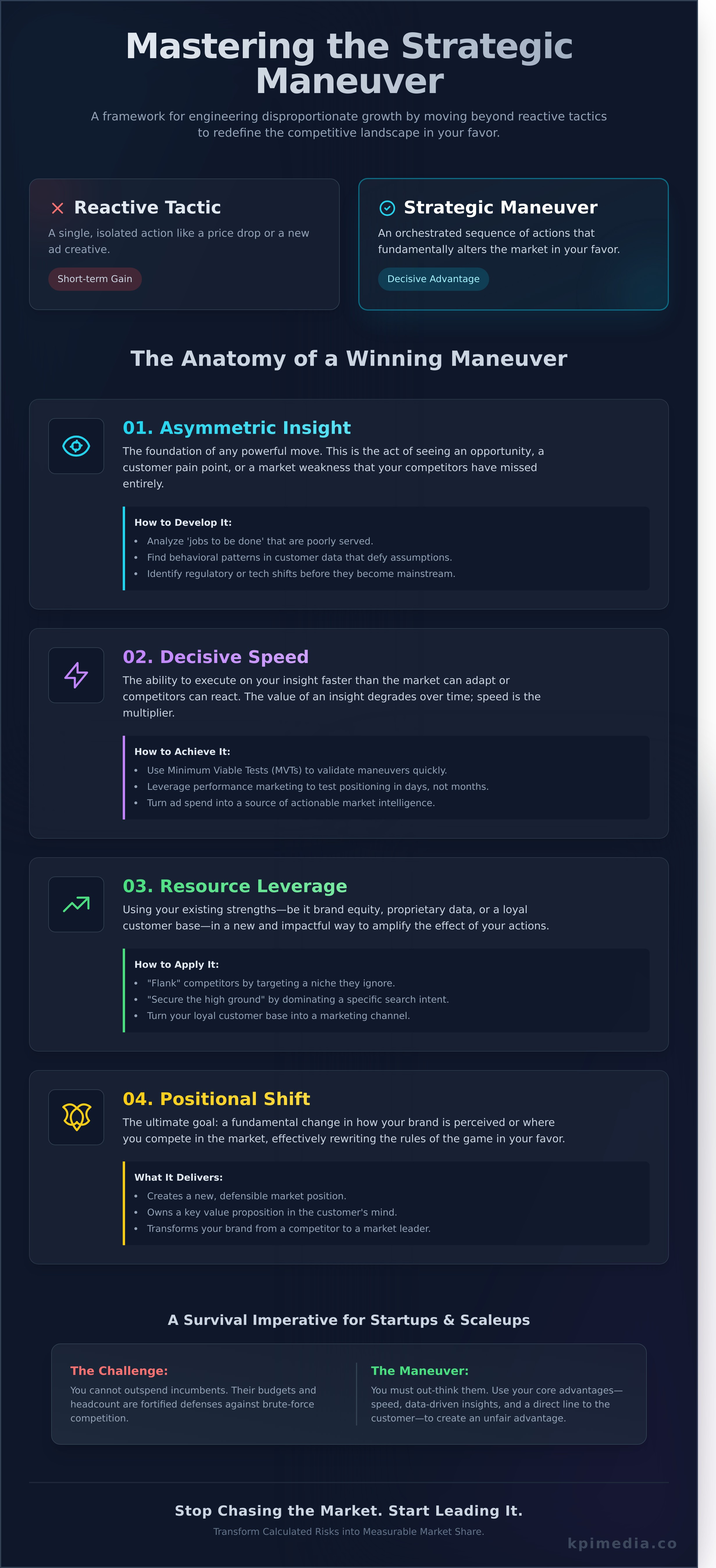
A maneuver is more than a single, skilled move. In business, it’s a calculated sequence of actions designed to gain a decisive competitive advantage. While a tactic might be a single price drop or a new ad creative, a strategic maneuver is an orchestrated series of tests and optimizations that fundamentally alters the competitive landscape in your favor. It’s about achieving a significant outcome with asymmetric effort-using intelligence to bypass an opponent’s strengths and strike at their weaknesses.
To see how this principle shifts the focus from simply competing to strategically outplaying, consider this breakdown:
From Military Roots to Market Domination
The concept isn't new. Strategists from Sun Tzu to modern military theorists have long understood the power of indirect approaches. This thinking is the foundation of Maneuver warfare, a strategy focused on shattering an enemy's cohesion rather than just depleting their numbers. In business, this translates directly. "Flanking" isn't about troops; it's about targeting a niche your $50M competitor ignores. "Securing the high ground" means dominating a specific search intent or owning a key value proposition in the customer's mind. The battlefield is market share, and the objective is customer perception.
Why Startups and Scaleups Must Master Maneuvering
For startups and scaleups in the hyper-competitive Singaporean market, this isn't just theory-it's a survival imperative. You cannot outspend the incumbents. Their headcount and marketing budgets are fortified defenses. Instead, you must out-think them. A well-executed maneuver allows a smaller, more agile team to use its core advantages: speed, data-driven insights, and a direct line to the customer. This mindset is critical for growth. The landing page tests we're about to explore are not just isolated tweaks; they are the tactical steps in your next strategic market maneuver.
The Anatomy of a Winning Maneuver: 4 Core Components
Effective landing page tests are not random acts of optimization. They are calculated strategic moves designed to capture market share and accelerate growth. Every successful maneuver, whether on a landing page or in the broader market, can be deconstructed into a repeatable framework. Understanding these components allows you to move from guessing to executing with precision.
A winning strategy is built on four pillars that work in concert to create a decisive advantage:
- Asymmetric Insight: The foundation of any powerful move. This is the act of seeing an opportunity, a customer pain point, or a market weakness that your competitors have missed entirely.
- Decisive Speed: The ability to execute on your insight faster than the market can adapt or competitors can react. The value of an insight degrades over time; speed is the multiplier.
- Resource Leverage: Using your existing strengths-be it brand equity, proprietary data, or a loyal customer base-in a new and impactful way to amplify the effect of your actions.
- Positional Shift: The ultimate goal. This is a fundamental change in how your brand is perceived or where you compete in the market, effectively rewriting the rules in your favor. This shift can redefine an entire industry, as detailed in the classic strategic case study, The Triumph of VHS Over Beta, where market positioning and leverage ultimately beat superior technology.
Developing Asymmetric Insight
True insight isn’t found in generic industry reports. It’s mined from deep, specific analysis. Focus on uncovering non-obvious truths by looking for 'jobs to be done' that are poorly served by existing solutions, analyzing customer data to find behavioral patterns that defy assumptions, and identifying regulatory or tech shifts in Singapore before they become mainstream knowledge.
Achieving Decisive Speed and Leverage
Insight without execution is worthless. To capitalize on your findings, you must move quickly. Focus on Minimum Viable Products (MVPs) or Minimum Viable Tests (MVTs) to validate your maneuver without committing to a full-scale build. Use performance marketing channels to rapidly validate positioning. Our approach to Paid Search Management, for instance, is engineered to test messaging and value propositions at speed, turning ad spend into actionable market data in days, not months.
Iconic Marketing Maneuvers That Rewrote the Rules
Before you can test a tactic on a landing page, you must understand the strategy behind it. The most powerful growth levers are not just clever copy or design; they are fundamental shifts in market positioning. A well-executed strategic maneuver can redefine a category and render competitors irrelevant. The concept is borrowed from the military doctrine of strategic maneuver, where the objective is to gain decisive advantage by exploiting weaknesses, not attacking strengths head-on. The following examples demonstrate this principle in action.
- The 'Flank Maneuver': Slack didn't try to sell its chat software to entire corporations. Instead, it targeted individual teams, bypassing slow C-suite approval processes. This land-and-expand model created internal champions and achieved market penetration from the inside out.
- The 'Repositioning Maneuver': HubSpot didn't just build better marketing tools. It created, named, and evangelized an entirely new category: "inbound marketing." This strategic move positioned all competing outbound tools as outdated, forcing the market to play on HubSpot's terms.
- The 'Timing Maneuver': Airbnb launched during the 2008 financial crisis. Its platform was the perfect solution for people needing extra income. This wasn't luck; it was a brilliant maneuver that leveraged a macroeconomic event to solve a new, acute pain point for millions.
- The 'Experience Maneuver': In the crowded Bangkok hospitality market, Cuisine Unplugged maneuvered beyond the standard hotel restaurant model. By creating a destination-worthy, interactive buffet experience, they shifted the value proposition from simply 'dining' to 'culinary entertainment,' successfully carving out a unique and defensible market position.
- The 'Visual Maneuver': In a commoditized market like real estate, where listings often look the same, professional presentation becomes a key differentiator. Agents who invest in high-end photography and videography, like the services seen on houzpics.com, are not just selling a house; they are selling a superior experience and perceived value, allowing them to outflank competitors who rely on basic smartphone photos.
- The 'Process Maneuver': In complex industries like construction, strategic advantages can be gained by streamlining communication. By simplifying the dialogue between the client and the contractor, consulting firms such as Maleon AB effectively create a smoother, more efficient project flow, turning procedural excellence into a competitive edge.
- The 'Niche Specialization Maneuver': In a highly competitive B2C market like healthcare in Singapore, differentiation is key. By focusing on specific, underserved areas such as men's health and aesthetics, a practice can sidestep general competition and build authority. This approach carves out a defensible market position by becoming the go-to expert for a targeted demographic. For an example of this strategy in action, you can learn more about Dr. Sankeerth Reddy's Clinic.
- The 'Specialist Authority Maneuver': In a competitive field like healthcare, a powerful move is to become the definitive authority in a specific niche. By focusing exclusively on complex areas like medical and surgical weight loss, a practice can outmaneuver larger, generalist competitors and attract highly motivated patients. To see an example of this focused strategy, you can check out Nusbaum Medical Centers.
- The 'Digital Experience Maneuver': For many SaaS companies, the website isn't just a brochure; it's the entire product and sales experience. A strategic maneuver can involve a complete overhaul of this digital presence to be faster, more intuitive, and more persuasive than any competitor. This focus on a superior online experience can become a decisive competitive advantage. For those looking to see what this level of creative execution looks like, you can learn more.
Disrupting a Commodity Market
Dollar Shave Club outflanked giants like Gillette with a two-pronged attack. First, a channel maneuver: its viral launch video on YouTube bypassed expensive traditional media, acquiring customers for a fraction of the cost. Second, a pricing maneuver: a simple subscription starting from a few SGD a month completely disrupted the high-cost retail model. Their irreverent brand voice turned a boring commodity into a cult brand, proving that positioning is everything.
Creating a New Category
Tesla didn't just sell electric cars; it made them a status symbol. The company maneuvered around the established auto dealer network in Singapore and globally, opting for a direct-to-consumer model. This controlled the entire customer experience, from the showroom to service. This wasn't just a new product launch; it was the creation of a new ecosystem that fused technology, luxury, and a superior buying process, repositioning electric vehicles as the future of performance.
How to Plan Your Next Strategic Maneuver: A 5-Step Framework
Data from A/B tests is useless without a plan to weaponize it. A successful test isn't just an isolated experiment; it's a strategic maneuver designed to capture market share and accelerate growth. Moving from analysis to execution requires a disciplined framework. Follow these five steps to translate your landing page insights into a decisive market move.
Identifying the High Ground and Your Advantages
First, pinpoint a market position that is both valuable and defensible. Go beyond a standard SWOT analysis and focus on opportunities your competitors undervalue or ignore. Ask your team: 'What is a core belief in our industry that might be fundamentally wrong?' Challenging these assumptions is how you find uncontested territory. Then, map your asymmetric advantages-the unique data, technology, or expertise you possess. This is the foundation of a winning strategy. See how we identify these unique growth levers in our client case studies.
War-Gaming and Defining Success Metrics
Before you launch, you must anticipate the market's reaction. Create a simple decision tree of potential competitor responses. Will they match your pricing? Copy a new feature? Prepare your counter-moves in advance. Crucially, define your 'Go' signal. This is the specific data point that validates the maneuver. Establish clear KPIs before launch-not after. Your goal might be to lower Customer Acquisition Cost from $220 to $150 or to capture an additional 5% of a key market segment. This level of planning is where expert execution becomes critical. We help scaleups manage this entire process to ensure every move is backed by data.
Finally, execute with precision, measure obsessively, and iterate. The goal is not a single, perfect launch but a continuous cycle of optimization. Track your pre-defined KPIs in real-time and use the data to inform your next move. This agile approach turns a one-time test into a sustainable competitive advantage, driving long-term, scalable growth for your business.
Underpinning any successful maneuver is a clear and compelling brand strategy. It's the consistent core that gives your tactical shifts meaning and ensures they build long-term equity. For those looking to solidify this foundation, you can learn more about PurpleCow Digital Marketing and their approach to strategic branding.
From Maneuver to Momentum: Executing and Measuring Your Strategy
The previous four tests provide a strategic roadmap. But a plan is worthless without execution, and a maneuver without measurement is just a guess. High-growth SaaS companies in Singapore don't win on ideas alone; they win by validating those ideas with data and rapidly scaling what works. This is where you translate your A/B testing strategy into tangible business momentum, measured in pipeline and revenue.
A successful test isn’t just a change in button colour. It’s a validated strategic shift that should impact your entire funnel. The goal is to move from isolated tests to a cohesive growth engine, where every adjustment is a deliberate, data-backed decision designed to lower CAC and increase LTV.
Building this cohesive growth engine often requires dedicated expertise. Agencies specializing in digital strategy, like Social Magic, are structured to translate these kinds of data-backed insights into a sustainable competitive advantage.
Similarly, firms like AHS Digital offer a cohesive suite of creative services to help businesses execute these precise maneuvers.
The Role of Performance Marketing in Execution
Organic changes take time to prove. Performance marketing collapses that timeline. By allocating a controlled budget (e.g., $5,000-$10,000) to paid channels, you can drive statistically significant traffic to your test variants in days, not months. This allows you to rapidly iterate on messaging and validate new positioning with your target segment on platforms like Google, LinkedIn, and Meta. See a spike in conversions from a new value prop? That’s your signal to deploy it across all channels. Our Meta Ads service is engineered specifically for this kind of rapid, data-driven validation.
Building Your Growth Dashboard
Your test results must be tied directly to core business KPIs. A dedicated dashboard ensures you’re not just tracking vanity metrics. It connects your inputs to your outputs, giving you a clear view of cause and effect. Your dashboard should track:
- Leading Indicators: Click-Through Rate (CTR) on new ad copy, Landing Page Conversion Rate, Cost Per Lead (CPL). These are your early warning signals.
- Lagging Indicators: Marketing Qualified Leads (MQLs), Sales Qualified Leads (SQLs), Demo Booked Rate, and ultimately, new monthly recurring revenue (MRR).
This data-first framework gives you the clarity to decide whether to double down on a winning strategy, pivot based on market feedback, or pull back from a failing test. It’s the infrastructure that turns a single test into a scalable growth system. Let's build the framework to execute your next maneuver.
Execute Your Winning Maneuver
Outpacing the competition is not a matter of chance-it is a function of calculated action. Remember that a strategic maneuver is a comprehensive, data-backed plan, not an isolated tactic. It requires a rigorous framework for planning and a relentless focus on execution and measurement to convert strategy into tangible momentum. In the hyper-competitive Singapore market, the ability to execute with precision is what separates market leaders from the rest.
Planning is the blueprint; execution builds the empire. As data-driven performance marketing experts, we specialize in scaling enterprises and scaleups by turning ambitious strategies into measurable KPIs. Our confidence isn't just talk-it's backed by a performance guarantee that aligns our success directly with yours.
Ready to make your move? Partner with us to turn strategy into measurable results. The market rewards decisive action.
Frequently Asked Questions
What is the difference between a strategy and a maneuver?
Strategy is your long-term growth roadmap-the destination. It defines your market position and overarching goals, like achieving a specific LTV:CAC ratio. A maneuver is a precise, tactical action executed to advance that strategy. Think of it as a single, agile move, like the specific landing page A/B tests we outlined. It’s a short-term sprint designed to produce a measurable KPI lift, directly contributing to the larger strategic win.
How can a small business execute a maneuver against a large competitor?
Large competitors are slow to pivot. Your advantage is speed. Execute a targeted maneuver by identifying a niche segment they neglect. Use rapid A/B testing on your value proposition to find a message that resonates deeply with this audience. While they spend months in committee meetings, you can deploy a highly optimized funnel in weeks, capturing high-value customers and carving out a profitable market share before they can react effectively in the Singapore market.
What are some common mistakes companies make when attempting a strategic maneuver?
The primary mistake is executing without clear, measurable objectives. A maneuver without a target KPI is just a hopeful guess. Another critical error is analysis paralysis-waiting for perfect data instead of acting on good-enough data. Finally, many fail to isolate variables. Running too many tests at once muddies the data, making it impossible to attribute a performance lift to a specific action. Every move must be clean, measured, and decisive.
How long should a strategic maneuver take to execute?
The timeline is dictated by one thing: data. A tactical maneuver, like an A/B test, should run long enough to achieve statistical significance-typically two to four weeks for a SaaS landing page with decent traffic. The goal isn't an arbitrary deadline; it's about collecting enough clean data to make a high-confidence decision. Once you have a clear winner, you implement the change and move to the next optimization sprint. Speed is critical.
Can a company perform multiple maneuvers at once?
Yes, but it requires rigorous data discipline. Executing multiple maneuvers simultaneously-like running a pricing page test while also changing ad creative-risks data attribution chaos. You won't know which action drove the change in your conversion rate. For maximum clarity, isolate your tests. Advanced teams can run parallel tests on different funnel stages, but only with a multi-touch attribution model that can accurately isolate the impact of each independent variable.
What is an example of a failed business maneuver?
Consider Quibi, the short-form streaming service. Their core maneuver was betting that users wanted high-production, 10-minute shows on their phones. They misread the market data entirely, as users were content with existing platforms. The foundational assumption was flawed from the start. They burned through over $2 billion because the maneuver wasn't validated against actual user behavior or a viable market need, a critical lesson for any business in Singapore.
How do you measure the success of a maneuver?
Success is measured exclusively against pre-defined Key Performance Indicators (KPIs). Before you launch any maneuver, you must define what a "win" looks like. For a landing page test, this is typically an increase in conversion rate (CVR) or a decrease in cost-per-acquisition (CPA). For a broader market move, it could be a lift in market share or a reduction in customer churn. If you cannot tie the outcome to a hard metric, you cannot prove success.








.webp)




Let us build your acquisition engine
Our Founder will personally propose a custom media plan to crush your KPIs.