


How to Lower CAC in Google Ads: Advanced Strategies for Scaling Brands in 2026
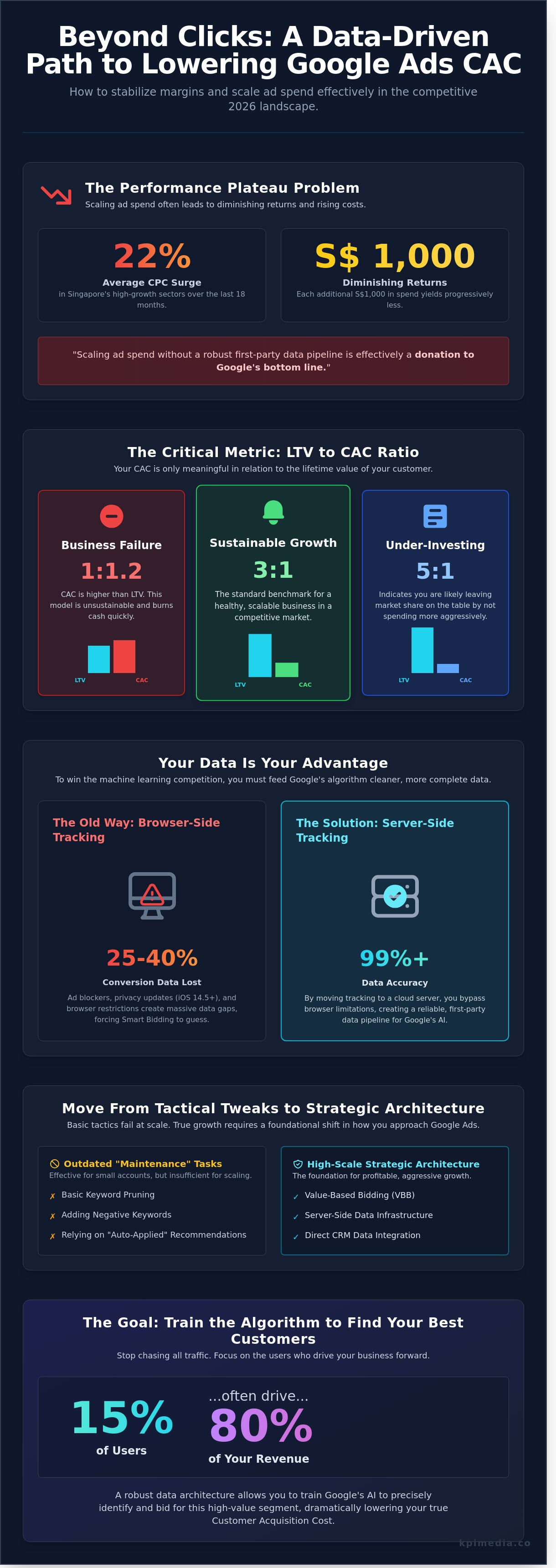
Scaling your ad spend in 2026 without a robust first-party data pipeline is effectively a donation to Google’s bottom line. In high-growth Singapore sectors, we’ve seen average CPCs surge by 22% over the last eighteen months, making it harder than ever to figure out how to lower cac google ads without sacrificing volume. You likely feel the pressure of performance plateaus where every additional S$1,000 in spend yields diminishing returns. It’s a frustrating reality for marketing leaders who need to justify every cent of their budget to a results-oriented board.
We promise to provide the precise, data-driven frameworks and technical optimizations required to stabilize your margins and reduce acquisition costs during aggressive scaling phases. We’ve tested these strategies across the APAC region to ensure they hold up in the most competitive auctions. This guide walks you through the transition from standard tracking to advanced profit-based bidding and server-side tagging. We will show you how to align your digital spend with bottom-line revenue to unlock a truly scalable growth model that works for established brands.
Key Takeaways
• Identify why performance often plateaus during expansion and learn how to stabilize efficiency as you scale your S$ ad spend.
• Master the transition to audience-first bidding and Customer Match lists to discover exactly how to lower cac google ads in a post-keyword landscape.
• Upgrade your data infrastructure with server-side tracking to provide the high-fidelity signals required for Google’s Smart Bidding algorithms to perform.
• Apply conversion rate optimization frameworks that turn your landing pages into a mathematical multiplier for every dollar invested in paid media.
• Align your growth strategy with a performance-first model that replaces traditional agency fluff with a guarantee on measurable ROI and bottom-line success.
Scaling Without the Burn: Why CAC Rises and How to Stabilise It
In the 2026 performance marketing landscape, Customer Acquisition Cost (CAC) has evolved from a simple marketing metric into the primary indicator of a brand's financial health. For growth-stage brands in Singapore, understanding how to lower cac google ads is no longer about finding "cheap" clicks. It's about maintaining efficiency while aggressively expanding market share. When you scale monthly spend from S$15,000 to S$75,000, you inevitably encounter the law of diminishing returns. The low-hanging fruit-high-intent branded searches and bottom-funnel keywords-exhausts quickly. To continue growing, you must enter more competitive auctions, which naturally drives up your cost per acquisition.
To better understand this concept, watch this helpful video:
Distinguishing between surface-level Cost Per Acquisition (CPA) and true business CAC is vital for marketing leaders. A platform CPA might tell you a lead cost S$45, but if that lead takes four months to close and requires S$200 in remarketing touchpoints, your true CAC is significantly higher. Stabilising this requires a relentless focus on three primary levers. First, data integrity ensures you're bidding on actual revenue, not just "conversions." Second, targeting precision moves beyond demographics into intent-based signals. Third, conversion optimisation ensures that every dollar spent on traffic isn't wasted on a friction-filled user journey.
The Relationship Between LTV and CAC
Growth-stage brands must stop viewing CAC in isolation. If your Customer Lifetime Value (LTV) is S$5,000, a S$1,000 CAC is an incredible result. However, if your LTV is only S$800, that same CAC is a business failure. We focus on the LTV:CAC ratio to determine scaling velocity. In the competitive Singapore market, a 3:1 ratio is the standard benchmark for sustainable growth, while a 5:1 ratio indicates you're likely under-investing and leaving market share on the table. An ideal CAC target for a scaling brand is the maximum spend allowed to acquire a high-value customer while maintaining a minimum 3:1 LTV ratio and preserving a 20% net profit margin.
The Problem with Generic Google Ads Advice
Basic tactics like keyword pruning or adding negative keywords work for small accounts, but they fail once you reach a certain spend threshold. At scale, these are just "maintenance" tasks. The real danger lies in over-relying on Google’s "Auto-Applied" recommendations. These suggestions often prioritise Google’s revenue by expanding reach at the expense of your specific ROI. To truly discover how to lower cac google ads at scale, you must move from tactical tweaks to strategic architectural changes. This means shifting toward Value-Based Bidding (VBB) and integrating your CRM data directly into the Google Ads engine. You aren't just looking for more traffic; you're training the algorithm to find the specific 15% of users who drive 80% of your revenue.
Advanced Data Infrastructure: The Foundation of Lower CAC
Google Ads isn't just a set-and-forget auction; it’s a machine learning competition. To win, your data must be cleaner and more comprehensive than what your competitors provide. If you're analyzing how to lower cac google ads, start by auditing what you're feeding the algorithm. Smart Bidding strategies like Target CPA or Target ROAS require high-volume, high-intent signals to function. When data is fragmented or delayed, the algorithm is forced to guess. Guessing leads to wasted spend and inflated acquisition costs that eat into your margins.
Transitioning to a robust data infrastructure is the first step for any brand spending over S$10,000 monthly. Browser-based pixels are no longer reliable. With the rise of ad blockers and privacy updates like iOS 14.5, brands often lose 25% to 40% of their conversion data. This gap makes your CAC look higher than it actually is and prevents Google from finding your best customers. By moving tracking to a cloud server, you regain control over your first-party data. This ensures every S$1 spent is accounted for accurately and every conversion is attributed to the right keyword.
For brands scaling in the Singapore market, real-time visibility is non-negotiable. You can't afford to wait for monthly reports to make budget pivots. Implementing automated dashboards allows your team to monitor real-time CAC fluctuations across different product lines or service categories. This transparency lets you cut underperforming segments before they drain your monthly budget, keeping your overall acquisition costs within a healthy range.
Implementing Server-Side Tracking for Better Attribution
Privacy changes have created a massive attribution blind spot for growth-stage brands. When a user clicks an ad on a mobile device but converts later on a desktop, browser pixels often fail to connect the dots. Server-side tracking bridges this gap by creating a direct link between your server and Google’s. This technical shift typically recovers 20% of "lost" conversions, immediately lowering your reported CAC. It provides the algorithm with the fuel it needs to optimize effectively, ensuring your ads reach users who actually convert rather than just those who click.
Offline Conversion Tracking (OCT) for Enterprise Brands
Established brands often struggle with lead quality because high lead volume doesn't always equal high revenue. Offline Conversion Tracking allows you to upload CRM data back into Google Ads. Instead of optimizing for a generic "Contact Us" form fill, you optimize for a "Qualified Opportunity" or a "Closed-Won" deal. This is a primary lever for those looking at how to lower cac google ads while maintaining high margins. Switching to Profit-Based Bidding rather than Revenue-Based Bidding ensures the algorithm prioritizes users with the highest LTV. This strategic shift moves the focus from cheap leads to profitable customers, which is the only way to scale sustainably in a competitive market.
Ready to stop guessing and start scaling with precision? Partner with KPI Media to audit your data infrastructure and unlock hidden growth opportunities.
Precision Targeting: Moving Beyond Keywords to Audience-First Bidding
The landscape of search engine marketing has moved past the era of simple keyword matching. In a post-keyword world, the intent behind a search is only half the story. The identity and behavior of the user provide the necessary context for profitable scaling. If you want to understand how to lower cac google ads, the answer lies in audience-first bidding strategies that prioritize high-value users over high-volume searches.
Stop treating every searcher as a new prospect. Use Customer Match lists to upload your first-party CRM data. This allows Google to identify patterns among your highest-LTV customers and build high-intent segments. When you combine these lists with Negative Audience lists, you prevent spend leakage. It's common for established brands to waste 12% of their budget showing ads to existing users who are simply trying to log in. Excluding these users ensures every cent targets incremental growth rather than redundant clicks.
Strategic use of Broad Match is now a requirement for scale, provided it's paired with tight Smart Bidding constraints. By setting a strict Target CPA (tCPA) based on your actual unit economics, you allow the algorithm to explore long-tail queries while keeping costs within your guardrails. This approach often uncovers high-converting search terms that a manual, Exact Match strategy would miss. We've seen this combination reduce CAC by 18% for B2B SaaS clients by capturing intent that competitors ignore.
Customer Match
Use your own data to find "lookalike" profiles with high conversion probability.
Negative Lists
Protect your budget by excluding current customers and low-quality leads.
Smart Bidding
Use tCPA or tROAS to automate bid adjustments based on real-time auction signals.
Mastering PMax for Growth-Stage Performance
Performance Max (PMax) requires precise guidance to avoid inefficiency. Use Audience Signals to steer the algorithm toward your most profitable customer segments from day one. Creative diversity is equally vital. Rotating assets every 30 days prevents frequency fatigue and keeps your CTR stable. Always implement brand exclusions. This forces PMax to find new customers rather than inflating performance metrics with low-cost brand traffic, which is essential when learning how to lower cac google ads for true growth.
Regional Scaling in APAC: Nuances that Impact CAC
Scaling across Asia requires a fragmented approach to bidding. Market maturity varies significantly. Singapore often sees CPC floors that are 250% higher than those in neighboring Malaysia or Thailand. In high-competition hubs like Singapore, you must optimize for conversion value rather than just lead volume to maintain a healthy ROI. Regional data localization laws in markets like Indonesia or Vietnam affect how user data is processed, which directly impacts the speed and accuracy of ad delivery across fragmented APAC networks. Focus your budget where the data signals are strongest to ensure your CAC remains sustainable as you cross borders.
The Post-Click Multiplier: Conversion Rate Optimization (CRO)
Most marketing leaders obsess over CPCs and Quality Scores. They miss the biggest lever in the equation. Your landing page is where the financial outcome is decided. If your traffic quality is high but your conversion rate is stagnant, you're essentially subsidizing Google's revenue at the expense of your own margins. The click is just the invitation; the landing page is the closing room.
The math of CRO is unforgiving yet full of opportunity. Imagine a campaign with a S$10.00 CPC. At a 2% conversion rate, your CAC is S$500. By optimizing the post-click experience to hit a 3% conversion rate, that CAC drops to S$333.33. You've slashed your acquisition cost by 33% without touching your Google Ads manager. This mathematical reality is why we treat conversion rate optimization as a core growth lever rather than a secondary design task. It's the most direct path to understanding how to lower cac google ads for established brands scaling in the APAC region.
Landing Page Architecture for High-Intent Traffic
Growth-stage brands often lose money by sending specific ad traffic to generic product pages. High-intent traffic requires frictionless transitions. Use dynamic text replacement to ensure your landing page headline mirrors the exact search query that triggered the ad. If a user in Singapore searches for "enterprise payroll software," they shouldn't land on a page that simply says "Our Services." They need to see their specific pain point addressed in the first three seconds. For the APAC market, mobile-first design is the standard. In Singapore, mobile traffic accounts for over 65% of web sessions. If your lead form has more than four fields or your page load time exceeds 2.5 seconds, you're burning your ad budget through avoidable friction.
A/B Testing Frameworks that Actually Scale
Stop testing button colors. Minor tweaks rarely move the needle for brands spending S$50,000 or more per month. Focus on "Big Rock" changes instead. This includes testing your primary offer, your value proposition, or the entire funnel structure. We use heatmaps and session recordings to identify exactly where users experience friction. If data shows 40% of your visitors drop off before scrolling past the fold, your hero section is failing to communicate value. Growth-stage brands have the traffic volume to achieve statistical significance in 14 to 21 days, making aggressive testing a viable weekly strategy.
Modern scaling also requires AI-driven personalization. Tools that adjust content based on the user's industry or past behavior can significantly lower acquisition costs. By serving a tailored experience, you increase the perceived value of your solution immediately. This level of precision is how you maximize the value of every dollar spent on Google Ads. When you align specific ad intent with a personalized landing experience, the how to lower cac google ads challenge becomes a predictable exercise in data-led refinement.
Stop wasting budget on high-bounce landing pages. Partner with KPI Media to build high-performance funnels that scale.
Scaling with a Performance Guarantee: The KPI Media Approach
Traditional agency models often fail growth-obsessed brands because their incentives are fundamentally misaligned. Most agencies in Singapore charge a percentage of ad spend. This creates a perverse incentive where the agency makes more money when you spend more, regardless of whether your acquisition costs are sustainable. For an established brand trying to figure out how to lower cac google ads performance, this model is a bottleneck to real growth.
We built KPI Media to solve this conflict. Our performance guarantee ensures that we only win when you hit your specific ROI targets. We don't hide behind vanity metrics like impressions or clicks. Instead, we focus on the metrics that actually impact your profit and loss statement. This results-first mindset is why we've become the preferred growth partner for brands scaling across the APAC region. We treat your ad spend like our own capital, prioritizing efficiency and measurable returns over simple volume.
Our approach centers on stabilizing your metrics before we ever talk about scaling. We've seen too many brands try to scale inefficient campaigns, which only leads to a ballooning CAC. By implementing our proprietary "Data-First" audit, we identify the friction points in your funnel that are driving up costs. You can see how this methodology works in practice by reviewing our case studies, where we document real-world examples of lowering CAC by 25% or more while simultaneously increasing lead quality.
The Audit: Identifying Immediate Waste
Our process begins with a 48-hour deep dive into your account structure and data layer. We don't look at surface-level data; we dig into the technical setup to find "Ghost Conversions." These are low-value actions, such as a user clicking a "Contact Us" page without actually submitting a form, that Google's algorithm mistakenly treats as a success. These false positives inflate your performance metrics and trick the AI into bidding on the wrong users. We've found that identifying and removing these ghost conversions can save brands between S$3,000 and S$12,000 in wasted monthly spend almost immediately. Once the waste is gone, we provide a clear roadmap for scaling spend while maintaining a strict CAC ceiling.
Next Steps: Get Your Performance Strategy
Transitioning from a detached vendor to an expert growth partner is the only way to achieve sustainable scale in competitive markets. We operate as an elite extension of your in-house team, providing the technical proficiency and strategic oversight needed to dominate your category. Our pricing is transparent and built to scale with your success, not just your spend. We're so confident in our ability to deliver results that we don't use long-term contract lock-ins. We believe our performance should be the only thing that keeps you coming back every month. If you're ready to stop guessing and start growing with a data-led strategy, let's talk about your numbers. Request your growth audit today and we'll show you exactly where your CAC is leaking and how to fix it.
Stop the Budget Burn and Unlock Scalable Growth
Scaling a growth-stage brand in the Singapore market requires a pivot from basic keyword bidding to sophisticated, audience-first data infrastructure. Success in 2026 hinges on your ability to integrate offline conversion data and prioritize high-LTV segments to maintain healthy margins. Mastering how to lower cac google ads isn't just about bid adjustments; it's about treating your post-click experience as a performance multiplier through rigorous CRO. KPI Media specializes in these advanced frameworks, ensuring every S$1 spent on media contributes directly to your bottom line across the APAC region.
We don't believe in long-term contracts or empty promises. Our growth specialists operate as an elite extension of your team, backed by a performance guarantee. We offer a 50% retainer discount if we fail to meet your agreed-upon KPIs. If you're ready to move beyond marketing fluff and focus on hard metrics, we're ready to execute. Request a Free Performance Audit and Lower Your CAC today. Let's build your next stage of growth together.
Frequently Asked Questions
What is a good CAC for Google Ads in 2026?
A healthy CAC is relative to your Customer Lifetime Value, typically aiming for a 3:1 LTV to CAC ratio. For established B2B SaaS firms in Singapore, a target CAC between S$300 and S$600 ensures sustainable scaling while maintaining profitability in a competitive auction environment. If your LTV is S$5,000, spending S$1,000 to acquire a customer is an efficient investment for long-term growth.
How does server-side tracking help lower my CAC?
Server-side tracking bypasses browser-based restrictions and ad blockers to provide Google’s algorithm with 25% more accurate conversion data. This increased signal density allows Smart Bidding to optimize for high-value users more precisely; reducing wasted spend on low-intent traffic and directly lowering your acquisition costs. By feeding the algorithm cleaner data, you shorten the learning phase and improve overall campaign efficiency across APAC markets.
Can I lower CAC without reducing my daily budget?
Scaling down spend isn't the only way to improve efficiency; you can learn how to lower cac google ads by improving your landing page conversion rate. Increasing your site's conversion rate from 2% to 3.5% effectively reduces your CAC by 40% without touching your media budget or sacrificing lead volume. Focus on technical CRO audits and message matching to ensure your ad copy aligns perfectly with your landing page.
Why is my Google Ads CAC higher than my Meta Ads CAC?
Google Ads typically commands a higher CAC because it targets high-intent searchers actively looking for a solution, whereas Meta focuses on lower-cost demand generation. You're paying a premium for the immediate conversion intent found in search queries; this often results in a higher initial cost but a significantly better lead-to-close rate. We often see Google leads convert at a 15% higher rate than social leads in the enterprise tech space.
How long does it take to see a reduction in CAC after optimization?
Most performance accounts see measurable shifts within 14 to 30 days after implementing structural changes. Google’s bidding models require roughly 50 conversion events per campaign over a 30-day period to exit the learning phase and stabilize performance. For brands with high transaction volumes, this stabilization happens faster, but smaller accounts must allow for a full month of data before judging the success of an optimization.
Does improving Quality Score still matter for lowering CAC?
Quality Score remains a fundamental lever because it determines your actual cost per click in the ad auction. Moving a keyword from a 5/10 to a 9/10 score can slash your CPC by up to 50%; which scales your reach and reduces the total spend required to acquire a single customer. It's a direct mathematical advantage that allows you to outbid competitors without actually increasing your maximum bid limit.












Let us build your acquisition engine
Our Founder will personally propose a custom media plan to crush your KPIs.