

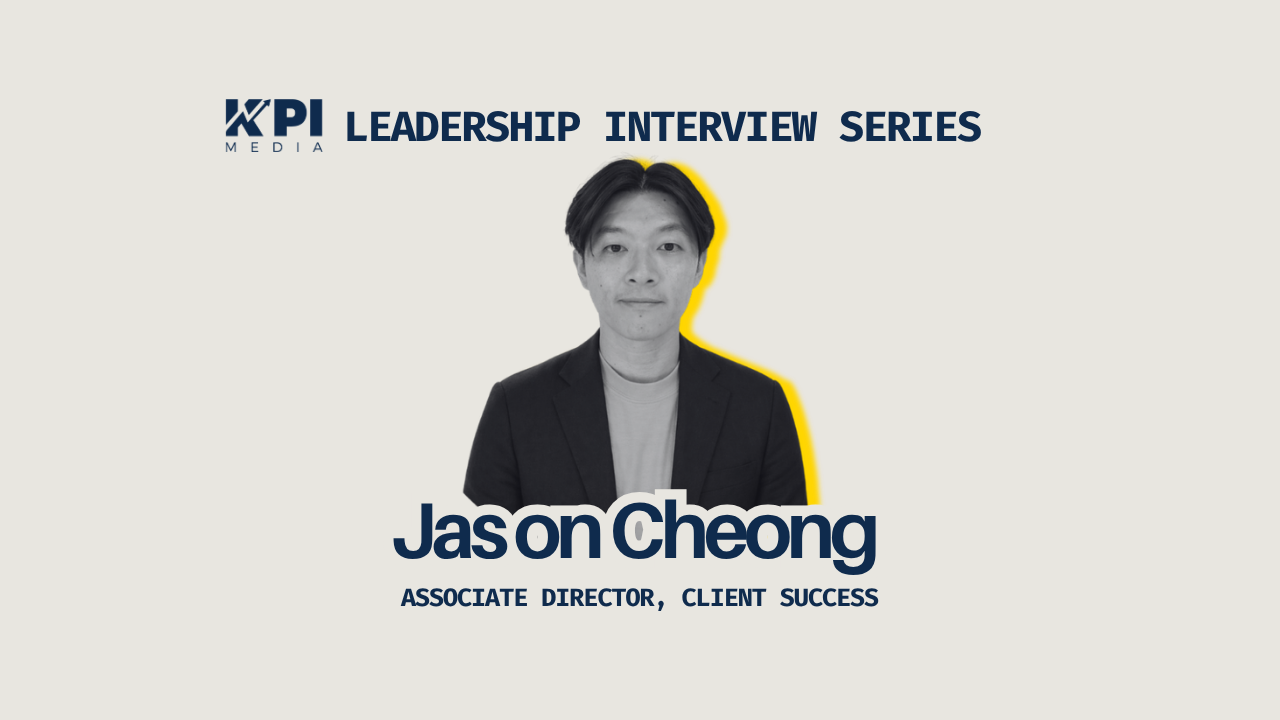
KPI Media Leadership Interview Series: Jason Cheong
THE CONTRARIAN VIEW ON CLIENT SUCCESS
What do clients think they want from their agency that's overhyped?
They assume an agency to be a miracle cure-all.
Clients often come to an agency expecting paid media to solve every growth problem single-handedly. But think about what makes a famous chicken rice stall successful. Is it just the prime street corner location? The chef? The rice, the chicken, or the chili sauce? It is never just one element, but the culmination of different factors that drive overall success.
Paid media is simply a cog in a much larger machine. We can build the tightest, most hyper-targeted ad campaign in the market. However, if your product-market fit is off, your pricing is wrong, or your checkout process is clunky, paid ads won't save the business. It’ll just burn through your budget faster.
And what do they under-value until they've felt it?
The strategic and analytical heavy lifting behind the scenes is understated.
Clients rarely get excited upfront about data architecture or audience segmentation models.
But what they under-value until they’ve truly experienced its compound impact is the unglamorous backend labor: continuous multivariate testing, deep audience research, conversion rate optimization feedback loops, and translating raw platform metrics into actual bottom-line business outcomes. That behind-the-scenes rigor is what turns volatile paid media into a predictable engine for enterprise growth.
You've managed multi-million-dollar budgets for global brands like PayPal. When the spend gets that big and a client gets nervous, what actually rebuilds their confidence?
When managing 7- or 8-figure budgets, reassurance isn't built with polished presentation decks or cheerful status calls. At that level, enterprise clients don't want a passive vendor; they want a partner who understands their P&L as intimately as their own executive team.
Rebuilding confidence comes down to three operational disciplines:
Deep Commercial Context: Proving you intimately understand their unit economics, Ideal Customer Profiles (ICPs), Customer Lifetime Values(CLTV), and Unique Selling Propositions (USPs), not just platform-level click-through rates.
Data-Driven Decisiveness: Delivering performance analysis coupled with proactive strategic adjustments before the client even has to ask.
The Courage to Challenge: Building lasting confidence with a client is having the boldness to challenge their decisions when you know a certain directive would likely lead to failure. When a client realizes you are actively protecting their bottom line with a data-driven hypothesis, even when it means pushing back on them, that is precisely when vendor relationships transform into true commercial partnerships.
What's the one thing that most decides whether a client relationship succeeds?
What actually determines success is strategic alignment and radical operational transparency.
Those are needed when things get bumpy. Auction costs fluctuate, algorithms shift, and campaigns hit rough patches; that’s just the reality of paid media. The relationships that last for years are the ones where the client views us as an extension of their team, working through complex business problems together. True success isn't measured when everything is going right; it’s decided by how openly and constructively both teams communicate when you hit a wall.
And what do people wrongly think matters most?
People think an instant, flawless result in week one, or an agency that says "yes" to every single request, will guarantee a successful client relationship. A common trap in this industry is that agencies think keeping a client happy means showing green numbers 24/7 and never disagreeing with their team.
LEADING ENTERPRISE RELATIONSHIPS
You've led multi-market campaigns across APAC and EMEA. What's the hardest part of keeping a global client aligned that people outside the work never see?
The invisible struggle is acting as the liaison between global corporate HQ and regional teams on the ground. HQ wants brand consistency, standardized governance, and uniform performance models. But a strategy that prints money in London can completely stall in Tokyo or Sydney due to local platform nuances, payment preferences, or cultural buying habits.
The hardest part that people outside don't see is managing that internal tug-of-war. You have to keep executive leads at HQ happy that global standards are being met, while simultaneously shielding local market teams and giving them the freedom to tweak creative and tactics so they can actually succeed in their respective regions.
KPI Media promises KPIs or a refund. From the client-facing seat, what does living up to that guarantee actually feel like day to day?
Day to day? Honestly, it’s a constant loop of dopamine hits, adrenaline rushes, and checking performance dashboards before you’ve even had coffee.
When a campaign breaks through, scales smoothly, and crushes the target baseline, the high is incredible. But when market dynamics shift overnight, or an account hits friction, the pressure kicks in immediately.
Jokes aside, operating under a performance-or-refund guarantee completely changes how you work. It strips away agency fluff and vanity metrics instantly. You can't hide behind "brand awareness" or pretty creative when real money and refunds are on the line. Living up to that promise forces us to treat every dollar of the client's budget with the exact same urgency as if it were coming out of our own bank account.
When should you talk a client out of what they're asking for, even a big one?
The second their request puts short-term vanity over long-term business health.
Enterprise clients frequently experience internal pressure to hit short-term targets, leading them to request tactics like scaling ad spend on an unoptimized sales funnel just to exhaust a quarterly media budget, or deploying aggressive, brand-damaging discount hacks to hit a volume goal.
A healthy partnership is built on a shared responsibility to achieve a common goal. If a client hires us for expertise and we stay quiet while watching them commit to a flawed strategy, we aren't acting as partners but rather order-takers. Coming to them with hard data, a clear explanation of the risk, and a better alternative isn't risking the account. It's the bare minimum required to build a real, high-growth relationship.
WHAT MAKES TRUST LAST
What's the earliest sign a client relationship will run for years versus fizzle after one campaign?
It always comes down to shared accountability for the whole funnel.
You can tell within the first few weeks. If a client treats media buying as an isolated test, where they expect ads to magically solve a weak offer, bad landing page UX, or slow sales follow-up, that account is already on a timer. They'll blame the ads the moment conversions drop.
The relationships that run for years are the ones where the client takes equal ownership of the customer experience. They hand over the keys to their CRM, share real margin data, and collaborate with us on creative iterations and site improvements. When performance hits a bump, long-term partners don't point fingers; they look at the full funnel with us and ask, "How do we fix this together?"
You focus on sustainable long-term growth. What's a short-term win you'd deliberately turn down because it would cost the relationship later?
The short-term win I’ll always turn down is what the industry calls 'ROAS mining', shifting media spend away from cold audience prospecting and dumping it heavily into retargeting and branded search just to make the monthly performance dashboard look incredible.
In paid media, bottom-of-funnel retargeting is low-hanging fruit. It targets people who already know the brand, visited the site, or put an item in their cart. If an agency gets under pressure or wants to look like immediate heroes, it’s dangerously easy to quietly starve top-of-funnel cold acquisition and reallocate that budget to retargeting.
For 30 to 60 days, it looks like a masterclass: your blended ROAS jumps from a 2.5x to a 6x or 8x, and everyone celebrates on the bi-weekly call. But it’s a complete illusion. You aren't growing the business; you are just charging a fee to intercept buyers who were already that close to being converted.
But it’s an illusion. You aren't growing the business; you're just paying ad platforms to intercept customers who were already about to buy. Meanwhile, because you stopped bringing in net-new eyeballs, your retargeting pool dries up, ad frequency skyrockets, and total revenue hits a brick wall three months down the line.
I’d much rather defend a steady 2.0x ROAS on cold prospecting because that’s actually acquiring new customers and expanding market share, than hand a client a fake 8x dashboard that starves their business next quarter.










.webp)
.webp)



Let us build your acquisition engine
Our Founder will personally propose a custom media plan to crush your KPIs.