


Hiring a Marketing Automation Consultant in Singapore: The 2026 Guide
Your marketing team is executing, but growth is flat. Leads are leaking from your funnel, manual tasks are consuming valuable hours, and your tech stack feels more like a cost center than a growth engine. You know automation is the answer, but the fear of a S$15,000+ investment with zero measurable ROI is paralyzing. Hiring the right marketing automation consultant in Singapore is the critical next step, but the market is filled with technicians, not revenue architects.
This 2026 guide cuts through the noise. We are providing the exact framework for B2B leaders to choose a partner who builds a scalable revenue engine, not just configures software. You will learn how to vet consultants on their ability to impact your bottom line-measurably lowering your CAC and increasing LTV. By the end, you will have the clarity and confidence to invest in a partnership that delivers predictable, scalable growth.
Key Takeaways
- Understand that the true role of a marketing automation consultant singapore is to architect your customer journey and unify data, not just configure software.
- Calculate the hidden costs of DIY automation, which often exceed the investment in a professional marketing automation consultant singapore.
- Discover the strategic playbook a top marketing automation consultant singapore uses to implement full-funnel lead nurturing and dynamic lead scoring.
- Utilize a 7-point checklist to vet partners, focusing on case studies with measurable KPIs like reduced CAC and improved LTV, not vanity metrics.
What a Marketing Automation Consultant *Actually* Does (It's Not Just Software Setup)
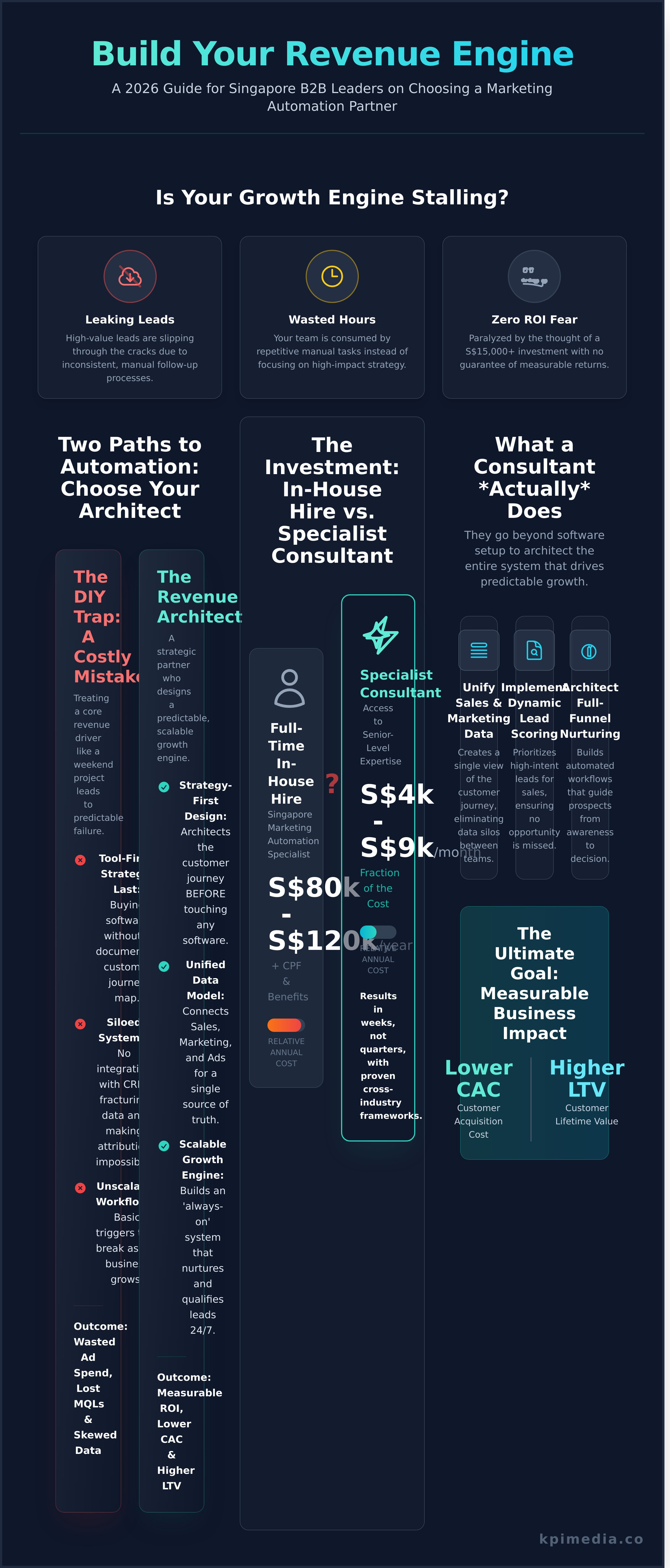
A common misconception is that a marketing automation consultant simply configures HubSpot or Marketo. This is a tactical error. The real role is that of a revenue architect. They don't just set up software; they design and implement the entire system that unifies your sales and marketing data, turning disparate touchpoints into a predictable, scalable growth engine. Their work goes far beyond basic email triggers, delving into the core principles of what marketing automation is: a strategic framework to nurture leads, accelerate sales cycles, and maximize customer lifetime value (LTV).
To see how this strategic approach translates into action, watch this overview:
The objective shifts from running fragmented, one-off campaigns to building an 'always-on' revenue machine. This system works 24/7 to qualify leads, score engagement, and deliver the right message at the right time. When evaluating options, it's crucial to distinguish between a freelancer (for specific tasks), a full-service agency (for broad execution), and a specialist marketing automation consultant in Singapore (for high-level strategy and implementation). The specialist focuses exclusively on architecting the data flows and workflows that drive measurable ROI.
Key Signs You Need a Consultant in Singapore
If your growth has stalled or your processes are breaking, specific pain points will emerge. These are clear signals that manual efforts are no longer sufficient.
- Your lead follow-up is manual and inconsistent. High-value leads are slipping through the cracks because your sales team is overwhelmed and lacks a systematic process.
- You can't accurately track marketing ROI. You're spending on ads and content but have no clear, multi-touch attribution model to prove what's working.
- Your sales and marketing teams operate in data silos. Marketing generates leads in one system while Sales works in another, with no unified view of the customer journey.
Consultant vs. In-House Hire: A Cost-Benefit Analysis
The immediate question for many Singapore businesses is whether to hire internally or engage an expert. The numbers often favour a consultant. A full-time marketing automation specialist in Singapore can command a salary of S$80,000 to S$120,000+ per year, plus CPF. In contrast, a specialist consultant's retainer provides access to senior-level expertise for a fraction of that cost, typically between S$4,000 - S$9,000 per month. Beyond cost, a consultant brings cross-industry experience, deploying proven frameworks to accelerate implementation and deliver tangible results in weeks, not quarters.
The True Cost of Inaction: Why DIY Automation Fails for Singapore Scale-ups
The most expensive decision a Singapore scale-up can make is attempting to "save money" with a DIY marketing automation setup. It’s a strategic miscalculation that treats a core revenue driver like a weekend project, leading directly to wasted ad spend, lost MQLs, and skewed data that poisons your decision-making. The real question isn't "Can we do this ourselves?" but "What is the true cost to our growth when we get it wrong?"
Every month without a properly scaled system is a month of leaked revenue, inflated CAC, and missed LTV opportunities. In a market moving at the pace outlined in the Singapore Digital Economy Report 2025, this inaction cedes critical ground to competitors who are already leveraging automation correctly. The opportunity cost isn't theoretical; it's a quantifiable drag on your P&L.
Common Pitfalls of DIY Marketing Automation
An in-house team, stretched thin and lacking specialized expertise, often makes the same critical errors. The most common is choosing a platform before defining the strategy-a classic cart-before-the-horse mistake that guarantees failure. Other frequent missteps include:
- Tool-First, Strategy-Last: Buying a powerful platform like HubSpot or Marketo without a documented customer journey map. This is like buying a race car with no racetrack.
- Siloed Systems: Failing to integrate automation with your CRM and ad platforms. This fractures your data, making multi-touch attribution impossible and lead follow-up inefficient.
- Unscalable Workflows: Building complex, brittle automations that break with the first product update or team change, grinding your entire funnel to a halt.
The 'Technical Debt' of a Poorly Implemented System
A flawed DIY setup doesn't just fail; it actively creates "technical debt." Every shortcut and poor integration choice accumulates, demanding a massive cleanup effort later. We've seen companies spend months and tens of thousands of S$ just to untangle a broken system. This debt corrupts your data integrity, rendering reports useless. Your team ends up flying blind, making strategic calls based on corrupted analytics. Fixing a broken foundation is exponentially more expensive and disruptive than hiring a professional marketing automation consultant singapore to build it right the first time. Similarly, another form of technical debt—unaddressed security vulnerabilities in your web applications—can be managed with automated platforms like Penetrify to prevent data breaches that would derail your marketing efforts entirely.
The Singapore Consultant's Playbook: 4 Pillars of a High-ROI Automation Strategy
Effective marketing automation isn't about sending more emails. It's about engineering a system for predictable growth. A top-tier marketing automation consultant in Singapore doesn't just manage a tool; they deploy a strategic playbook built on four core pillars designed to maximize your return on investment and accelerate pipeline velocity.
This framework moves beyond basic setup to create a sophisticated growth engine. It connects marketing actions directly to revenue outcomes, giving you a clear, data-backed view of what truly works.
Pillar 1 & 2: Nurturing and Scoring Leads
We move beyond generic email drips to architect intelligent, behavior-triggered sequences. When a prospect views your pricing page, they get a relevant case study. When they attend a webinar, a demo-focused follow-up is automatically triggered. This intelligence is supercharged by integrating data from paid channels like LinkedIn and Google Ads, ensuring your nurture paths reflect a lead's origin and intent.
Dynamic lead scoring runs in parallel, assigning value to these actions. This system prioritizes your pipeline, pushing only the hottest, most engaged MQLs to your sales team. The result: your sales reps stop wasting time on cold prospects and focus exclusively on opportunities ready to convert.
Pillar 3 & 4: Attribution and Personalization
Guesswork doesn't scale. We implement multi-touch attribution by unifying data from your CRM and ad platforms into a single source of truth. This finally allows you to see exactly which channels and campaigns drive revenue-not just vanity metrics. From there, we leverage this data for personalization at scale. For the diverse APAC market, this means delivering content segmented by industry, role, and even language, a critical advantage for businesses operating out of Singapore.
This entire framework is designed to prove marketing's direct contribution to your bottom line. See how we build automated dashboards to track this entire process in real-time, giving you complete visibility into your ROI.
How to Choose Your Marketing Automation Partner: A 7-Point Checklist
Selecting a partner to scale your marketing automation is a high-stakes decision for any Singapore-based business. The right consultant accelerates growth; the wrong one burns cash and time. Use this checklist to cut through the noise and identify a genuine growth partner who is as obsessed with your bottom line as you are.
- Verify Business Model Fluency: Your B2B SaaS funnel is fundamentally different from an e-commerce model. Ensure the consultant has a proven track record in your specific vertical. They must understand your unit economics, sales cycles, and customer journey intimately.
- Demand Revenue-Tied KPIs: Do not accept vanity metrics like "email open rates." A top-tier marketing automation consultant in Singapore will provide case studies demonstrating direct impact on Customer Acquisition Cost (CAC), Lifetime Value (LTV), and lead-to-close velocity.
- Assess Strategic Depth: Are they just a technician or a strategist? The best consultants focus on the "why" before the "how," designing a strategy that aligns automation with your core revenue goals, not just setting up workflows.
- Confirm Platform Agnosticism: A consultant who immediately pushes one tool might be motivated by partner commissions. They should be platform-agnostic, recommending the best stack for your needs, or provide a data-backed justification for their preferred platform.
- Evaluate Data and Analytics Capabilities: Powerful automation is powered by clean data. Confirm they can handle complex data integrations with your CRM and ad platforms. For truly bespoke solutions that require custom software, you can visit AP4 Digital to see examples of personalized systems that can unify a tech stack.
- Demand a Transparent Process: Ask for their documented process for strategy, implementation, and reporting. A clear, phased methodology shows they are organized, professional, and focused on delivering predictable outcomes.
- Clarify Post-Launch Optimization: The work isn't done at launch. A true partner has a clear, iterative process for monitoring performance, running A/B tests, and continuously optimizing workflows to drive incremental gains.
Key Questions to Ask Potential Consultants
Use these questions to pressure-test their expertise and focus on results:
- 'How will you measure the success of this project in terms of revenue and pipeline contribution?'
- 'Show me an example of a complex, multi-touch workflow you've built and explain the strategic logic behind it.'
- 'How do you handle data integration and hygiene with platforms like Google Ads or Salesforce?'
- 'What does your reporting and optimization process look like 30, 60, and 90 days post-launch?'
Red Flags to Watch For
Walk away if a consultant exhibits these behaviours. They signal a focus on their own process, not your business outcomes.
- They promise specific results without a deep discovery call about your business goals and current metrics.
- They immediately push one specific software solution before understanding your tech stack and operational needs.
- Their case studies lack hard numbers on KPIs that matter, like a reduction in CAC, an increase in LTV, or a faster lead-to-close rate. Review our case studies to see our focus on KPIs.
KPI Media's Approach: We Build Revenue Engines for Singapore's Top Startups
Choosing a marketing automation consultant in Singapore isn't about finding someone to just set up software. It's about architecting a system that drives predictable revenue. Our philosophy is simple: strategy first, technology second. We don't just implement tools; we build integrated revenue engines designed for the unique velocity of Singapore's scale-up ecosystem.
We move at the speed of SaaS. Our process is built on rapid implementation and relentless iteration, ensuring your marketing automation platform isn’t a siloed tool but the central nervous system of your entire growth stack. We integrate your platform directly with your paid media channels (Google, LinkedIn, Meta) and analytics platforms, creating a closed-loop system where every dollar of ad spend is tracked, attributed, and optimized for maximum LTV.
Forget vanity metrics and opaque reports. Our reporting is built for the C-suite and your board, providing a transparent, real-time view of how automation directly impacts your most critical KPIs. We connect every workflow to a measurable financial outcome-from accelerating lead velocity and shortening sales cycles to reducing customer acquisition cost (CAC).
Unifying Your Growth Stack
We specialize in connecting disparate systems like HubSpot, Salesforce, and Segment to create a single source of truth for customer data. This ensures a seamless data flow from the first ad click to a closed-won deal. The result is a powerful feedback loop that allows us to optimize ad spend with precision and build sophisticated, full-funnel marketing campaigns. We go beyond basic email sequences to deliver true business process automation, and for companies managing complex sales channels, it's even possible to explore Ship & Debit automation to streamline partner claims and rebates.
Our Performance Guarantee
We are so confident in our ability to drive measurable results that our engagement model is built on a unique performance guarantee. We don’t succeed unless you do. As your dedicated marketing automation consultant, we operate as a specialized extension of your team, obsessed with hitting your revenue targets. We align our success directly with your growth, ensuring we are always pushing for the next milestone.
Ready to build your revenue engine? Get started with KPI Media.
Stop Guessing. Build Your Revenue Engine.
The path to sustainable growth in Singapore's competitive landscape isn't paved with off-the-shelf software. It's built with strategic precision. As we've covered, effective marketing automation transcends simple tool configuration-it requires a full-funnel strategy designed to lower CAC and maximize LTV. Choosing the right marketing automation consultant singapore has to offer is the critical decision that separates stagnant teams from market leaders.
At KPI Media, we specialize in building these systems for B2B SaaS and tech companies. Our proven track record with Singapore's leading scale-ups and unique performance guarantee means our success is tied directly to yours. We don't just offer advice; we become an extension of your team, obsessed with your bottom line and engineered for performance.
Ready to unlock predictable growth? Schedule your free strategy session today and let's build the revenue engine your business deserves.
Frequently Asked Questions
How much does a marketing automation consultant cost in Singapore?
The cost varies based on project scope and engagement model. Project-based fees for implementation typically range from S$5,000 to S$25,000+. Hourly rates for a skilled marketing automation consultant in Singapore fall between S$100 and S$250. For ongoing strategy and optimization, monthly retainers can range from S$3,000 to S$10,000+, depending on the complexity and required deliverables.
What are the most popular marketing automation platforms for startups?
Startups in Singapore often gravitate towards platforms that offer scalability and a strong feature set at an accessible price point. HubSpot is a top choice due to its powerful free CRM and startup-friendly pricing. ActiveCampaign is favored for its advanced automation capabilities and value. Mailchimp is also popular for businesses starting with email and scaling into more complex automation sequences later.
How long does it take to implement a marketing automation system?
A foundational implementation, including basic setup and a few initial workflows, can take 3 to 6 weeks. A comprehensive rollout with deep CRM integration, complex lead scoring models, and extensive team training typically requires 8 to 12 weeks. The timeline is directly influenced by the cleanliness of your data, the number of required integrations, and the strategic complexity of your goals.
Can marketing automation integrate with my existing CRM?
Yes, integration is a core function. Leading platforms like HubSpot, Marketo, and Pardot offer seamless, native integrations with major CRMs such as Salesforce, Zoho, and Microsoft Dynamics. This creates a unified data pipeline between your sales and marketing teams, ensuring a single source of truth for all customer interactions and enabling precise, full-funnel attribution and reporting.
Is marketing automation suitable for small businesses?
Absolutely. Marketing automation is a significant force multiplier for small businesses. It enables lean teams to execute sophisticated lead nurturing and customer retention campaigns that would otherwise require a large headcount. By automating repetitive tasks, you free up critical resources to focus on high-impact activities like strategy and product development, directly accelerating your growth trajectory.
What's the difference between marketing automation and email marketing?
Email marketing is a specific tactic focused on sending one-off campaigns to a list. Marketing automation is a broad strategy and technology stack. It uses behaviour-based triggers and logic to deliver personalized, multi-channel communications across the entire customer lifecycle. It’s the difference between broadcasting a message and building an intelligent, automated conversation that nurtures leads toward conversion.
How do you measure the ROI of marketing automation?
We measure ROI with hard business metrics, not vanity stats. Key performance indicators include a reduction in Customer Acquisition Cost (CAC), an increase in lead-to-customer conversion rates, and a measurable lift in Customer Lifetime Value (LTV). We focus on tracking marketing-attributed revenue and shortening the sales cycle, connecting every automated action directly to bottom-line financial impact.






.webp)





Let us build your acquisition engine
Our Founder will personally propose a custom media plan to crush your KPIs.